


How to Prepare Kids for New Pet Life: A Family Guide
Bringing home a pet is pure magic for kids — and it goes much more smoothly when they know what to expect first. If you’re wondering how to prepare kids for new pet life, the short version is this: set honest expectations, teach gentle handling before day one, and give every child a real job in the pet’s care. This guide walks your family through the whole process, with age-by-age guidance and a calm plan for the first week.
A quick framing note: PawsGuide covers general pet care information, not veterinary or behavioral professional advice. The guidance below reflects what many families and shelters report works well — adapt it to your child and animal, and check with your vet on anything health-related.
Quick Tips
- Start talking about the new pet one to two weeks before arrival — expectations set early prevent most first-week meltdowns.
- Teach the “gentle hands” rule before the pet arrives: practice on stuffed animals with slow strokes, no grabbing, and calm voices.
- Give each child one real, age-appropriate job (refilling water, brushing, poop-bag duty for teens) rather than vague promises to “help.”
- Prepare kids for the boring truth: new pets sleep a lot, need quiet time, and won’t want to play on demand.
- Set up the pet’s space together as a family so kids feel ownership of the rules, not just the fun parts.
- For the actual first meeting, our guide to introducing a new pet to kids covers the step-by-step of day one.
How to Prepare Kids for New Pet Life: Setting Honest Expectations
The biggest source of trouble isn’t the pet — it’s the gap between what kids imagine and what actually happens. Many children picture a new puppy or kitten as a toy that plays whenever they want. The reality: young animals sleep 16 to 20 hours a day, need quiet decompression time in a new home, and can be frightened by loud, fast-moving small humans. Closing that expectation gap before arrival day prevents most tears.
Start the conversation one to two weeks out. Explain in plain terms that the pet will be scared at first — new smells, new sounds, new people — and that the kindest thing the family can do is be calm and quiet for the first few days. Tell kids the pet might hide, might not want to be held, and might have accidents while learning the house rules. Framing this as normal (“she’s just getting used to us, like the first day at a new school”) turns potential disappointment into empathy.
Be honest about the work, too. Pets need feeding, water, exercise, grooming, and vet visits — every day, for years. Say out loud which jobs belong to the kids and which stay with adults: a seven-year-old can refill a water bowl but cannot be solely responsible for a living creature. Naming this upfront avoids the classic pattern where enthusiasm lasts two weeks and parents inherit everything by month two.
Finally, talk about the long timeline. A dog or cat is a 12-to-18-year commitment — longer than your child’s entire school career so far. You don’t need to lecture; just plant the idea that this is a family member, not a phase. Kids who understand permanence tend to take the daily jobs more seriously. In the end, how to prepare kids for new pet life comes down to this: talk early, practice gentleness, and share the work.
Teaching Gentle Handling Before the Pet Arrives
Don’t wait until there’s a squirming puppy in the room to teach gentle hands — practice first, while the stakes are zero. The classic method: a stuffed animal, a calm voice, and slow practice strokes. Show kids how to pet with an open hand in the direction of the fur, how to avoid grabbing ears, tails, and paws, and how to let the animal come to them rather than chasing it down.
Teach the body-language basics in kid-friendly terms. A wagging tail doesn’t always mean happy; a tucked tail, flattened ears, growling, hissing, or a cat’s swishing tail all mean “I need space.” Give kids a simple rule they can remember: if the pet walks away, let them go — following a retreating animal is how most nips and scratches happen. Practice the freeze-and-be-a-tree pose for excited dogs: stand still, arms at sides, look away until the dog calms down.
Role-play the scenarios that cause problems. Puppy jumps up? Turn away — pushing looks like play. Kitten scratches? Stop the game and switch to a wand toy; never use hands as toys. Pet eating or sleeping? Leave them completely alone. Rehearsing these as a game makes the rules feel like family knowledge rather than scolding later.
One more essential lesson: indoor voices around the new pet, especially in week one. Make it a concrete challenge — “let’s see who can be quietest while the kitten explores.” Many families say this single rule does more for a smooth first week than anything else.
Age by Age: What Kids Can Realistically Do
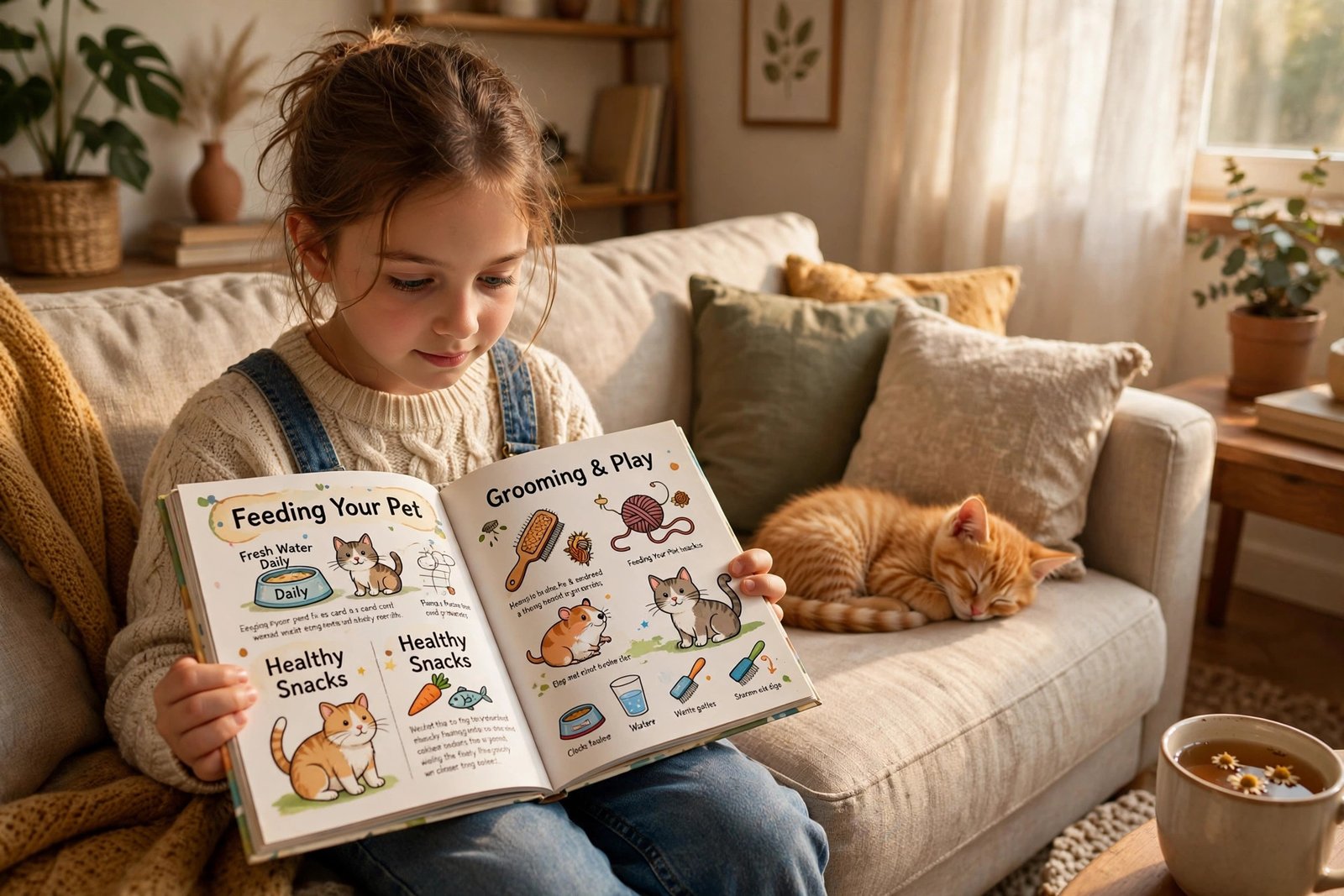
Match the jobs to the child, not the fantasy. Toddlers and preschoolers (under 5) should never be alone with a pet, full stop — but they can “help” with supervised tasks like dropping kibble into the bowl with you, choosing which toy to offer, or sitting beside you during calm petting time. Keep interactions short and always within arm’s reach. This age group learns gentleness by watching you model it, not by instruction alone.
Early elementary kids (roughly 5 to 8) can take on one daily job: refilling the water bowl, helping measure food, or holding the leash with you on walks. They can learn to brush a tolerant cat or dog with supervision, and they’re old enough to understand the “let the pet come to you” rule. Keep the responsibility light and supervised — consistency matters more than scope at this age.
Older kids and tweens (9 to 12) can handle real routines: morning feeding, litter box scooping with gloves, brushing, and structured play. Many enjoy clicker-training basics with a dog — short sessions, lots of treats. This is also the age to teach noticing when something seems off (not eating, limping, hiding) and telling an adult immediately.
Teenagers can take on near-adult responsibility: solo dog walks, full feeding routines, and helping with vet visits. But stay the backup system — the adult remains ultimately responsible for the animal’s welfare, including vet decisions and costs. If you’re getting a cat, our first-time cat owner checklist is worth sharing with older kids.
The First Week: Rules That Keep Everyone Calm
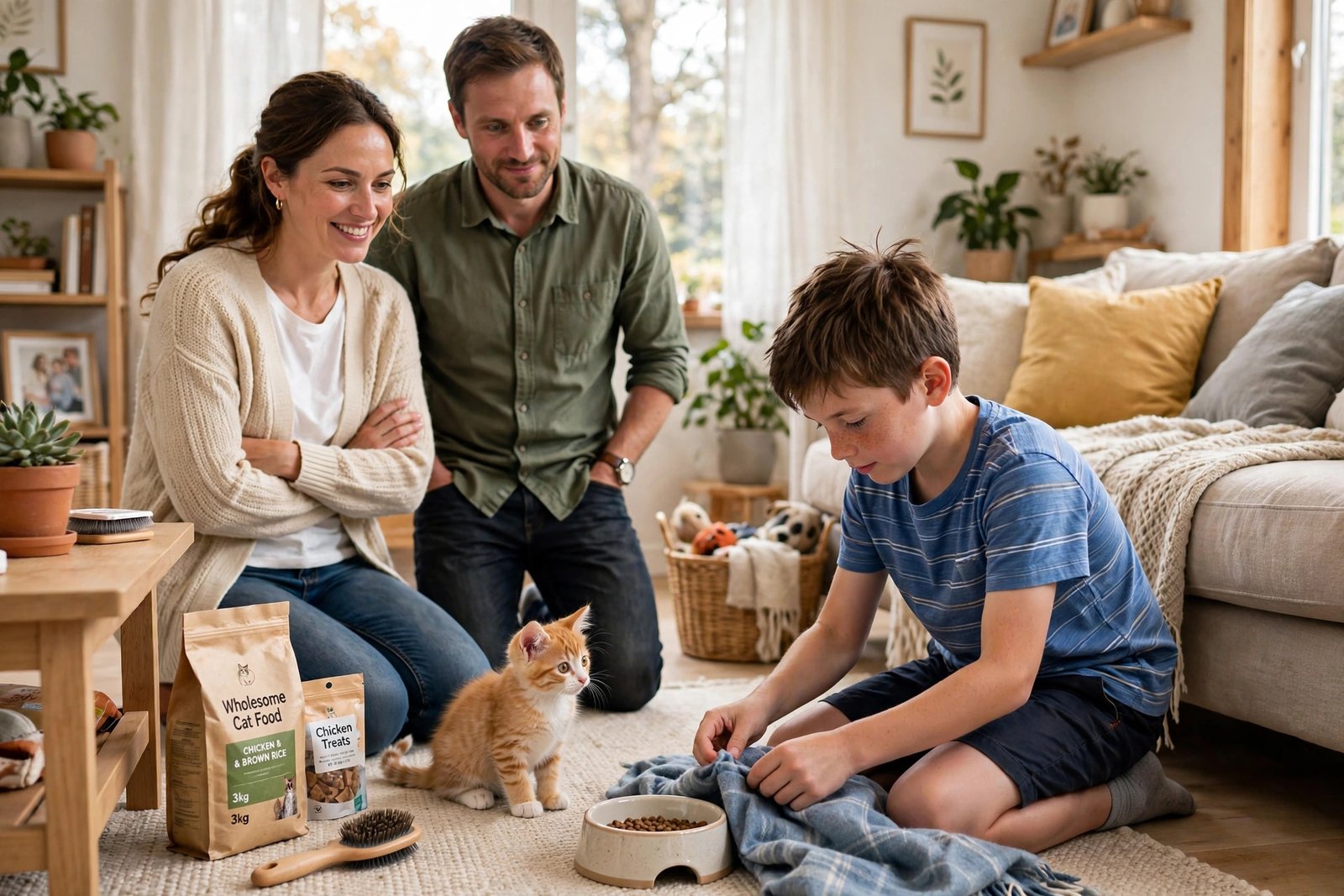
Week one sets the tone for everything after, so plan it like an event. Before the pet arrives, set up their space together as a family — the bed or crate corner, food and water station, litter box or puppy pads, a few toys. Let the kids place the bowls and arrange the blankets; children who build the space feel ownership of the rules that protect it.
On arrival day, keep it small — no welcome party. Let the pet explore one room at their own pace while kids watch quietly from a distance. The rule for day one: the pet decides the distance. If the kitten hides under the bed for six hours, that’s success — celebrate brave moments (“she sniffed your shoe!”) rather than mourning the cuddles.
Establish household rules on day one and post them on the fridge: quiet voices near the pet, no picking up without an adult, no disturbing sleep or meals, hand-washing after handling, doors kept closed. A printed list beats repeated verbal reminders — everyone forgets spoken rules by day three.
Protect the pet’s downtime. Young animals need enormous sleep, and an overtired puppy or kitten gets mouthy and cranky — like an overtired toddler. Enforced naps in a quiet crate or room aren’t cruel; they’re necessary. A sleeping pet is “recharging” and off-limits.
When Things Go Wrong: Nips, Scratches, and Fading Interest
Even well-prepared families hit bumps. The most common: a puppy nips during play, a kitten scratches, or a child’s enthusiasm fades after the novelty wears off. None of these mean the adoption was a mistake — they mean it’s time to adjust.
For nipping and scratching, the response is management plus teaching, never punishment. Puppies nip while teething — redirect to a chew toy, pause the game when teeth touch skin, and ensure enough sleep. Kittens scratch when hands become toys — switch to wand toys and keep sessions short. If a bite breaks skin, clean it promptly and call your vet or pediatrician for guidance.
Fading interest is the harder problem, and it’s extremely common around week three. The fix is structural: build pet-care jobs into the family routine like homework — non-negotiable, scheduled, backed up by an adult. A simple chore chart keeps things visible. And model the attitude you want: kids who see you cheerfully doing unglamorous jobs absorb that care is the whole point.
One last thing to say out loud as a family: the pet is never a punishment tool or a reward to be taken away. Threatening to “get rid of the dog” — even emptily — teaches kids the animal’s place is conditional. The pet stays, the rules stay, and the family figures it out together.
Frequently Asked Questions
What age should kids be before getting a pet?
There’s no magic number — it depends on the child, the pet, and the adults’ willingness to be the real caretakers. Families do well with children of any age as long as adults accept full responsibility and supervise kids under about 8. If you want a child to be the primary caretaker, the tween years are more realistic.
How do I teach my child to be gentle with a new pet?
Practice before the pet arrives using a stuffed animal: slow open-hand strokes, no grabbing ears or tails, calm voices. Teach kids to let the animal approach them, to freeze and look away if a dog gets jumpy, and to leave eating or sleeping pets alone. Supervise every interaction for young children and praise gentle behavior specifically — “that was such a kind, slow pet” reinforces more than “be careful.”
What if my child is scared of the new pet?
That’s normal and okay — don’t force contact. Let the child observe from a comfortable distance, involve them in low-pressure jobs like filling the water bowl, and let the pet’s calm presence do the convincing over days or weeks. Many cautious kids become the pet’s closest companion once the animal feels predictable. If fear is intense or persistent, go slowly and consider asking your vet or a trainer for desensitization tips.
Should kids be present when we pick up the pet?
For the shelter visit and choosing, yes — kids should meet the animal and be part of the decision. For the actual car ride home, it depends: a calm car ride with one parent up front and the pet secured is often smoother without excited children in the back seat. Many families have the kids prepare the home space as their special job while one parent handles transport.
How do we handle it if our child loses interest in the pet?
Plan for it rather than being blindsided — novelty fading around week three is the norm, not a crisis. Keep pet care as a non-negotiable family routine (like homework), with adults as the backup system. A visible chore chart helps. Avoid framing care as optional or as punishment; steady, boring routine is what keeps both the pet and the child’s sense of responsibility intact.