
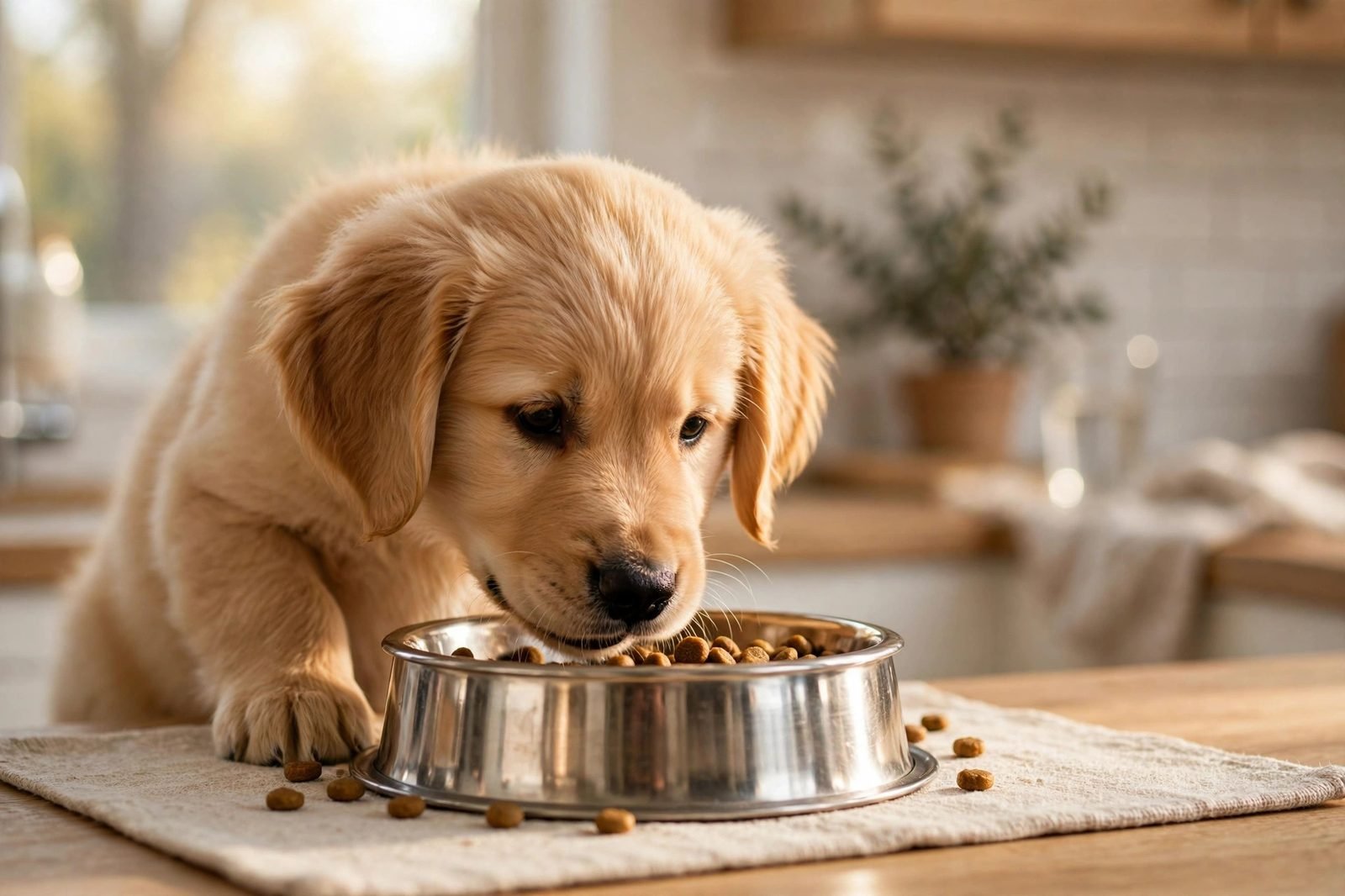

Nobody warned me that feeding a puppy would cause me this much anxiety. I stood in the pet food aisle for forty minutes before I even brought my pup home, staring at bags like they were written in code. Then I got home, poured what looked like a reasonable amount into the bowl, and watched him inhale it in eleven seconds flat — and immediately thought, “That was definitely not enough.”
That was the beginning of a month where I swung wildly between overfeeding and underfeeding, guided entirely by guilt and those big eyes. If you’re standing in your kitchen right now, measuring cup in hand, wondering the same thing — here’s everything I wish someone had told me about how much to actually feed a puppy.
Published: May 1, 2026 | Last updated: May 1, 2026
Quick Tips
- Follow the feeding guide on your puppy food bag as a starting point, not gospel.
- Feed puppies 3–4 small meals a day until about 6 months, then drop to 2.
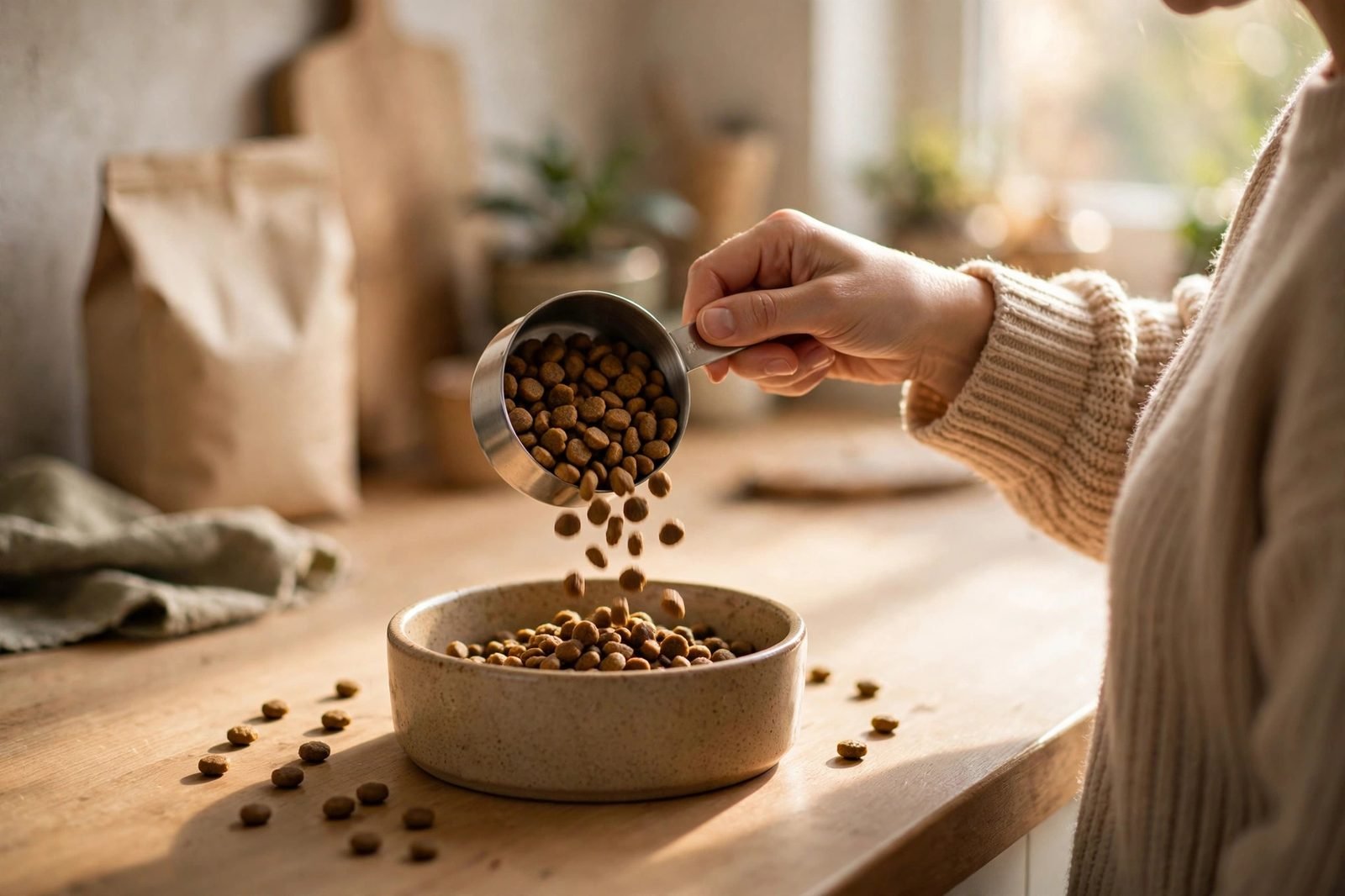
- Measure food with a proper measuring cup — eyeballing leads to overfeeding.
- Use the rib check: you should feel ribs easily but not see them prominently.
- Adjust portions based on your puppy’s body condition, not the bag alone.
- Ask your vet about portions at every puppy checkup — growth changes fast.
- Treats count as calories: keep them under 10% of daily intake.
Why This Feels So Confusing
Here’s the dirty secret of puppy feeding: there’s no single right answer. The bag gives you a range. Your vet gives you a slightly different range. The breeder says one thing, the internet says seventeen things, and your puppy acts like he’s never been fed in his life regardless of what you do. It’s enough to make anyone second-guess themselves.
The reason for all the ranges is that puppies vary enormously. A Great Dane puppy and a Chihuahua puppy are both “puppies,” but one will grow to 150 pounds and the other to 5. Even within a breed, individual puppies have different metabolisms and activity levels. So every guideline is a starting point that you adjust based on the actual animal in front of you.
Start With the Bag (Yes, Really)
I know, the feeding chart on the bag looks like it was designed by someone who hates clarity. But it’s actually the best starting point you have, because it’s calibrated to that specific food’s calorie content — and different foods vary a lot. A cup of one brand might have 350 calories; a cup of another might have 450. Generic advice from the internet can’t account for that. The bag can.
Find your puppy’s expected adult weight (your vet or breeder can estimate this) and their current age on the chart, and start with the amount listed. Then — and this is the part people skip — watch your puppy for two weeks and adjust. The chart gets you in the neighborhood. Your eyes get you to the right house.
How to read a feeding chart without losing your mind
Most charts list daily totals, not per-meal amounts. So if the chart says 2 cups a day and you’re feeding three meals, that’s roughly ⅔ cup per meal. Start in the middle of any range given, then adjust based on your puppy. And check whether the chart is based on current weight or expected adult weight; mixing those up is a classic beginner error that I absolutely made.
The Meal Schedule That Actually Works
Puppies have tiny stomachs and enormous energy needs, which is why they eat more often than adult dogs. Here’s the schedule most vets recommend:
Under 3 months: 4 meals a day. Yes, four. Their stomachs are tiny and their growth is explosive. Set phone alarms if you need to — I did, and I’m not ashamed.
3 to 6 months: 3 meals a day. This is the sweet spot for most of puppyhood — morning, midday, evening.
6 to 12 months: 2 meals a day. Most puppies transition to the adult schedule around six months, though large and giant breeds may stay on three meals a bit longer since they keep growing.
12+ months: Most dogs move to adult food and stay on 2 meals a day. (Large breeds often stay on puppy food until 12–18 months — your vet will tell you when to switch.)
The consistency matters as much as the amount. Puppies thrive on routine: same times, same place, same measured portions. It also makes housetraining dramatically easier, because what goes in on a schedule comes out on a schedule.
The Rib Check: Your Most Important Tool
Forget the scale for a moment. The best way to judge whether your puppy is eating the right amount is with your hands. It’s called body condition scoring, and vets use a version of it at every checkup. Here’s the home version:
Run your hands along your puppy’s ribs. You should be able to feel them easily with light pressure, like running your fingers over the back of your hand. You should not be able to see them prominently from across the room. Look at your puppy from above: there should be a visible waist — a slight tuck in behind the ribs. From the side, the belly should tuck up, not hang straight or sag.
Puppies are supposed to be a little roly-poly — they’re babies, not fitness models. But there’s a difference between “puppy chub” and “too much.” If you can’t feel the ribs at all, portions are too big. If the ribs, spine, and hip bones are all visible and prominent, portions are too small. Check every couple of weeks, because puppies grow fast and the right amount changes constantly.
Why I stopped trusting the “empty bowl” test
Here’s something nobody told me: most puppies will eat whatever you put in front of them, as fast as possible, and then act hungry. This is not because they’re starving. Puppies are descended from opportunistic scavengers — eating fast and acting hungry is hardwired. An empty bowl in eleven seconds tells you nothing about whether the portion was right. The rib check tells you everything. I had to learn to trust my hands over those eyes, and those eyes are extremely persuasive.
Balancing Food With Exercise
Food and activity are two sides of the same coin, and getting one right while ignoring the other doesn’t work. A puppy that’s eating the right amount but getting no exercise will still get soft and flabby. A super active puppy on too-small portions won’t have the fuel to grow properly.
The tricky part is that puppy exercise has its own rules — you can’t just run a young puppy into the ground to balance extra food. Growing joints need care. I’ve written about how much exercise a puppy needs, and the short version is: multiple short sessions beat one long one, and the right amount depends heavily on age and breed. Once you’ve got both the feeding and the exercise dialed in for your pup’s stage, everything else gets easier.
As your puppy grows into their walking routine, the same principle applies to meals and walks together: regularity beats intensity. I found that thinking about how often to walk my dog alongside the feeding schedule helped me build one coherent daily routine instead of two separate chores. Morning walk, breakfast, midday play, lunch — it all slots together.
The Mistakes I Made (So You Don’t Have To)
Free-feeding. For the first two weeks, I just kept the bowl full all day because it seemed easier. The result: I had no idea how much he was eating, housetraining was a nightmare (no schedule in, no schedule out), and he grazed himself into a little barrel. Scheduled meals fixed all three problems within days. Free-feeding works for some adult dogs; for puppies, scheduled meals are almost always better.
Too many treats. Training a puppy means a lot of treats — sit, stay, come, don’t eat the remote — and those calories add up fast. A good rule: treats should be no more than 10% of daily calories. I started using part of his measured kibble as training treats, which felt like discovering a cheat code. Same food, same calories, but now it was “training.” He never noticed the difference.
Guilt-feeding. The eyes. Those eyes. Every puppy owner knows the look — the “you’ve clearly forgotten to feed me for weeks” look, delivered twenty minutes after a full meal. The rib check is your defense against the eyes. Trust the ribs.
When to Talk to Your Vet
I’m not a vet, and this guide doesn’t replace one. But here are the situations where you should definitely check in with yours rather than adjusting portions on your own:
If your puppy is losing weight or not gaining steadily, eating ravenously but staying skinny, or suddenly goes off food for more than a day — check in with your vet rather than adjusting portions on your own. And “how much should I feed?” is a great question to ask at every single puppy vet visit. The answer changes as they grow. I asked at every visit for the first year. Nobody judged me.
Frequently Asked Questions
How do I know if I’m overfeeding my puppy?
The rib check is the fastest answer: if you can’t feel the ribs with light pressure and there’s no visible waist from above, portions are probably too big. Other signs include very rapid weight gain, soft stools, and a puppy that seems low-energy despite being young. Reduce portions by about 10%, wait two weeks, and check again. Small adjustments, not dramatic cuts.
Can puppies eat adult dog food?
They can survive on it short-term, but they shouldn’t live on it. Puppy food is formulated with higher protein, fat, and calorie density plus specific mineral balances for growing bones and brains. Feeding adult food long-term to a growing puppy risks nutritional gaps during the most critical growth period. Stick with puppy food until your vet gives the all-clear to switch, usually around 12 months (longer for large breeds).
Should I feed my puppy wet food, dry food, or both?
Any of these can work — what matters is that the food is complete and balanced for puppies (look for an AAFCO statement on the label, or the equivalent FEDIAF standard in Europe). Dry food is convenient and good for teeth; wet food is smellier, more appealing to picky eaters, and adds hydration. Many owners do a mix. I do mostly kibble with a spoonful of wet food on top for dinner, which my pup considers a five-star dining experience.
My puppy eats too fast. Is that a problem?
Eating very fast can cause vomiting, bloating discomfort, and in rare cases bloat (more common in large, deep-chested breeds). Slow-feeder bowls — the ones with maze-like ridges — are a cheap, effective fix. You can also scatter kibble on a snuffle mat or even a clean towel so they have to forage. It turns a 30-second inhale into a 30-minute activity, which is better for digestion and mental stimulation.
When should I switch from puppy food to adult food?
Usually around 12 months for small and medium breeds, and 12–18 months for large and giant breeds (their growth period is longer). The switch should be gradual over 7–10 days. Your vet will confirm the timing at a checkup — it’s based on your individual dog’s growth, not just the calendar. Switching too early is a more common mistake than switching too late.
[…] in and you know when to head for the door. If you’re still figuring out portions, my guide on how much to feed a puppy will help you nail amounts and […]
[…] the feeding schedule. If you are still figuring out the right daily amount for a growing dog, my puppy feeding amounts guide will help you get portions right before the switch complicates […]