


Why Does My Cat Sit on My Laptop?
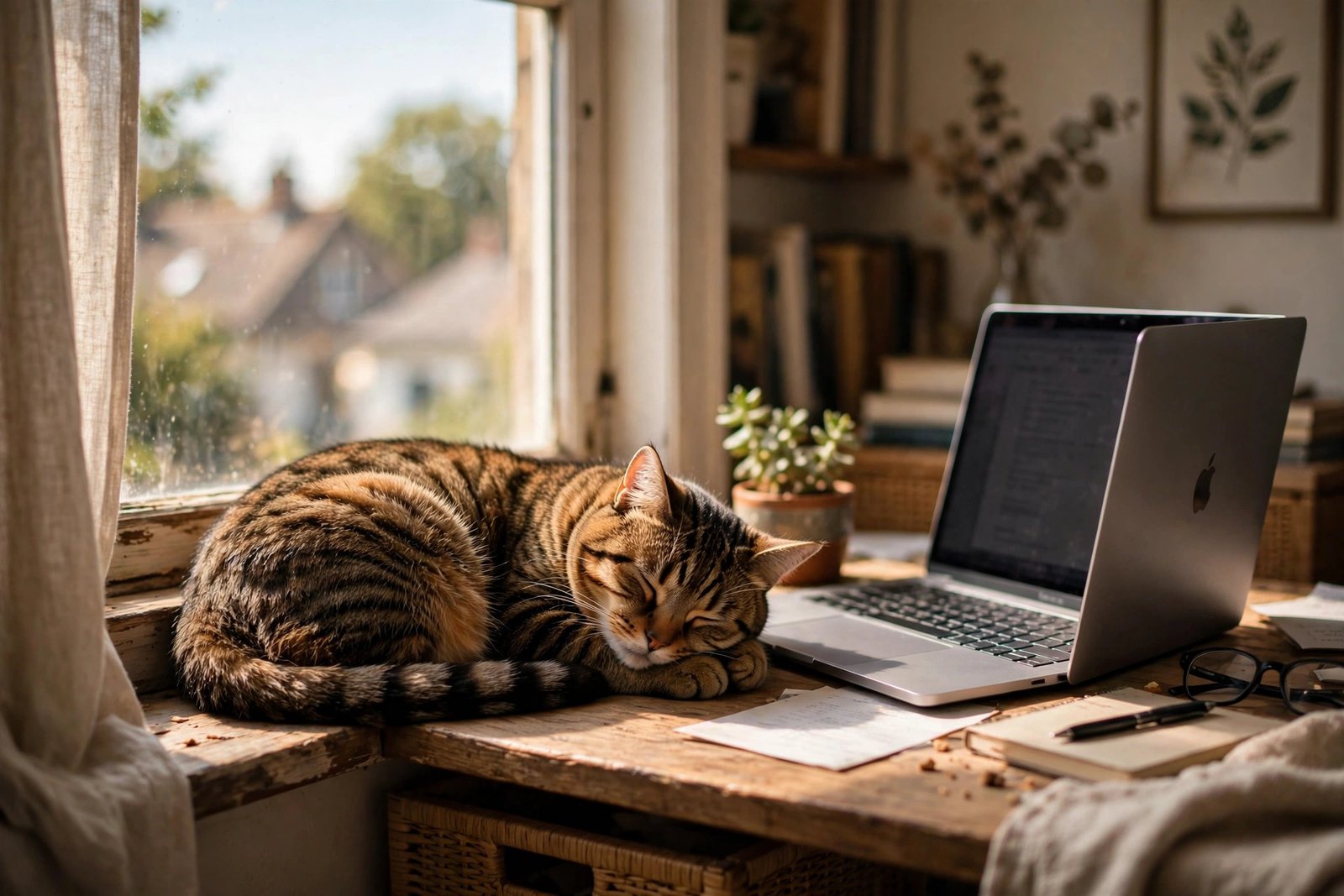
You open your laptop, settle in to get some work done, and within minutes there is a cat parked squarely on the keyboard. If you have ever asked yourself why does my cat sit on my laptop at the worst possible moment, take comfort in the fact that nearly every cat owner working from home knows this exact scene. It is not sabotage — though it can certainly feel like it when an email sends itself.
The truth is that your laptop is, from a cat’s perspective, just about the perfect object in the house: warm, smelling strongly of you, and positioned exactly where your attention is focused. This article breaks down the real reasons behind the behavior, and — more usefully — shows you how to share your desk peacefully instead of fighting a daily turf war you will never win.
Quick Tips
- Your laptop is warm, smells like you, and holds your attention — that combination is irresistible to most cats.
- Never punish the behavior; calmly move your cat to an appealing alternative spot instead.
- Place a cozy cat bed or heated pad on your desk next to your laptop as a legal alternative.
- A decoy keyboard or closed laptop can satisfy cats that love the shape and warmth.
- Close the laptop or lock the screen when you step away to prevent accidental keystrokes.
- Give a short play session before focused work — a tired cat is a less keyboard-obsessed cat.
The Short Answer: Why Does My Cat Sit on My Laptop?
There is no single reason — it is a stack of small motivations that add up to one very determined cat. Warmth is usually at the top of the list. A running laptop puts out steady, gentle heat, and cats are famously drawn to warm spots; it is the same instinct that parks them on sunny windowsills, fresh laundry, and heating vents. Your keyboard is essentially a heated cat mat that you keep thoughtfully warming up for them.
Then there is the attention factor. Cats are excellent observers of human behavior, and yours has noticed that when the glowing rectangle opens, your eyes and hands belong to it. Sitting on the laptop is a remarkably effective way to redirect that attention — it is hard to ignore a cat making direct eye contact from six inches away. Many owners report that the behavior intensifies during video calls, which makes sense: that is when you are most visibly engaged and least available. If you have also noticed why your cat stares at you during these moments, it is part of the same attention-seeking package.
Finally, there is scent. Your laptop smells like you — your hands are on it for hours — and cats navigate their world through smell. Sitting on it, rubbing their face on the corner, and kneading the keyboard are all ways of mixing their scent with yours, which is how cats mark the things they consider part of their territory and their social group. That face-rubbing is closely related to headbutting for scent-marking, another way cats claim their favorite people and objects.
It’s Warm — and Cats Are Heat-Seeking Creatures
To understand the warmth angle, it helps to know that cats generally prefer temperatures warmer than what most humans find comfortable. That is why they gravitate toward sunbeams, radiators, and the warm spot you just vacated on the couch. A laptop, especially one running demanding programs, can feel like a personal heating pad — and unlike the sunny windowsill, it is available on demand and conveniently located wherever you are.
This also explains the timing. Many cats ignore a closed, cool laptop completely and only show interest once it has been running for a while and warmed up. If your cat seems particularly obsessed during winter or in air-conditioned rooms, warmth is almost certainly the main draw. The practical upshot: any good alternative you offer needs to compete on temperature, which is why a plain cold cat bed on the desk often loses to the laptop.
You’re Giving the Laptop Your Attention, Not Them
Cats may have a reputation for independence, but most of them are quietly attentive to their people’s routines. Your cat has learned the pattern: laptop opens, human becomes unavailable. From their point of view, sitting on the keyboard is not mischief — it is a logical intervention. And it works, because almost everyone stops typing to laugh, take a photo, or gently relocate the cat, which is precisely the interaction the cat was after.
This is worth keeping in mind because it means the behavior is at least partly reinforced by us. Every time laptop-sitting reliably produces cuddles, treats, or even amused scolding, the cat files that away as a successful strategy. That does not mean you should ignore your cat — far from it — but it does mean the most effective fix is proactive: give your cat dedicated attention before you need to focus, rather than only interacting when they have already claimed the keyboard.
How to Share Your Desk Without the Keyboard Takeover
Fighting the behavior head-on rarely works; cats do not respond to scolding the way dogs might, and moving them off the laptop ten times a day just becomes your new cardio. The approach that actually works is redirection: make an alternative spot near you more appealing than the keyboard, and make the keyboard itself slightly less rewarding.
Start with the alternative. Place a small cat bed, a folded blanket, or a heated pad on your desk right next to your laptop — close enough that your cat can still be near you, because proximity to you is half the point. Many owners have great success with a “decoy keyboard”: an old disconnected keyboard or even a closed laptop that the cat is allowed to sit on freely. Reward your cat with treats and calm praise whenever they choose the approved spot, especially in the early days.
At the same time, make the real laptop less interesting. When you step away, close it or at least lock the screen — this prevents both accidental emails and the warm-keyboard reward. Some people place a light box or a tray over the keyboard when not typing. And build a short play session into your routine before periods of focused work; ten minutes with a wand toy takes the edge off a cat’s energy and attention-seeking, making the cozy bed far more attractive than your keyboard.

When Laptop-Sitting Becomes a Genuine Problem
Most of the time this behavior is harmless and even endearing, but there are situations worth managing more firmly. If you handle sensitive work, a cat stepping on the keyboard can send half-written messages, delete paragraphs, or join video calls uninvited — amusing once, less so the fifth time. Locking your screen whenever you stand up is the simplest insurance policy.
Heat is the other consideration. Laptops vent hot air, and while a cat sitting on a warm keyboard is generally fine, you should make sure vents are not blocked for long periods — overheating is bad for the machine, and a very hot surface is not comfortable for the cat either. If your laptop runs particularly hot, that is another argument for steering your cat toward their own warm bed. And if your cat ever seems obsessively drawn to electronics beyond the laptop — chewing cords, for instance — that is a separate safety issue worth addressing with cord covers and redirection.
Frequently Asked Questions
Why does my cat only sit on my laptop when I’m using it?
Because a laptop in use is warm, and because using it means your attention is occupied. A closed, cool laptop offers neither heat nor an audience, so most cats ignore it. The behavior is specifically triggered by the combination of warmth and your focused attention — which is why it feels so perfectly timed to interrupt you.
How do I keep my cat off my laptop while I work?
Offer a better alternative rather than just saying no. Put a warm, comfortable bed on your desk next to the laptop, reward your cat for using it, and give a play session before focused work blocks. Close or lock the laptop when you step away. Consistency matters more than any single trick — most cats learn the new routine within a couple of weeks.
Is it bad for my cat to sit on a hot laptop?
A comfortably warm keyboard is generally fine, but a laptop that runs very hot is not an ideal resting spot for anyone. Make sure air vents are not blocked, since restricted airflow can overheat the machine. If your laptop gets notably hot during heavy use, encourage your cat toward their own heated bed instead — it is safer for both the cat and the computer.
Why does my cat also sit on my books, papers, and phone?
Same motivations, different objects. Cats are drawn to whatever you are focused on, and they like the feeling of being on top of things that carry your scent. Papers and books also make satisfyingly crinkly, interesting textures. It is all part of the same attention-and-scent-seeking behavior, and the same redirection strategies apply.
Should I buy my cat a heated bed for my desk?
It can be a genuinely effective solution, since warmth is such a big part of the attraction. A low-wattage heated pad designed for pets, placed in a bed on your desk, competes directly with the laptop on the cat’s own terms. Just choose a product made specifically for pets with safety certifications, and supervise its first uses the way you would with any new heated item.