
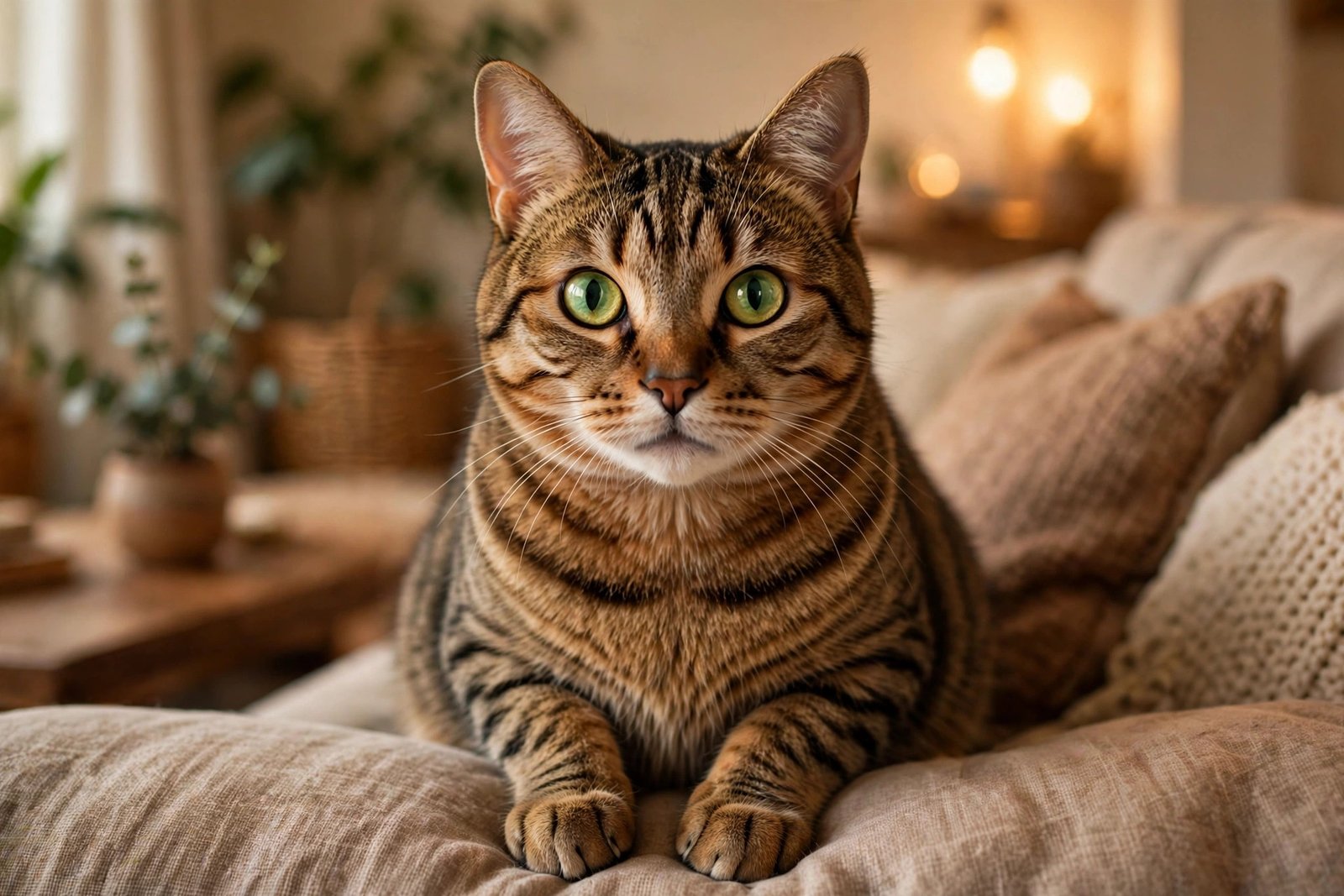

Why Does My Cat Stare at Me?
You look up from your laptop and there it is: two unblinking eyes, fixed on you with an intensity that would make a detective nervous. Your cat is staring at you again. Not doing anything. Just… staring. And the longer it goes on, the more you start to wonder what exactly is happening in that small striped head.
The feline stare is one of those behaviors that feels mysterious but is actually pretty readable once you know the vocabulary. Cats stare for a handful of consistent reasons — some affectionate, some practical, some just very cat. Here is what your cat is probably telling you.
Quick Tips
- Most staring is communication — your cat wants something or is watching you.
- Slow blinking back is the feline equivalent of a friendly smile.
- Staring before mealtimes usually means the food schedule needs adjusting.
- Avoid staring contests — direct hard stares can feel threatening to cats.
- Sudden intense staring with other behavior changes is worth noting.
- Cats watch routines closely; you are the most interesting show in the house.
Reason 1: You Are the Most Interesting Thing in the Room
Let us start with the simplest explanation, because it is the most common: cats watch what interests them, and you are — by an enormous margin — the most interesting thing in your cat’s environment. You move around, make sounds, open the mysterious food containers, operate the warm laptop. From the couch, you are basically television.
Cats are ambush predators by design, and watching is what they do. In the wild, a cat might spend hours motionless, tracking movement. Your indoor cat has repurposed that surveillance hardware for its primary occupation: monitoring the human. The stare that feels intense to you is often just a cat doing what cats do — observing, processing, and filing everything away.
Reason 2: Communication — “I Want Something”
Cats quickly learn that staring works. You are sitting there, the cat fixes you with its gaze, and eventually you get up to check — food bowl? water? door? — and the cat has successfully transmitted a message without making a sound. It is remarkably efficient, and cats are nothing if not efficient.
The pre-meal stare is the classic version. If your cat starts staring you down thirty minutes before dinner, that is not a coincidence — cats learn schedules with impressive precision, and the stare is a reminder service. The fix, if the food-staring bothers you, is usually a schedule adjustment rather than a behavior correction: many owners find that splitting meals or using a timed feeder breaks the “stare at the human until food appears” cycle. For the broader picture of feline communication, my guide to why cats purr decodes another piece of the same language.
Reason 3: Bonding and Affection
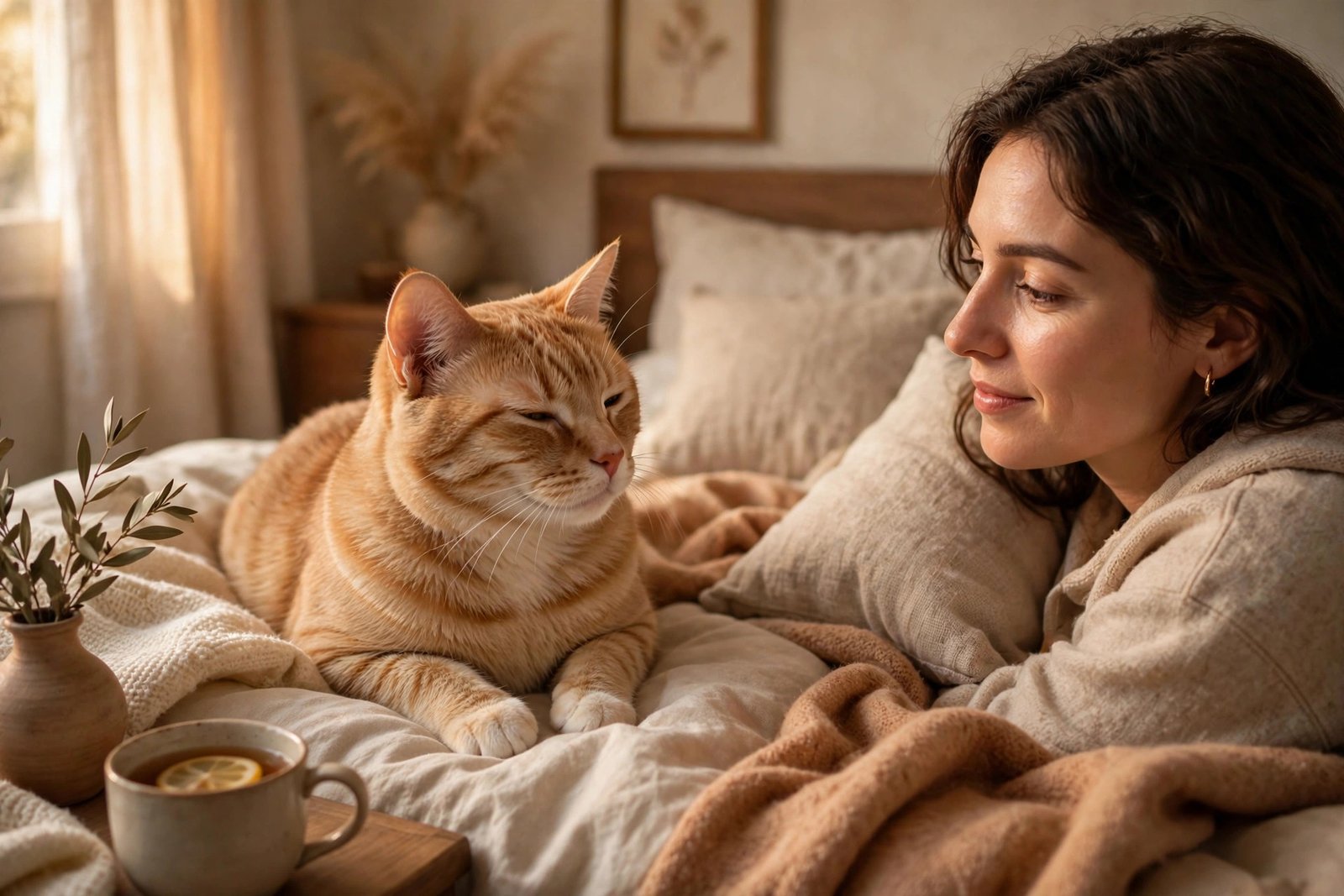
Not all staring is transactional. Cats that feel safe and bonded with their owners often watch them with soft eyes and a relaxed body — sometimes accompanied by the famous slow blink. Researchers have found that slow blinking is a genuine positive social signal in cats; when a cat slow-blinks at you, it is expressing trust and contentment.
You can slow-blink back. It sounds slightly ridiculous, but it works: meet your cat’s gaze softly, close your eyes slowly, hold for a beat, open them. Many cats will return the blink, and some will visibly relax — ears softening, body settling. It is one of the few reliably two-way conversations you can have with a cat, and it costs nothing.
The distinction between affectionate staring and demanding staring is in the body: soft eyes, relaxed whiskers, maybe a gentle tail curl means contentment. Wide eyes, forward ears, and a tense posture aimed at the kitchen means business.
Reason 4: Curiosity and Learning Your Patterns
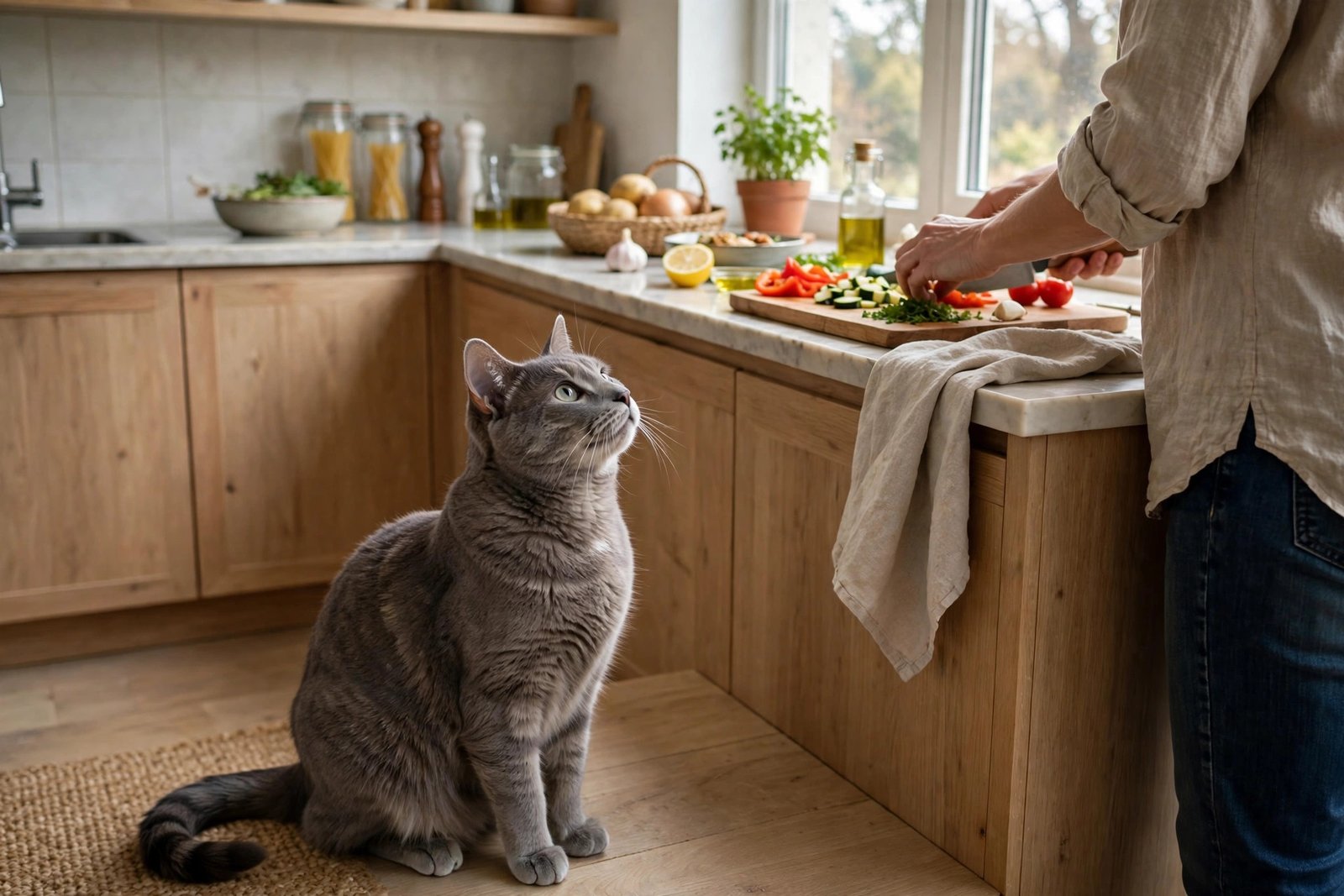
Cats are pattern-recognition machines. Your cat has learned that you putting on shoes means you are leaving, that the rustle of a particular bag means treats, that picking up the red blanket means couch time. The staring is often data collection — the cat is watching the sequence of events to predict what happens next.
This is why cats stare hardest during transitions: when you stand up, when you walk toward the kitchen, when you reach for a bag. They are reading the opening moves of a familiar routine. New owners sometimes find this unnerving, but it is actually a compliment — it means your cat has built a detailed mental model of your life and finds it worth tracking.
You can even use this to your advantage. Because cats watch sequences so closely, they learn new routines quickly when you are consistent. Want the cat to come when called, or to go to its room at bedtime? Pair the sequence with a treat a dozen times and the watching turns into anticipating — the stare becomes the first step of a trained behavior.
Reason 5: Something Is Off
Most staring is benign, but context matters. A cat that suddenly starts staring intently — especially combined with other changes like hiding, appetite shifts, vocalizing differently, or sitting in odd postures — may be trying to tell you something is wrong. Cats are masters at hiding illness, so behavior changes are often the first visible sign.
The staring itself is rarely the symptom; it is the change in pattern that matters. A cat that has always watched you cook and suddenly stares at the wall, or a cat that begins fixing you with an intense gaze while yowling, is communicating distress in the limited vocabulary available. Trust your sense of what is normal for your cat — you know its baseline better than anyone, and a vet would rather hear “something seems off” early than late.
Reason 6: It Is Just a Cat Thing
Some staring defies analysis. The 3 a.m. stare from the foot of the bed. The intense focus on a blank wall. The gaze that follows you from room to room for no discernible reason. Cats do a certain amount of things simply because they are cats — their sensory world includes sounds and movements we cannot perceive, and their internal logic is not always translatable.
There is a particular joy in accepting this. Not every behavior needs a training plan. Sometimes the correct response to the stare is to slow-blink back, go about your day, and appreciate that you share your home with a small, strange, wonderful predator who finds you fascinating. If the staring comes with kneading too, my guide to why cats knead explains that cozy behavior.
What Not to Do About Staring
Avoid turning it into a confrontation. Staring back hard, looming over the cat, or making sudden movements to “break” the stare can feel threatening — in cat body language, a fixed hard stare is a challenge signal. If the staring bothers you, the graceful move is to break gaze casually (look away, go do something) rather than to dominate the interaction.
Also avoid accidentally training demand-staring. If every intense stare earns a treat, you will get more intense stares — cats are excellent at identifying which behaviors pay. Reward the cat on your schedule, not in response to the stare, and the staring stays at its natural background level instead of escalating into a full-time lobbying campaign.
Frequently Asked Questions
Why does my cat stare at me while I sleep?
Usually a mix of routine-monitoring and early-morning food anticipation — cats are crepuscular and often wake before their owners. Some cats also find the sleeping human’s rhythmic breathing interesting to watch. If the pre-dawn staring comes with face-patting, a feeder on a timer often solves it by decoupling breakfast from your wakefulness.
Do cats stare to show dominance?
Not really — dominance is a poor framework for cat behavior. Cats stare to gather information, communicate wants, or bond. A hard, fixed stare with a tense body can be a warning signal in a conflict, but the everyday living-room stare is communication or curiosity, not a power play.
Why does my cat stare at the wall?
Often it is hearing or seeing something you cannot — a mouse in the wall, an insect, a light reflection. Cats also stare blankly when they are simply resting with eyes open. If wall-staring is new, prolonged, and paired with disorientation or behavior changes (especially in a senior cat), mention it to your vet.
Should I stare back at my cat?
Softly, yes — the slow blink is a wonderful exchange. But avoid hard, unblinking staring contests; to a cat, that reads as confrontational. Think of it as the difference between a warm smile and an aggressive glare. Blink slowly, look away casually, and you are speaking fluent cat.
Why does my cat follow me with its eyes everywhere I go?
You are the center of its world and the source of all good things — food, play, warmth, the opening of doors. Following you with its eyes is low-effort monitoring. Cats that are strongly bonded, slightly bored, or hoping for a meal are the most dedicated watchers. It is normal and, frankly, a little flattering.
[…] your cat chasing an imaginary mouse with total commitment. If you’ve ever watched your cat stare intensely at nothing, you’ve seen the early stage of the same […]
[…] sense: that is when you are most visibly engaged and least available. If you have also noticed why your cat stares at you during these moments, it is part of the same attention-seeking […]