
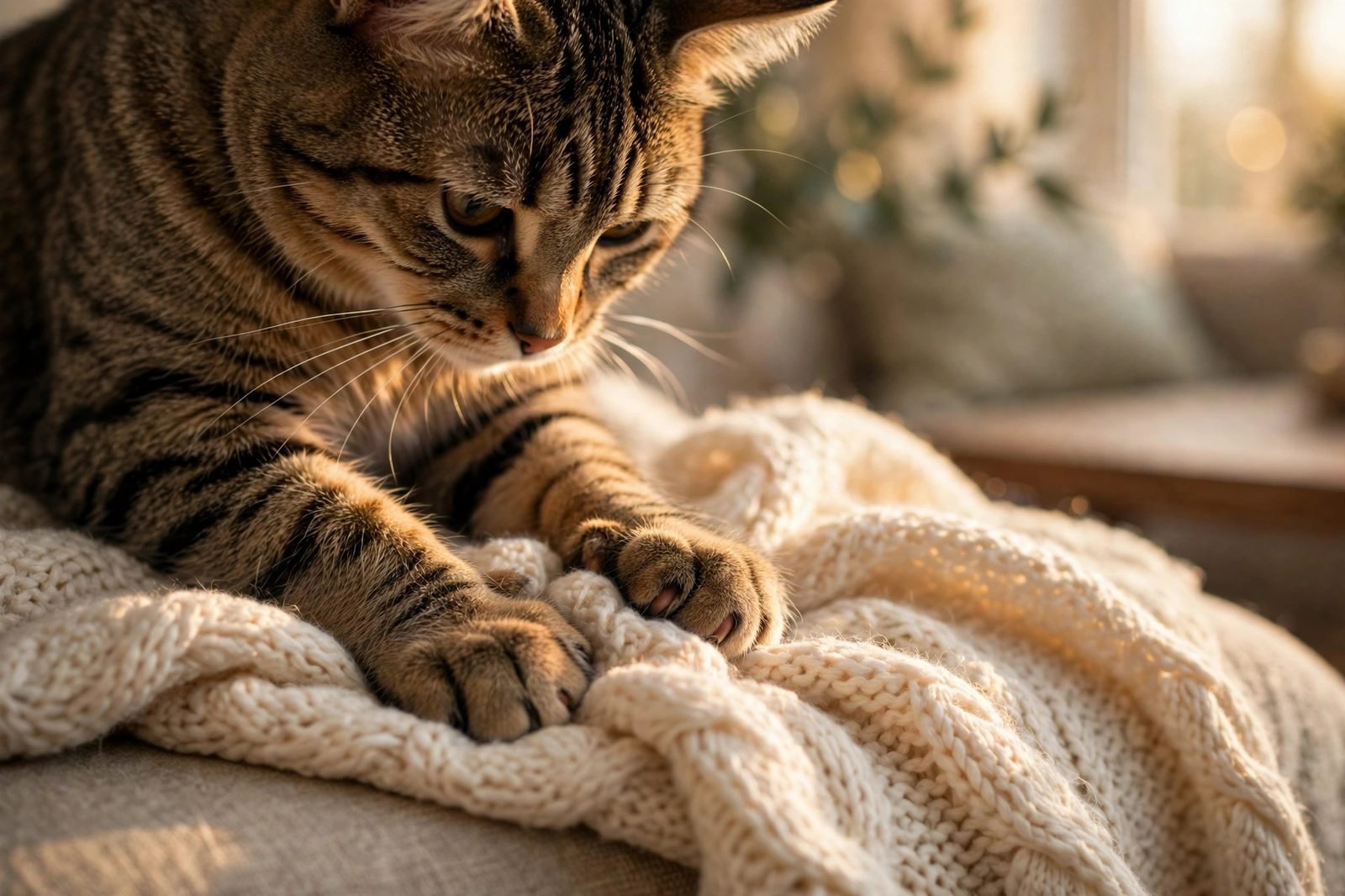

The first time my cat Biscuit did it, I genuinely thought she was stuck. She was sitting on my lap, staring off into the distance, and her front paws were doing this slow, rhythmic push-push-push into my thigh — like she was trying to inflate me. It went on for five full minutes. Her eyes went half-closed, and then she fell asleep. I sat there afraid to move, wondering what on earth had just happened.
That was kneading — the weird little ritual where a cat pushes its paws alternately into something soft, over and over, sometimes with claws out. If you’ve ever been on the receiving end, you know it’s equal parts adorable and mildly dangerous.
Published: April 28, 2026 | Last updated: April 28, 2026
Quick Tips
- Kneading is a comfort behavior that starts in kittenhood — it’s normal and a sign of contentment.
- Keep a thick blanket on your lap if your cat kneads with claws out.
- Trim your cat’s claws regularly to make kneading sessions painless.
- Don’t punish kneading — redirect to a pillow or blanket instead.
- Sudden changes in kneading (stopping suddenly or becoming frantic) are worth mentioning to your vet.
- Kneading before naps is a nesting instinct; give your cat a soft spot to do it on.
What Kneading Actually Looks Like
For the uninitiated: kneading is when a cat rhythmically presses its front paws into a soft surface, alternating left-right-left-right, like a tiny baker kneading dough. (That’s literally where the nicknames “making biscuits” and “kneading dough” come from — and honestly, they’re perfect.) Some cats do it on blankets, some on laps, some on the couch cushions. Some use all four paws. Some drool. Some purr so loudly the floor vibrates.
Biscuit’s technique, for the record, is intense and theatrical. She starts with a full-body wiggle, climbs onto whatever soft surface is nearest, and begins with her paws like she’s playing the world’s smallest piano. Her back legs get involved sometimes, which makes it look like she’s riding an invisible bicycle. Every cat has their own style, and once you’ve seen yours do it, you’ll recognize it instantly.
It Starts With Mom
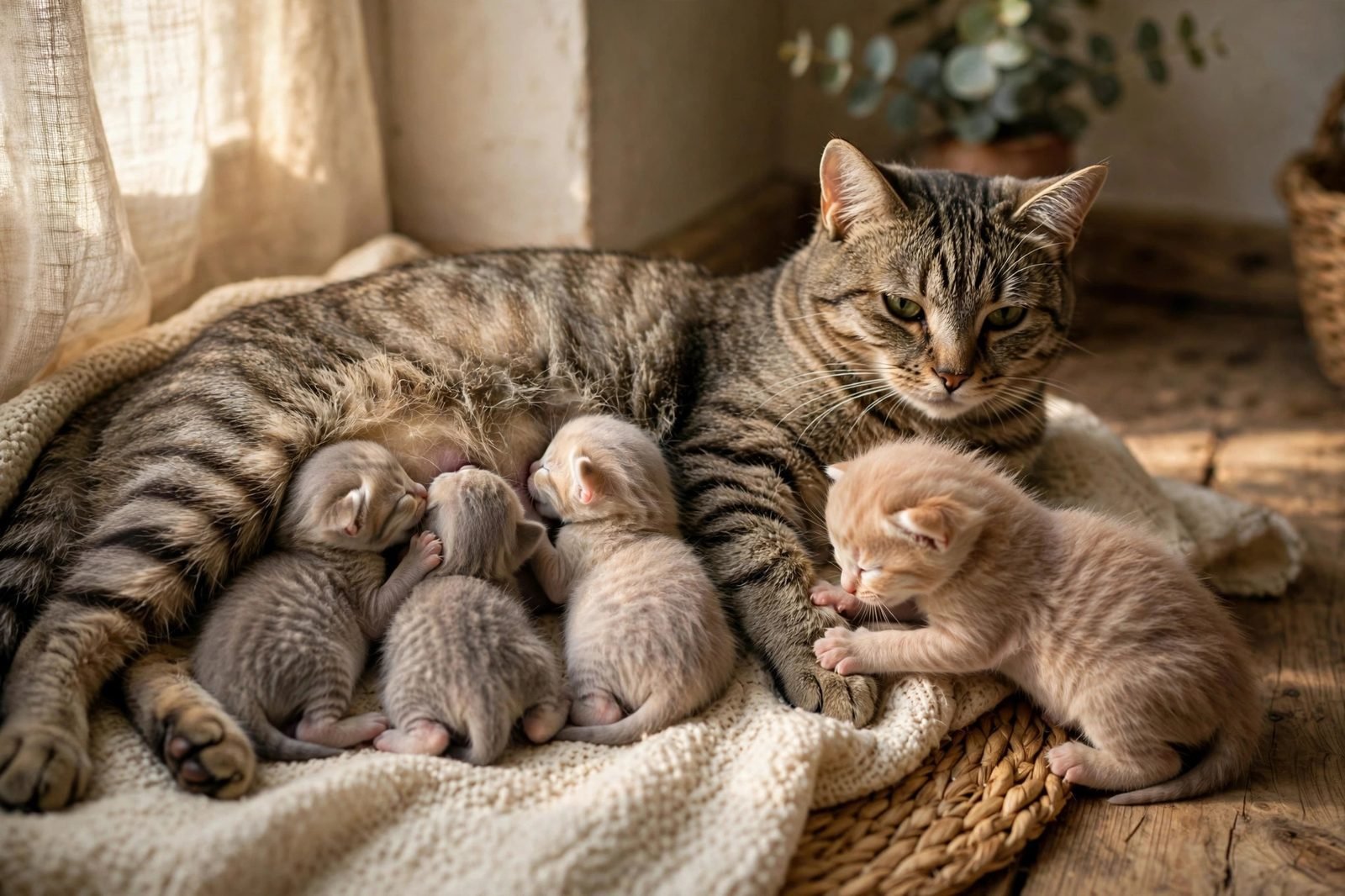
The most widely accepted explanation for kneading is that it’s a leftover from kittenhood. Newborn kittens knead their mother’s belly while nursing — the pressing motion stimulates milk flow. It’s one of the very first things a kitten ever learns to do with its paws, and the feeling gets permanently wired to warmth, fullness, and safety.
The Main Reasons Cats Knead
1. They’re content and relaxed
This is the big one, and it’s the reason most kneading happens. A cat that climbs onto your lap, starts purring, and kneads is telling you they’re happy. It’s a compliment of the highest order. Biscuit kneads almost exclusively in two situations: on me, and on her favorite blanket right before falling asleep. Both are peak-comfort situations.
2. They’re getting ready to sleep
Before domestication, cats’ wild ancestors would pat down grass, leaves, and twigs to make a soft nesting spot before lying down. The kneading instinct is thought to be partly descended from that nesting behavior. Watch your cat sometime: many of them do a little knead-circle routine on a blanket or cushion, then curl up in the exact spot they just kneaded. It’s a bedtime ritual. Speaking of sleep habits, I’ve written about how much sleep dogs need too — and while the numbers differ, that pre-nap wind-down ritual looks remarkably similar across pets.
3. They’re marking territory
Cats have scent glands in their paw pads. When they knead, they’re not just pressing — they’re leaving their scent on the surface. That blanket your cat kneads every night? That’s theirs now, officially, chemically. This is also why some cats knead their owner’s clothing. They’re not being rude; they’re putting their name on you. I find this weirdly flattering, even when it means Biscuit has claimed my favorite hoodie as her property.
4. They’re showing affection
Cats knead people they trust. That’s really all there is to it. If your cat kneads your lap, your chest, or — as happened to me last winter — your face at 3 AM, it’s because they associate you with comfort and safety. It’s one of the most direct ways a cat says “I love you.” The 3 AM face version is less fun, but the sentiment counts.
5. They’re stretching or feeling good
Sometimes kneading is just… physical. Cats that wake up from a nap will often stretch their front legs and knead the air or the couch cushion a few times. It’s like us doing a morning stretch before getting out of bed. Not every knead session has deep emotional meaning — sometimes the paws just need to move.
Why Does Kneading Hurt So Much?
Because of the claws, obviously. Cats knead with their claws sheathed or extended depending on the cat and the moment, and extended claws plus bare thighs is a combination that has ended many a cozy evening. Biscuit’s claws are out more often than not when she’s really into it — the deeper the contentment, apparently, the deeper the claws.
The fix is simple and boring: keep their claws trimmed. A cat with freshly trimmed claws can knead your lap for an hour and you’ll barely feel it. I trim Biscuit’s claws every couple of weeks, and the difference between pre-trim and post-trim kneading is night and day. (If you’ve never trimmed cat claws before, ask your vet to show you the first time — there’s a quick you want to avoid, and seeing it done once makes it much less intimidating.)
What Kneading Is NOT
Over the years I’ve heard some strange theories about kneading, so let me clear a few up:
It’s not a sign of stress. Kneading is overwhelmingly associated with contentment. If your cat is stressed, you’ll see flattened ears, hiding, appetite changes — not a happy rhythmic paw dance. That said, some cats do knead more when something changes in the household (a move, a new pet), and in that context it seems to be self-soothing rather than distress.
It’s not something they grow out of. Adult cats knead. Senior cats knead. My neighbor’s 16-year-old cat kneads his bed every single night. It’s a lifelong habit for most cats.
It’s not a dominance thing. Nobody is “claiming” anything in a power sense. The scent-marking aspect is about comfort and familiarity, not hierarchy.
It’s not hunger. I’ve seen this one online — people saying kneading means the cat wants food because of the nursing connection. In my experience, hungry cats meow, follow you to the kitchen, and sit by the bowl. Kneading is a comfort thing, not a dinner bell.
When Should You Worry?
Honestly? Rarely. Kneading is one of the most normal behaviors a cat can have. But there are a couple of situations worth noting:
If your cat suddenly stops a lifelong kneading habit, or if the behavior changes dramatically — kneading becomes frantic, or is paired with pacing, vocalizing, or other signs of restlessness — that’s worth a conversation with your vet. Behavioral changes are always worth paying attention to, even when the behavior itself is harmless.
Similarly, if kneading is directed at themselves — like a cat suckling or kneading at its own belly or flank — that can sometimes indicate anxiety or, occasionally, a medical issue. I’m not diagnosing anything here; just saying that’s the kind of thing where a vet visit is the right move rather than a Google deep dive at 2 AM. (I’ve done the 2 AM Google deep dive. It never helps.)
One practical aside: when I was trying to figure out whether Biscuit’s behavior changes meant something, I ended up auditing everything about her routine — including her litter box, since cats are creatures of habit and a dirty box can genuinely stress them out. If you’ve never thought about it, how often you should clean the litter box matters more than most new owners realize. It’s one of those boring fundamentals that quietly affects everything else.
Should You Stop Your Cat From Kneading?
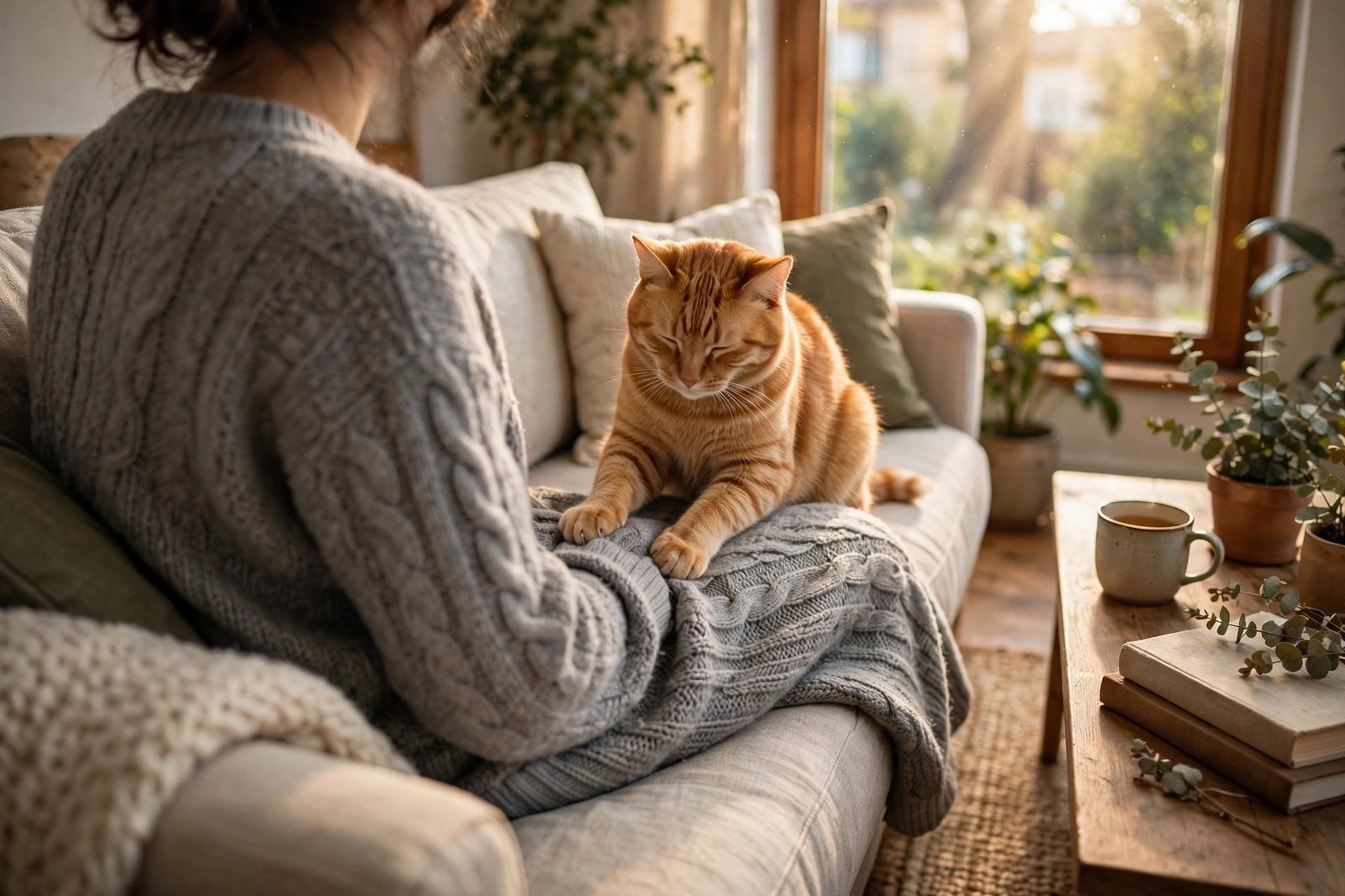
Please don’t. Kneading is a sign that your cat feels safe and happy. Punishing it — pushing them off, scolding them, getting up abruptly every time — teaches them that being affectionate with you leads to rejection. That’s the opposite of what you want.
That said, you don’t have to be a martyr. If the claws hurt, redirect. Put a blanket between the paws and your skin. Trim the claws. Gently shift the cat onto the cushion next to you instead of your lap. All of these preserve the behavior while protecting your thighs. The goal is to keep the kneading and lose the puncture wounds.
Living With a Kneader
Here’s what I’d tell any new cat owner about kneading, having lived with Biscuit’s dramatic piano-playing for years now:
Accept it as a compliment. Your cat chose your lap, your blanket, your hoodie. That’s trust. Not all cats knead, by the way — some just don’t, and that’s fine too. It doesn’t mean they love you less. Every cat expresses contentment differently.
Enjoy it. Honestly, this is the advice. A cat kneading on your lap, purring, half-asleep, drooling slightly — that’s one of the best feelings in pet ownership. It’s weird and it’s wonderful and it doesn’t last forever. I used to gently move Biscuit off my lap because I had things to do. Now I just… stay. The things can wait. That’s what she taught me.
Frequently Asked Questions
Why does my cat knead on me but not on blankets?
You’re warmer, softer in the right ways, and you smell like safety. Some cats are picky about their kneading surfaces and only knead living things — usually their favorite person. It’s actually a bigger compliment than blanket kneading. The downside is that your lap is not replaceable with a $20 throw blanket. Trim their claws, keep a lap blanket handy, and accept your role as the chosen surface.
Is it normal for cats to drool while kneading?
Yes, completely normal for many cats. The drooling is linked to the same nursing instinct as the kneading — kittens don’t exactly have tidy table manners, and some of that carries over. A little damp spot on the blanket is nothing to worry about. If your cat starts drooling heavily outside of kneading, or the drooling is new and paired with appetite loss, that’s worth a vet check.
Why does my cat knead with claws out?
Deeper contentment, better grip, or just habit — cats vary. Some knead with claws sheathed their whole lives; others extend them the moment the purring starts. Regular claw trimming is the practical answer. Don’t try to train the claws out of the behavior; you’ll just frustrate both of you.
Do all cats knead?
No, and that’s perfectly normal. Some cats knead daily, some rarely, some never. It doesn’t indicate anything about how happy or well-adjusted a cat is — it’s just an individual quirk, like whether a person is a morning person. If your cat has never kneaded and is otherwise healthy and content, there’s nothing missing.
Why does my cat knead before sleeping?
It’s a nesting ritual, inherited from wild ancestors who patted down grass to make a sleeping spot. The kneading gets the surface “just right” and signals the brain that it’s wind-down time. Many cats do a whole routine: knead, circle, curl up, sleep. It’s one of the most satisfying things to watch.
[…] is the nursing motion kittens make, and the combination basically means maximum comfort. My cat kneading guide digs into that particular quirk if you want the full […]