

I never planned to become a cat person. Then Miso — a scrawny tabby with one folded ear and the confidence of a landlord — moved herself into my life via a friend’s “temporary” rehoming situation. I knew dogs. I did not know litter boxes. My first week, I treated the box like a distant relative: acknowledged its existence, kept my distance, dealt with it when I could no longer pretend it was fine. By day five, Miso was staring at me with an expression I can only describe as legal counsel, and I found a protest poop in the laundry basket.
Here is what I have learned since: how often to clean a litter box is not a housekeeping preference. It is one of the highest-impact things in cat care. A clean box means a healthy cat, a fresh-smelling home, and no laundry-basket incidents. The good news: the actual routine takes about two minutes a day once you build the habit.
Published: April 27, 2026 | Last updated: April 27, 2026
Quick Tips
- Scoop every day — twice a day is even better for multi-cat homes.
- Do a full litter change and box wash weekly (or every 2 weeks for non-clumping litter).
- Keep 2–3 inches of litter in the box; top up as you scoop.
- One box per cat, plus one extra, in quiet, accessible spots.
- Unscented litter and mild soap — strong fragrances put cats off.
- Avoiding the box is often the first sign of a health or stress problem — ask your vet.
The Daily Scoop: Non-Negotiable
Scoop the box at least once a day. Every day. This is the single rule everything else hangs on — ninety seconds, less time than scrolling one social media post.
Cats are fastidious to a degree that shames most humans. In the wild, a dirty elimination area attracts predators, so the instinct to avoid a soiled spot runs deep. A box with yesterday’s clumps sitting in it reads, to a cat, the way a day-three festival portable toilet reads to you. Some cats will hold it rather than use a dirty box, which can contribute to urinary issues. Others, like Miso, will simply find somewhere cleaner — your laundry basket.
Twice-daily scooping is the gold standard, especially if you have more than one cat or a small home where smells travel. I scoop in the morning while the kettle boils and again in the evening — stitching it to routines I already had is the only reason it stuck. The smell difference between a box scooped daily and one scooped “when I get around to it” is not subtle. Guests notice.
The Weekly Deep Clean
Scooping removes the waste; it does not remove the slow buildup of odor and residue that coats the box itself. That is what the full change is for.
Clumping litter: full change weekly
Once a week, dump all the litter, scrub the box with warm water and a mild unscented soap, dry it completely, and refill with fresh litter. I do Miso’s every Sunday morning — ten minutes, start to finish. Old plastic absorbs odor over time, and no amount of fresh litter on top fixes a box that smells from the base up.
Non-clumping litter: change twice weekly
Non-clumping litter does not isolate urine the way clumping does — it all just gets progressively more saturated. So the full dump-and-replace needs to happen about twice a week. It uses more litter and more effort, which is honestly why most owners end up switching to clumping.
What to clean with (and what to avoid)
Mild, unscented dish soap and warm water. That is it. Bleach, ammonia-based cleaners, and strong disinfectants are a bad idea: the fumes are harsh in an enclosed box, and ammonia smells like urine to a cat. Scented cleaning products can also put a cat off the box entirely. Rinse well and dry fully — a damp box plus fresh litter equals concrete.
How Much Litter, What Kind, How Many Boxes
Cleaning frequency is only half the equation. The setup determines how fast a box gets gross and whether the cat accepts it at all.
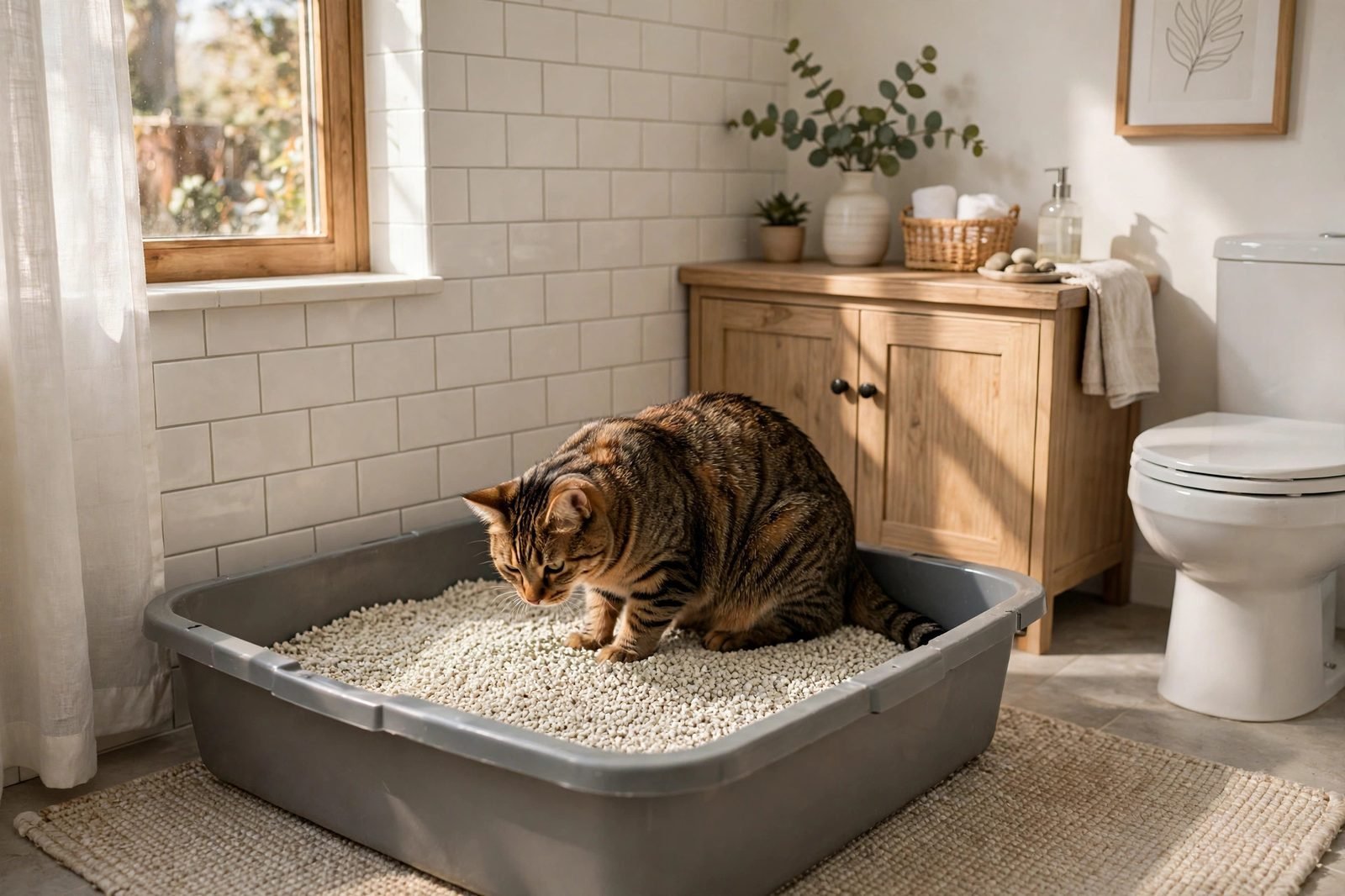
Depth: 2–3 inches
Too shallow and urine hits the plastic bottom, where it bonds and stinks forever. Too deep and you are wasting litter. Two to three inches lets clumping litter form neat clumps you can lift out cleanly. Top up to this level as you scoop through the week.
Litter type: let the cat vote
Start with unscented clumping — most cats accept it readily. If the cat avoids the box, litter texture or scent is suspect number one.
The n+1 rule for boxes
One box per cat, plus one extra. One cat: two boxes. Two cats: three. This is the standard guidance from feline behaviorists, and it exists because cats can be territorial about toilets and because a single box for multiple cats gets disgusting between scoops. The boxes should be in different locations, not side by side — two boxes in one corner count as one toilet in cat logic.
Placement matters
Quiet, low-traffic, easy to reach — and never next to the food and water. Avoid laundry rooms with suddenly slamming machines, and make sure there are two exit routes (an anxious cat will not use a box it can be cornered at). For kittens, seniors, and arthritic cats, low-sided boxes matter — a cat that struggles to climb in will simply go next to it.
Smell Control That Actually Works
Let us be blunt: the number one reason people ask about litter box cleaning is smell. Here is what actually moves the needle, in order of impact.
Daily scooping is easily 70% of the battle. Fresh litter depth is next. Then ventilation — a box in a stuffy cupboard will smell like it; a box in a ventilated room with the door ajar dissipates. An open-top box ventilates better than a covered one, though covered boxes contain litter scatter — pick your trade-off.
Baking soda sprinkled lightly under the fresh litter helps modestly. Air purifiers near the box area help noticeably. What does not help: scented litter, plug-in air fresheners next to the box (they can repel the cat from the area entirely), and just adding more litter on top of old litter. You cannot bury the problem. Literally.
Diet plays a background role too. A cat on a decent-quality diet produces less voluminous, less pungent waste than one on bargain food full of fillers. For the wider picture of everyday cat care beyond the box, the cat care basics guides cover feeding, grooming, and the rest. Regular brushing in particular keeps tracked litter and loose hair down — my cat brushing guide shows how to make it a routine your cat actually tolerates.
When Box Problems Mean Something Else
Sometimes the issue is not your cleaning schedule. Cats do not avoid the box to spite you — despite how personal Miso’s laundry-basket protest felt, it was communication, not revenge.
Medical red flags
A cat that suddenly starts avoiding a clean box, straining, crying in the box, going more often in small amounts, or has blood in urine needs a vet — promptly. Urinary blockages are genuinely urgent in cats, especially males; a blocked cat can go downhill in hours. I am not a vet and this is not a diagnosis guide — it is the “do not wait and see” rule. The litter box is a health dashboard; scooping daily means you actually read it.
Stress and territory
New home, new pet, new baby, new schedule, a neighborhood cat staring through the window — cats are routine animals and stress goes straight to the bladder, behaviorally speaking. If the box is clean and the vet finds nothing, think about what changed in the cat’s world. Extra boxes and a predictable routine resolve a surprising number of “behavioral” box problems. If the change is a brand-new home, my new cat introduction guide walks through settling a cat in without the litter-box drama.
The multi-cat dynamic
In multi-cat homes, box avoidance is often politics. One cat guarding the hallway to the box, one box for three cats, boxes too close together — any of these creates a cat that would rather risk the rug than run the gauntlet. The n+1 rule, spread-out locations, and twice-daily scooping fix most of it.
Building the Routine (The Two-Minute Version)
Here is the whole system, as I actually run it:
Morning (90 seconds): scoop while the kettle boils, quick visual check of what is in there (the health dashboard), top up litter if it is getting low. Tie the bag, done.
Evening (60 seconds): quick scoop, especially important in multi-cat homes. This is the one that keeps the overnight smell down.
Weekly (10 minutes): full dump, soap-and-water scrub, dry, refill to 2–3 inches. Sunday morning, same as the bins. Boring, predictable, effective.
Monthly (5 minutes): inspect the box itself. Scratched-up plastic harbors odor permanently — if the box smells even right after washing, replace it. Boxes are cheap; a permanently funky box will slowly train your cat to prefer the rug. I replace Miso’s about once a year.
That is the entire program. Two minutes a day, ten minutes a week, and a fresh box once a year. If you are new to all of this and want the full beginner’s tour, start at the PawsGuide homepage and take it one guide at a time.
Frequently Asked Questions
How often should you scoop a litter box?
At least once a day — twice a day is better, especially with multiple cats. Daily scooping is the single highest-impact habit in litter box care: it controls odor, keeps the cat willing to use the box, and lets you spot health changes early. It takes about ninety seconds.
How often should you change cat litter completely?
With clumping litter, do a full dump-and-replace weekly, plus a soap-and-water scrub of the box. With non-clumping litter, change it fully about twice a week. Between full changes, top up to maintain 2–3 inches. If the box smells right after a full clean, the plastic has absorbed odor and it is time to replace the box.
How many litter boxes do I need for two cats?
Three — the standard rule is one box per cat plus one extra. They should be in different locations around the home, not lined up in a row, since cats count adjacent boxes as a single toilet. Spread them across quiet, accessible spots with escape routes, and scoop twice daily in multi-cat homes because boxes fill up fast.
Why does my cat poop outside the litter box?
The common causes, in order: the box is not clean enough, the cat dislikes the litter or box style, bad placement (noisy, no escape route, next to food), stress or territorial issues, or a medical problem. Start with a scrupulously clean box and the right setup; if a previously reliable cat suddenly starts avoiding a clean box, see your vet — urinary issues can be urgent.
Is clumping or non-clumping litter better?
Clumping litter is easier to maintain — you scoop out urine clumps daily and do a full change weekly — and most cats accept it readily. Non-clumping needs full changes twice a week and uses more litter, but some owners prefer it for lower dust or because certain cats like the texture. Unscented beats scented regardless of type; strong fragrances put many cats off the box entirely. Let your cat’s willingness to use it be the deciding vote.
How do I stop my house smelling of litter box?
Daily scooping does most of the work. Beyond that: maintain 2–3 inches of fresh litter, do the weekly full change and box scrub, keep the box in a ventilated room, sprinkle baking soda under fresh litter, and consider an air purifier nearby. Avoid scented litters and plug-in fresheners by the box — they mask odor for you while potentially repelling the cat.
[…] the burying behavior. If you’re unsure about maintenance, I’ve got a whole guide on how often to clean the litter box, because during the adjustment period especially, a clean box matters. A new cat that finds a dirty […]
[…] as feeding works best on a predictable schedule, so does everything else. I’ve written about how often to clean the litter box, and the principle is identical — cats are creatures of habit, and a consistent daily rhythm for […]
[…] Most cats shed more heavily in spring and fall. During those weeks, I double Luna’s brushing to twice a week, and the difference in household fur is dramatic. Indoor cats can shed year-round thanks to artificial lighting, so more frequent brushing just becomes the norm. All that loose fur has to go somewhere — better in the brush than in your cat’s stomach as a hairball. (On household fur management, keeping the litter area clean helps too — I cover that in my guide on how often to clean the litter box.) […]
[…] the box in a ventilated spot — that will beat any bag’s promises. For the full routine, my litter box cleaning schedule guide covers exactly how often to scoop and […]