
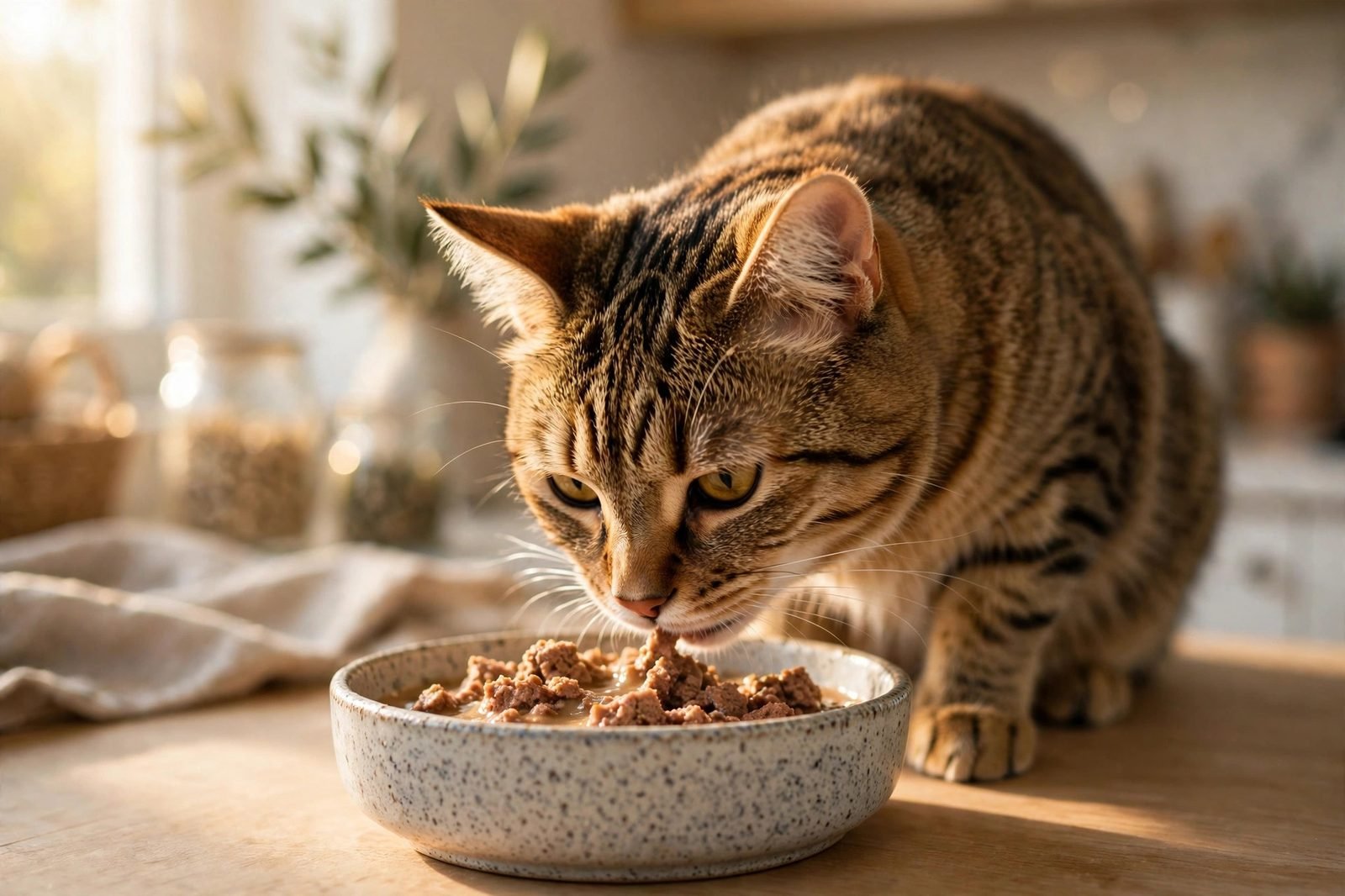

Biscuit has opinions about meal frequency, and she expresses them loudly, at 5:30 every morning, directly into my ear. For a long time I assumed the answer to “how often should I feed my cat” was simply “whenever she demands it,” which is how we ended up on a schedule designed entirely by a cat.
Then my vet asked me, very gently, how many times a day I was feeding her, and I watched her expression change as I answered. That conversation sent me down a rabbit hole of actual feline nutrition, and it turns out the real answer is more interesting — and more flexible — than I expected.
Published: May 2, 2026 | Last updated: May 2, 2026
Quick Tips
- Most adult cats do well on 2–3 meals a day — consistency matters more than the exact number.
- Kittens under 6 months need 3–4 small meals daily.
- Measure portions; don’t rely on “a scoop” or free-pouring.
- Wet food helps with hydration — cats are notoriously bad drinkers.
- An automatic feeder is a lifesaver if you work long or irregular hours.
- Sudden appetite changes (up or down) warrant a vet visit.
- Treats should stay under 10% of daily calories.
The Short Answer (and the Longer One)
For most healthy adult cats: two to three meals a day. Morning and evening at minimum, with a midday meal if your schedule allows. That’s the baseline that vets and feline nutritionists land on most often.
But here’s the longer answer, which is the actually useful one: the ideal number depends on your cat’s age, health, lifestyle, and personality. A kitten eats differently from a senior. A grazer eats differently from a gorger. An indoor couch-potato cat needs a different routine than a young, hyperactive one. So instead of giving you one rigid number, let me walk through how to figure out the right schedule for your cat — because “twice a day” is a starting point, not a religion.
What Cats Would Do in the Wild
It helps to know what a cat’s stomach is actually designed for. In the wild, cats are small-prey hunters — mice, mostly — and they’d typically eat 8 to 12 tiny meals a day, catching and eating a little at a time. Their stomachs are small. Their metabolism is built for frequent, small intakes rather than one or two big feasts.
Now, obviously, you’re not going to feed your cat twelve times a day. But this biology explains a few things: why many cats prefer to graze rather than eat a whole bowl at once, and why the “one giant meal a day” approach that works for some dogs is a bad fit for cats.
The practical takeaway: more, smaller meals are closer to how cats are built to eat — but anywhere from two to four meals a day works fine in practice.
Feeding Schedules by Life Stage
Kittens (under 6 months): 3–4 meals a day
Kittens are growing fast, and their tiny stomachs can’t hold enough food in one or two sittings to fuel that growth. Three to four small meals a day is the standard.
Young adults (6–12 months): 2–3 meals a day
Growth is slowing but not done. Most cats transition to three meals, then two, during this period. Watch their body condition and energy — if they’re maintaining a healthy weight and seem satisfied, you’re on track.
Adults (1–7 years): 2–3 meals a day
This is the long, stable stretch. Two solid meals — morning and evening — works for the vast majority of adult cats. Add a third small meal or a puzzle feeder at midday if you’re home, or if your cat tends to inhale food and then beg an hour later. Biscuit is on a two-meal schedule with a small midday snack from a puzzle toy, and it’s the routine that’s finally stuck after years of negotiation (mostly her negotiating).
Seniors (7+ years): 2–3 smaller meals a day
Older cats often do better with smaller, more frequent meals — their digestion gets fussier and their appetites can be inconsistent. If your senior cat’s appetite changes significantly, that’s a vet conversation, not a feeding-schedule tweak.
Grazers vs. Gorgers: Know Your Cat
This was the insight that changed everything for me. Cats fall roughly into two eating styles, and the right schedule depends on which one you’ve got:
Grazers nibble a little, walk away, come back later. They self-regulate reasonably well. Biscuit is a grazer with wet food — she’ll eat half, go stare out the window, and finish the rest in an hour. For grazers, you can leave measured wet food down for a bit (not all day — wet food spoils) or use timed feeders for dry food.
Gorgers inhale the entire bowl in ninety seconds and then look for more. Gorgers do not self-regulate. If you free-feed a gorger, you will end up with an overweight cat — it’s just physics. Gorgers need strict scheduled meals with measured portions.
Most cats are one or the other, and it’s usually obvious within a week of watching them eat. Once you know your cat’s style, the schedule practically picks itself.
Wet Food, Dry Food, or Both?
This debate generates more heat online than almost any other cat topic, so let me give you the calm version. Cats evolved as desert animals — they’re designed to get most of their moisture from prey, and they’re famously bad at drinking enough water. Chronic low-level dehydration is linked to urinary and kidney issues, which are depressingly common in cats. Wet food helps a lot here, because it’s roughly 75% water versus dry food’s 10%.
That doesn’t mean dry food is poison. Good-quality dry food is nutritionally complete and convenient. Many vets recommend a mix: wet food for the main meals, a measured amount of dry for grazing or puzzle toys. That’s what I do with Biscuit — wet food morning and evening, a small measured portion of dry in a puzzle feeder at midday.
Whatever you choose, the key word is measured. The number of meals matters less than the total daily amount. Two meals of the right total beats four meals of too much.
The 5:30 AM Problem
Let’s talk about the thing every cat owner knows: the dawn wake-up call. Cats are crepuscular — most active at dawn and dusk — which is why Biscuit considers 5:30 AM the correct breakfast time regardless of what my alarm says. For a while, I got up and fed her. This was a mistake, because I was training her: scream → human appears → food happens.
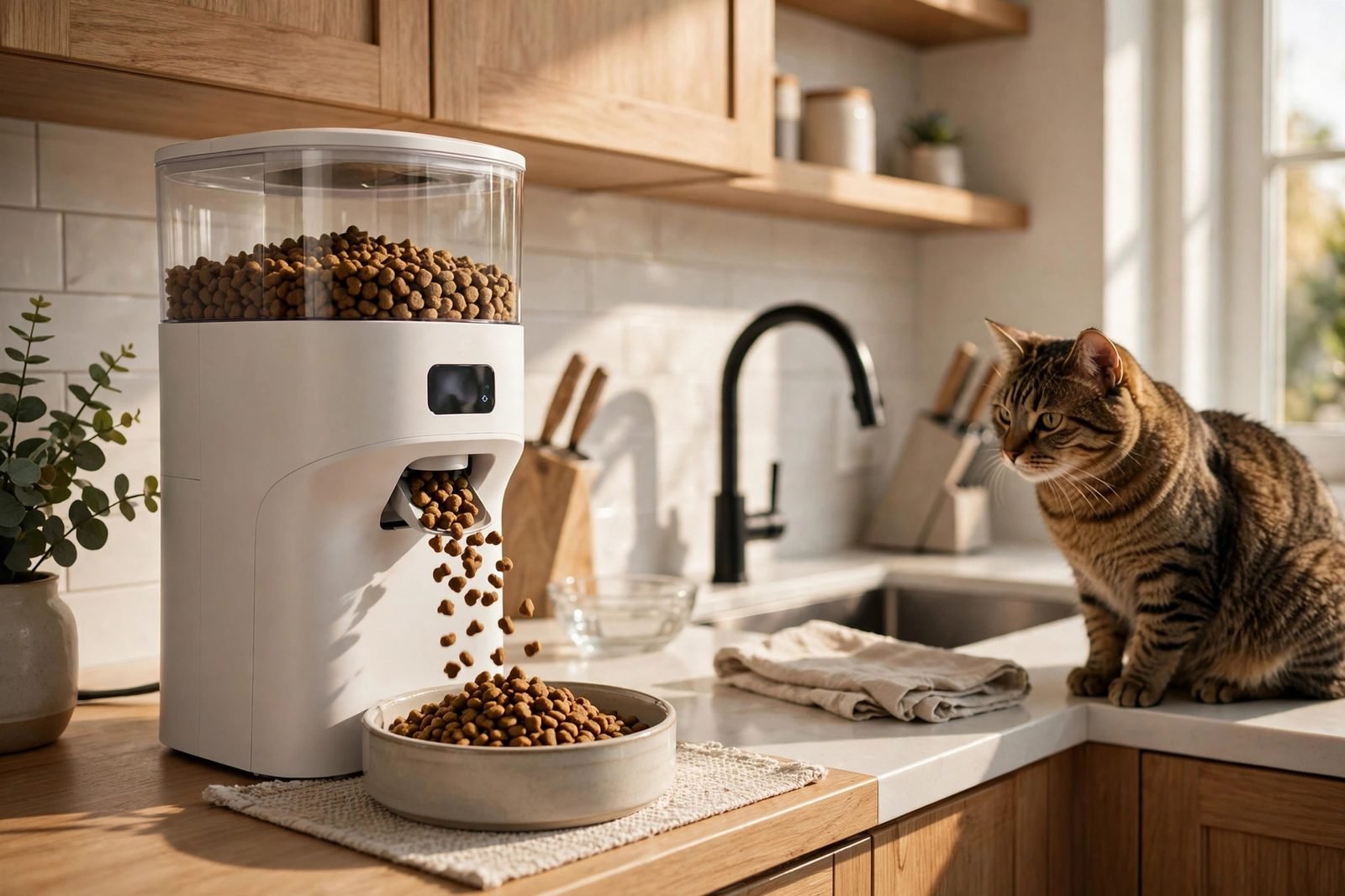
The fix that actually worked: an automatic feeder set for 5:45 AM. She still wakes me up sometimes out of habit, but the screaming stopped within two weeks once she learned that food comes from the machine, not from me. If your cat is an early-morning food terrorist, a timed feeder is the single best investment you can make.
One more tip from the trenches: don’t feed your cat the instant you wake up. Get up, do your routine, then feed. It breaks the association between your alarm and their breakfast, which makes the whole morning calmer.
Portions Matter More Than Frequency
I want to underline this because it’s the thing I got wrong for longest: how much your cat eats in a day matters far more than how many sittings it’s divided into. The feeding guide on the food packaging is your starting point — find your cat’s weight and the recommended daily amount, divide it across your chosen number of meals, and adjust based on body condition over a few weeks.
The hands-on check works for cats just like it does for dogs: you should feel the ribs easily under a thin layer of fat, see a waist from above, and notice a belly tuck from the side. Indoor cats are prone to gradual weight gain because the calories creep up while the activity stays flat — an extra ten kibbles a day doesn’t look like anything, but over a year it’s significant.
There’s a nice parallel here with the rest of a cat’s daily routine: just as feeding works best on a predictable schedule, so does everything else. I’ve written about how often to clean the litter box, and the principle is identical — cats are creatures of habit, and a consistent daily rhythm for food, box cleaning, and play keeps them noticeably calmer. Biscuit’s whole personality improved when her days became predictable.
Special Situations
Multi-cat households
Feed cats separately — different spots, ideally different rooms at first. Food competition creates stress and can lead to one cat hogging everything while the other under-eats.
Cats who beg constantly
Some cats beg out of habit, boredom, or because it’s worked before — not hunger. Before adding a meal, check: are they actually underweight? Are they eating their real meals fully? Often the begging is behavioral. More play and puzzle feeders usually fix it. If a previously satisfied cat suddenly starts begging ravenously, that’s a vet question.
Overnight fasting
Adult cats handle an overnight fast of 8–10 hours perfectly well — it’s the natural gap between the evening meal and breakfast. Don’t leave food out all night “just in case” unless your vet has recommended it. The overnight break is good for their digestion, and it makes breakfast something they look forward to.
Sleep, Food, and the Daily Rhythm
One thing I noticed once Biscuit’s feeding schedule stabilized: her sleep got better too. She’d eat dinner, do her evening zoomies, groom herself, and then settle for the night — a proper routine. It reminded me that all of this is connected: food timing, activity, rest. Animals, like people, do better with rhythm. Interestingly, the same is true across species — I was reading about how much sleep dogs need and the takeaway was the same: predictable daily patterns, with meals anchoring the day, lead to calmer, healthier pets. The species differ; the principle doesn’t.
Frequently Asked Questions
Is it okay to feed my cat once a day?
It’s not ideal. A cat’s small stomach and fast metabolism are built for multiple small meals, and one large meal a day often leads to gorging or vomiting. Two meals is the practical minimum for most adult cats.
Should I leave dry food out all day?
Only if your cat is a genuine grazer who self-regulates — and even then, measure the daily amount rather than keeping the bowl perpetually full. For gorgers, free-feeding is the fast track to obesity. When in doubt, scheduled meals are the safer default.
My cat wakes me up for food at 4 AM. Help.
Automatic feeder, set for just before the usual wake-up time. Don’t get up and feed them yourself — that rewards the behavior. It takes one to three weeks of consistency for most cats to learn the new system. Also make sure the evening meal is substantial and maybe slightly later; a well-fed cat at 10 PM is less desperate at 4 AM. Earplugs for the transition period are a legitimate strategy.
When should I worry about appetite changes?
A cat that skips a meal occasionally is usually fine — cats have off days like anyone. But a cat that stops eating for 24+ hours, or whose appetite drops or spikes significantly over several days, should see a vet. Appetite is one of the earliest indicators that something’s off, in both directions. You know your cat’s normal; trust yourself when something feels wrong.
[…] refusing their nutritionally complete food. Treats work best as part of a sane overall routine; my cat feeding frequency guide lays out how meals and extras should fit […]