
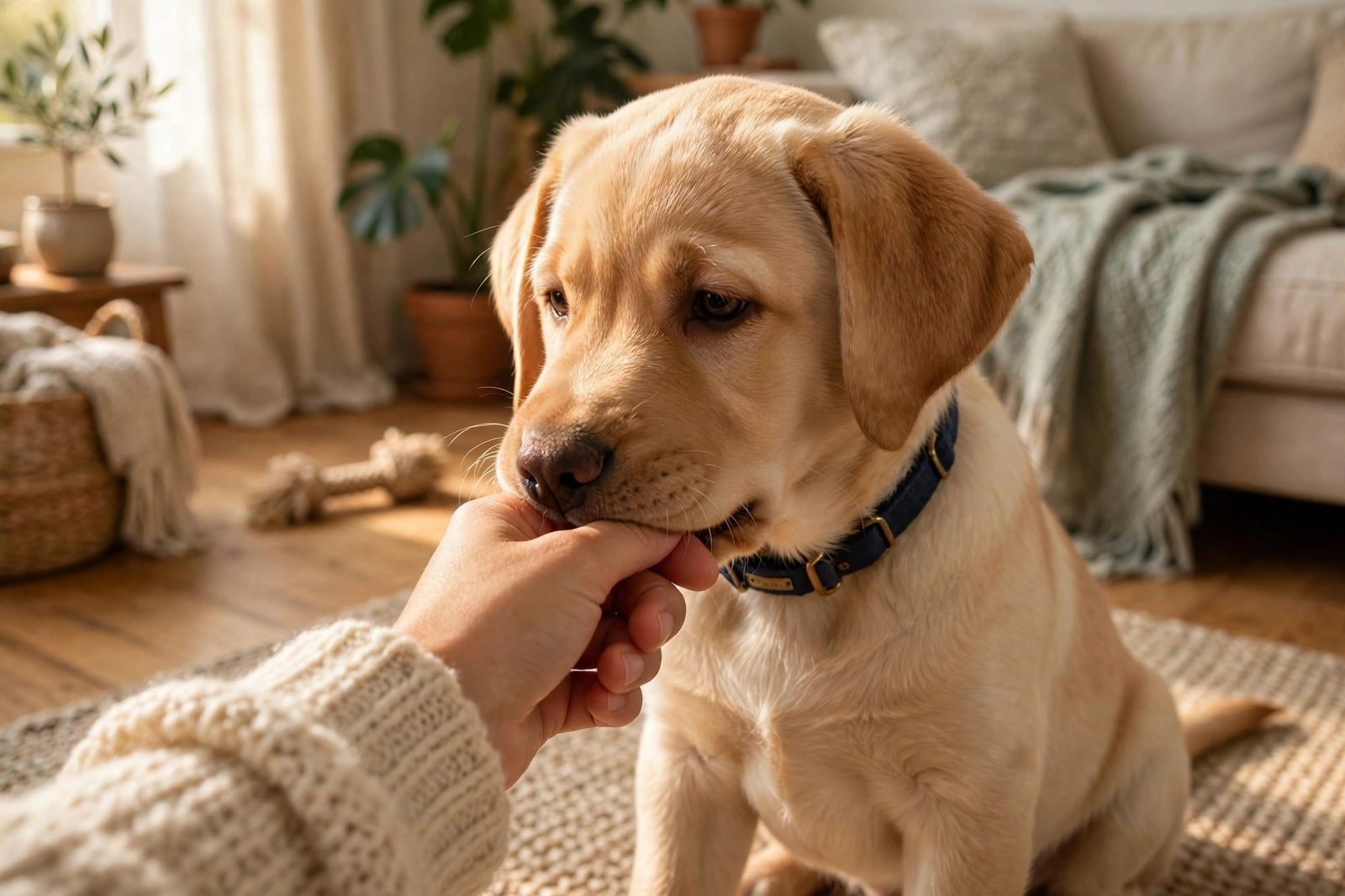

For the first month of puppy ownership, my hands looked like I’d been gardening with roses — without gloves. Needle teeth on my fingers, my sleeves, my ankles when I walked past. I remember googling “puppy biting” at 2 a.m. with a sleeping land-shark on my lap, half convinced I’d adopted a defective dog. I hadn’t — just a completely normal puppy with abnormal-looking teeth.
Published: May 12, 2026 | Last updated: May 12, 2026
If your puppy is biting everything including you: this is normal, temporary, and fixable. Puppies don’t bite from aggression — they bite because they’re babies exploring with their mouths, teething, playing, and learning how jaws work. This guide covers why it happens and how to teach gentleness, without punishment.
Quick Tips
- Biting is normal puppy behavior — not aggression. Most puppies outgrow the worst of it by 5–6 months.
- When teeth touch skin, yelp or say “ouch,” then withdraw attention for 10–20 seconds.
- Always redirect to a toy — teach them what to bite, not just what not to bite.
- Keep a toy in your pocket so a redirect is always within reach.
- Overtired puppies bite hardest — enforce naps like you would for a toddler.
- Never punish biting physically — it creates fear and often makes biting worse.
- Hands are not toys. If you wrestle with bare hands, you’re teaching that hands are for biting.
Why Puppies Bite (It’s Not What You Think)
Puppies bite for a handful of overlapping reasons, and most are doing several at once.
Exploration
Puppies don’t have hands. Their mouth is how they investigate everything — texture, taste, whether it squeaks. Your fingers are just interesting objects in a world of interesting objects. This kind of biting is curious, not intense, and the easiest to redirect.
Teething
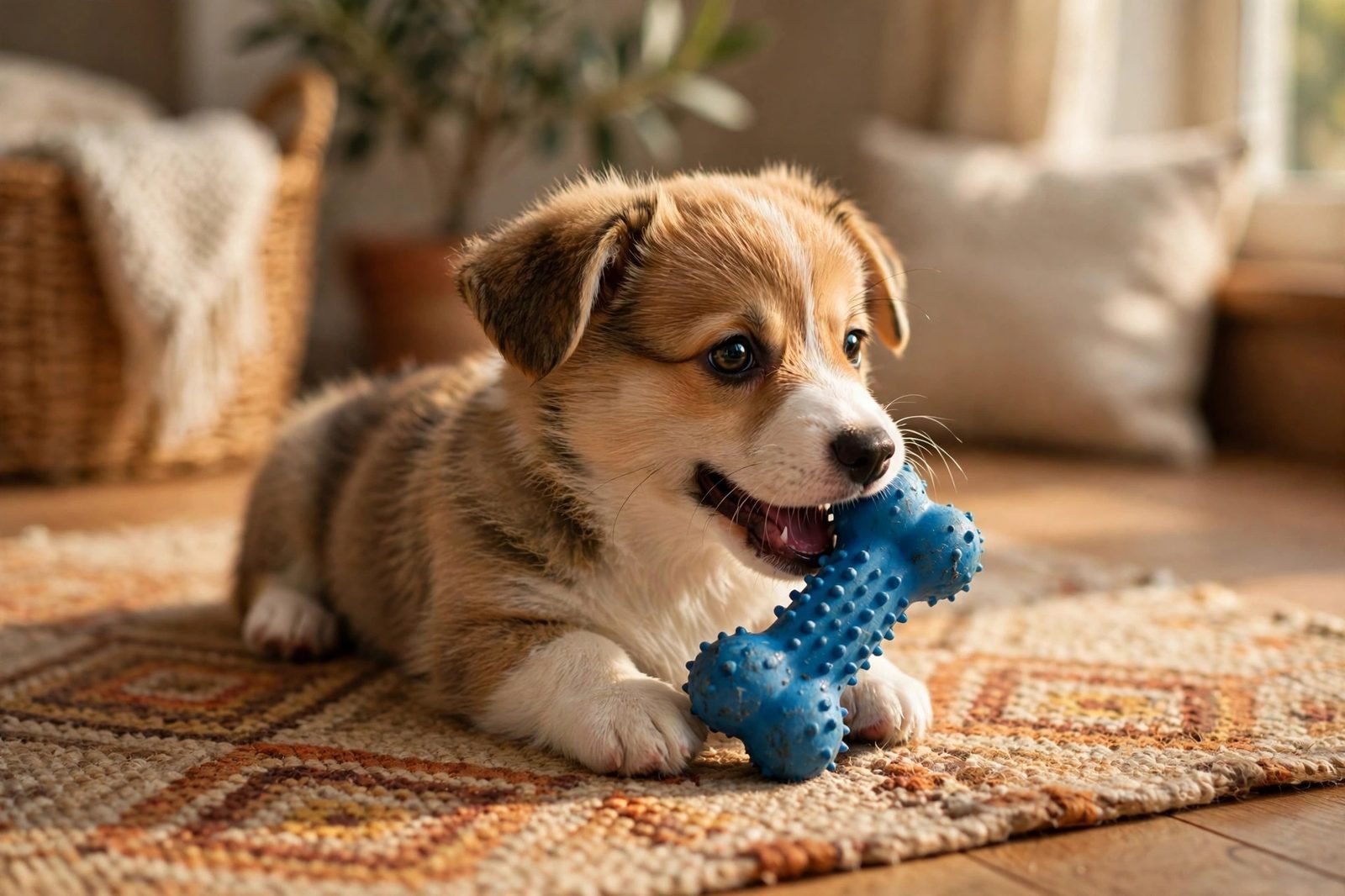
Around 12–16 weeks, puppy teeth start falling out and adult teeth push through, continuing until about six months. Teething hurts, and chewing relieves the pressure and soreness — the same way a teething baby gnaws everything in sight. If your four-month-old has suddenly become a chewing machine, teething is almost certainly a big part of it. Cold chews — a damp washcloth twisted and frozen, or rubber toys chilled in the fridge — genuinely soothe sore gums.
Play
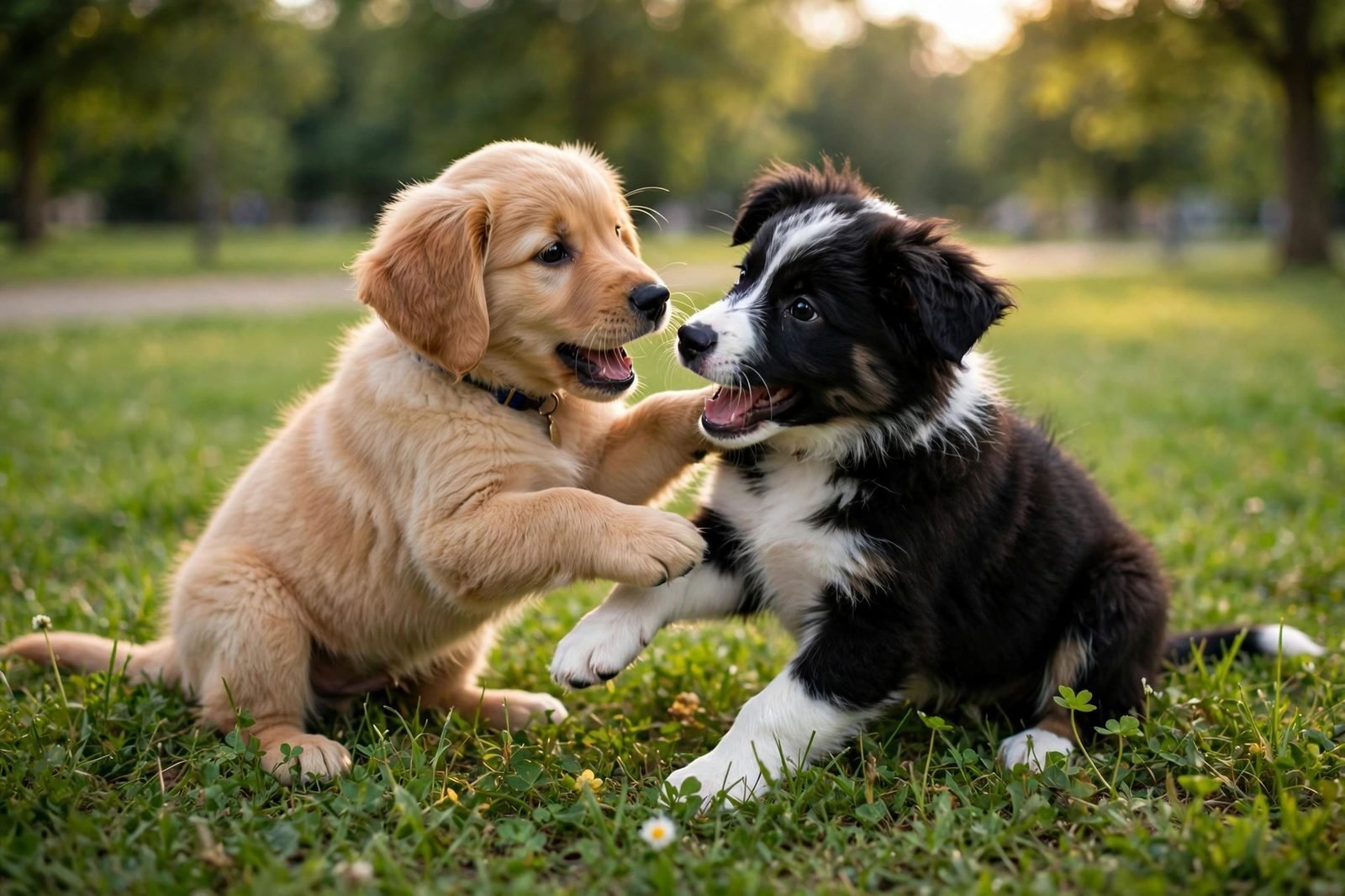
Watch puppies play together: it’s all mouths. They wrestle, mouthing each other’s necks, ears, and legs — it’s how they learn social skills, and when they play with you, they’re treating you like a fellow puppy. The problem is human skin is dramatically thinner than puppy fur, and what feels like gentle play to them draws blood on us. They don’t know that yet. Teaching them is your job.
Overtiredness
There’s a specific kind of biting — frantic, intense, unstoppable, usually in the evening — that isn’t about teeth at all. It’s an overtired puppy melting down. Young puppies need up to 18–20 hours of sleep a day, and an overtired puppy acts like an overtired toddler: wild, bitey, incapable of calming down. If yours turns into a demon around 7 p.m. nightly, that’s not a behavior problem — it’s a puppy who needs a nap. Enforced crate naps were the single biggest improvement to our biting situation.
The Core Method: Teach Bite Inhibition
The goal isn’t to stop all mouthing immediately — it’s to teach bite inhibition first (gentleness with the mouth), then phase out mouthing on people. This two-stage approach matters: a dog that learned human skin is fragile is a safer adult dog, even in fear or pain. You want that lesson installed.
Step 1: React to pressure
When teeth touch skin with real pressure, yelp or give a sharp “ouch!” like a fellow puppy would. Then stop the interaction: hands still, turn slightly away, fun ends for ten to twenty seconds. Then resume. The lesson: hard bites make good things stop. Within days, most puppies bite softer — stage one working.
Make the yelp a real, surprised sound — not a scream. Some puppies get more excited by high-pitched noises and treat your yelp as the best part of the game. If yours ramps up instead of backing off, skip the yelp and calmly remove yourself — step over a baby gate for twenty seconds, then return. Boring, consistent, effective.
Step 2: Lower the bar gradually
Once your puppy bites softly (mouthing without pressure), react to any teeth on skin — even gentle mouthing gets the “ouch” and withdrawal. Raise the standard in stages: first no hard bites, then no teeth on skin. Going from shark-mode to zero mouthing in one jump frustrates everyone.
Step 3: Redirect, redirect, redirect
Every “don’t bite me” needs a “bite this instead.” Keep toys everywhere — pockets, cushions, every room. The moment teeth head for your hand, put a toy in the puppy’s mouth and praise them for chewing that. You’re building an alternative habit: a puppy with a toy in its mouth can’t bite your hand, and one that learns toys earn praise will increasingly choose the toy alone.
Rotate toys to keep them interesting, and learn your puppy’s texture preferences — plush, rubber, or cold for teething. Mine ranked them: frozen washcloth for sore gums, rubber bone for serious chewing, plush duck for carrying like a trophy. The right texture makes redirection far more successful than waving a random toy.
Management: Setting Up for Success
Half the battle is management — arranging life so the puppy has fewer chances to practice biting you.
Protect the witching hour
Most puppies have a daily crazy period, usually evening, where biting peaks. Plan for it: a play-and-train session followed by a stuffed food toy and a nap, or a calm chew while you watch TV. Once I treated 7 p.m. as a scheduled event with a plan instead of a surprise attack, our evenings transformed.
Enforce naps ruthlessly
Young puppies rarely choose sleep when they should — too much world to experience. An 8–12 week old awake more than an hour or two is heading for overtired meltdown territory. Crate them for regular naps: roughly two hours of sleep per one hour awake. Enforced naps fixed most of our biting problem, and countless other owners say the same.
Exercise the body and the brain
A puppy with no outlet uses you as the outlet. Exercise, short training sessions, sniffing games, and food puzzles drain the energy that becomes ankle-biting. Getting the amount right matters — overtired is as bad as under-exercised — and how much exercise a puppy needs helped me calibrate, because “tire them out” is terrible advice without numbers.
What NOT to Do
A depressing amount of internet advice on puppy biting is counterproductive. The worst of it:
Don’t hold the muzzle shut. Grabbing a puppy’s snout teaches nothing about gentleness and can make them head-shy — flinching when hands come near their face. Some puppies respond by biting harder. Lose-lose.
Don’t alpha-roll or pin the puppy. Rolling a puppy onto their back to “show dominance” is outdated, stressful, and risks fear-based aggression. Modern behavioral science has debunked the theory it came from. If a trainer suggests this, find a different trainer.
Don’t flick the nose, tap the muzzle, or use physical punishment. Pain doesn’t teach gentleness — it teaches that human hands are unpredictable and scary. Physically punished puppies often become adults that bite harder when frightened, having learned to suppress warnings without learning inhibition.
Don’t expect it to vanish in a week. The methods above work, but they work over weeks. If someone promises a three-day fix, they’re selling something.
The Timeline: When Does It End?
The honest schedule: needle-teeth intensity peaks between 8 and 16 weeks; teething chewing ramps up around 4 months and resolves by 6–7 months. Most owners see dramatic improvement between 5 and 6 months, and by 7–8 months the biting phase is a memory — in my case replaced by a dog that gently takes treats and mouths toys instead of forearms.
There are blips. Adolescence (6–12 months) can bring a brief resurgence of mouthy behavior, especially in excitable breeds. New environments, new people, and high excitement can all temporarily lower a young dog’s self-control. Return to the basics — redirect, reward calm, manage overtiredness — and they pass.
What helped me during the worst weeks: getting out with the puppy in safe, age-appropriate ways. New experiences tire puppies mentally, and a mentally tired puppy is a gentle puppy. If you’re wondering what’s safe before vaccinations are complete, I covered the timing in when puppies can go outside — the socialization window and vaccination schedule overlap awkwardly, and it’s worth getting right.
Special Cases Worth Mentioning
Biting children’s hands and clothes
Small children move fast, squeal, and flail — the world’s best game to a puppy. Supervise every interaction, teach kids to “be a tree” (stand still, arms folded, boring) when the puppy gets mouthy, and give the puppy a toy to hold around children. Never leave them unsupervised together — both are still learning.
Biting the leash on walks
Leash biting is usually excitement or frustration, not the same as hand-biting. A tired puppy at the end of a walk, or an overstimulated one at the start, grabs the leash because it’s there. Redirect with a toy, keep walks short, and consider a chain leash cover (puppies find metal much less fun to chew) as temporary management while training catches up.
Biting that seems genuinely aggressive
True aggression in young puppies is rare, but trust your gut. Normal biting is loose-bodied, happens during play or excitement, and the puppy is otherwise friendly. Get professional input for: stiff body, hard staring, escalating resource growling, or biting that breaks skin with intent. Talk to your vet, who can refer you to a qualified behaviorist. I’m not a vet and this isn’t a diagnosis — but “this feels different” is worth a professional opinion.
Frequently Asked Questions
At what age do puppies stop biting?
Most puppies improve dramatically between 5 and 6 months as teething finishes and bite inhibition takes effect. By 7–8 months, mouthing people is usually over. Larger, mouthier breeds (retrievers, herding dogs) may take longer. Early consistency determines the timeline more than anything else.
Should I yelp when my puppy bites me?
A yelp mimics how puppies communicate “too hard!” to each other, and it works for many. But some get more excited by the sound. Try it for a few days: if biting softens, keep it. If your puppy treats your yelp as a party invitation, drop the sound and withdraw attention calmly. The withdrawal is the real lesson; the yelp is just the announcement.
Is it okay to let my puppy chew my fingers gently?
During early bite-inhibition training, some trainers allow gentle mouthing as a teaching stage. Others prefer a zero-teeth rule from the start. Either can work. What doesn’t work is inconsistency: gentle mouthing that’s cute on Monday and punished on Wednesday confuses the puppy. Pick an approach and stick with it until you move to the next stage.
My puppy bites my ankles when I walk — help?
Ankle biting is herding and chasing instinct, especially common in herding breeds and terriers. Moving feet trigger the chase. Stop moving the moment teeth touch (be a tree), redirect to a toy, and reward calm walking beside you. Never kick at the puppy or move faster — both escalate the game. Most puppies drop this as they mature and find better outlets for the impulse.
When should I get professional help for biting?
If biting is escalating by 6 months despite consistent training, if it seems driven by fear or resource guarding rather than play, or if anyone in the household is genuinely afraid — get help. A certified professional dog trainer or veterinary behaviorist can assess what’s happening far better than any article. There’s no failure in asking; it’s what responsible ownership looks like.