


How to Introduce Your Dog to Other Dogs Safely
Most owners know the awkward version: another dog appears, both dogs lunge, the leashes tangle, somebody barks, and you stand there apologizing while your dogs perform an extremely intense sniffing ritual neither of you can interpret. It feels chaotic — but good introductions are a learnable skill.
Dogs are social animals, but they are not automatically good at meeting strangers. The way most of us introduce dogs — face to face, leashes tight, both straining forward — is roughly the worst possible method: it creates tension and forces a confrontation neither dog asked for. A calmer, far more reliable method exists, and it works for puppies, rescues, nervous dogs, and overexcited greeters alike.
Quick Tips
- Never force a face-to-face greeting — let dogs approach on a curve, not head-on.
- Keep leashes loose; a tight leash tells your dog there is something to worry about.
- Use the parallel walk method: walk the dogs near each other before letting them meet.
- Three seconds is enough for a first sniff — then cheerfully call your dog away.
- Watch body language constantly: stiff bodies and hard stares mean “give space.”
- End every introduction on a good note, even if that means ending it early.
Why Most Introductions Go Wrong
Picture the classic dog meeting. Two owners see each other, both dogs pull forward, the owners stop and let the leashes go taut, and the dogs end up nose-to-nose, straining against their collars, circling with stiff legs. This looks like socializing. It is actually a pressure cooker.
Dogs read intentions through body language, and a head-on approach with a stiff body reads as confrontational. Add a tight leash, and you remove the dog’s two best tools for managing social tension: the ability to increase distance and to approach on a curve. A dog that cannot move away feels trapped — and a trapped dog is far more likely to snap.
This is why so many “friendly” dogs start fights on leash but play beautifully off leash — the leash changed the entire conversation, not the dog’s temperament. Understanding this transforms every meeting from now on.
Before the First Meeting: Setting Up for Success
A good introduction starts before the dogs ever see each other. A few minutes of preparation makes the difference between a smooth hello and a stressful mess.
Exercise your dog first. A dog bursting with pent-up energy greets every new dog like a long-lost sibling who owes him money. A twenty-minute walk or a game of fetch beforehand takes the edge off and leaves you with a dog capable of thinking.
Bring high-value treats. Small, soft, smelly treats — the kind your dog would trade a kidney for. You will use these to reward calm behavior, redirect attention, and create positive associations with the other dog’s presence.
Choose neutral ground. For planned introductions, pick a place neither dog considers “theirs” — a quiet street, an open field, a wide trail. Dogs are more relaxed on neutral territory because there is nothing to guard. Your own front yard or living room is the worst possible venue for a first meeting, because the resident dog is already in guard-everything mode.
Check your own energy. Dogs read human tension through the leash like a telegraph wire. If you are bracing for trouble and gripping the leash, your dog concludes trouble is coming. Breathe, relax your shoulders, keep the leash loose — your calm is contagious.
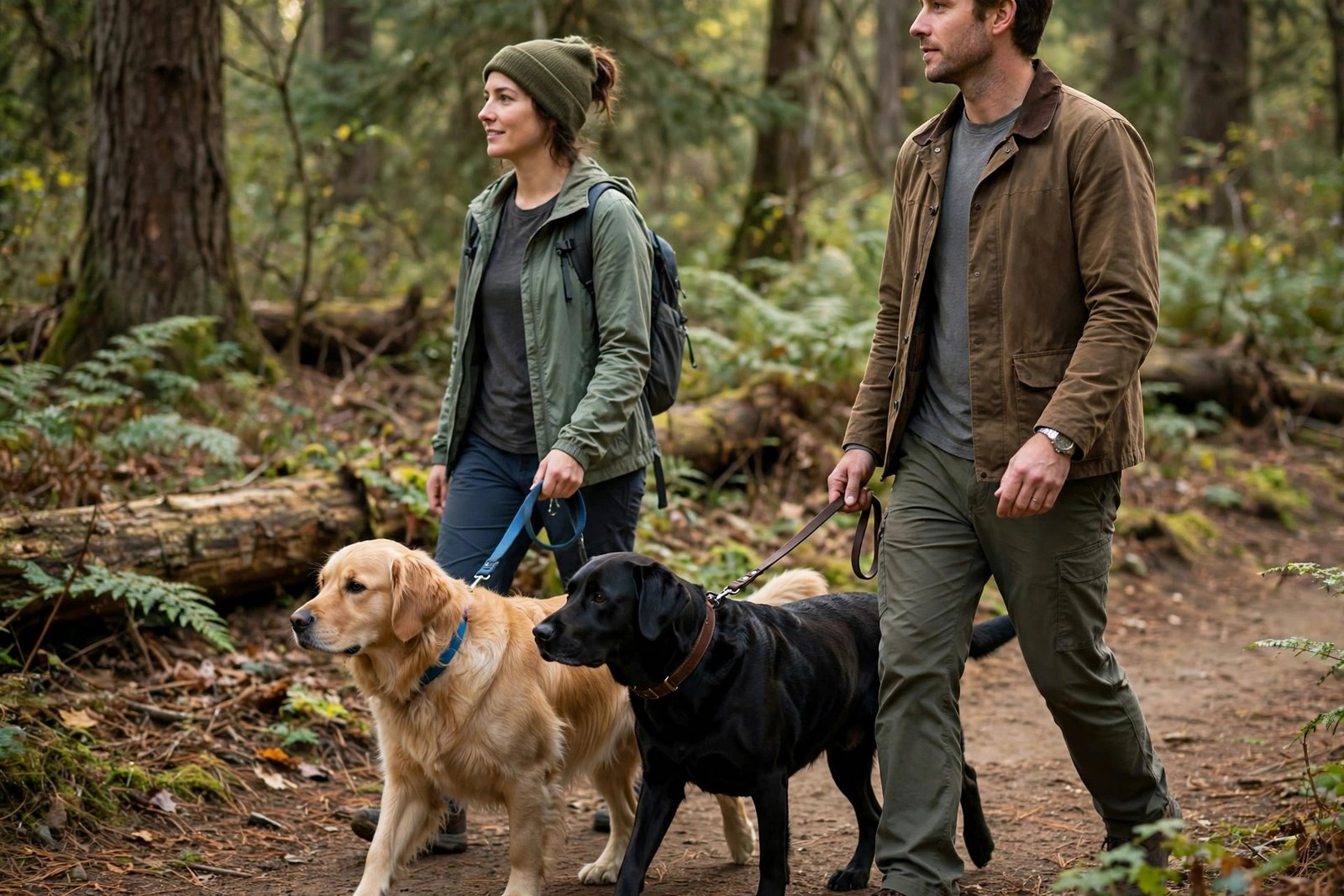
The Parallel Walk Method: The Gold Standard
If you learn one technique from this guide, make it this one. The parallel walk is what professional trainers use, and it works because it lets dogs get used to each other gradually, without any social pressure at all.
Step 1: Start at a distance. With the other owner, begin walking in the same direction, about 20 to 30 feet apart. No greetings, no eye contact between the dogs — just two dogs walking the same direction, aware of each other but not interacting. Walk for five to ten minutes like this.
Step 2: Close the gap gradually. If both dogs are relaxed — loose bodies, soft eyes, glancing without fixating — move a little closer, then a little closer. Let the dogs set the pace; some pairs need two minutes, some need twenty. If either dog stiffens, stares, or pulls, increase the distance again.
Step 3: Allow a brief sniff. When the dogs are walking calmly side by side, let them drift toward each other for a short sniff — three seconds is plenty. Then cheerfully call your dog away with a treat. Short and sweet beats long and tense every time.
Step 4: Repeat and extend. A few more brief sniffs, a bit more walking together, and most dogs will settle into easy coexistence. Many will start offering play signals — play bows, bouncy movements — which is your green light that the introduction worked.
The beauty of this method: nothing dramatic ever has to happen. Just two dogs discovering the other is boring — which in dog social life is the highest compliment.
Reading Body Language During Introductions
While the dogs are getting acquainted, your job is to watch — really watch — what their bodies are saying. Here is the quick translation guide:
Relaxed and happy: loose, wiggly body; soft, squinty eyes; ears in a neutral position; tail wagging in wide sweeps (not just the tip); play bows; curved approaches. This dog is having a fine time. Let it continue.
Mildly unsure: lip licking, yawning, turning the head away, sniffing the ground suddenly. These are calming signals — the dog’s way of saying “no pressure, please.” Give more space and more time. This is normal and not a problem.
Uncomfortable — intervene: stiff, frozen body; hard stare fixed on the other dog; closed mouth with lips pushed forward; tail held high and vibrating, or tucked tight; raised hackles along the shoulders. Any of these means the dog needs distance now. Calmly increase space between the dogs, redirect with a treat, and do not push the greeting.
One signal confuses almost every owner: the shake-off. A dog that suddenly shakes its whole body as if wet is resetting — a shake-off after a greeting usually means “that was a bit intense, I am letting it go.” It is a good sign, and you will notice it everywhere once you know it.

Common Mistakes That Spark Trouble
Letting leashes go tight. The single most common error. A tight leash restricts movement and telegraphs your anxiety straight to your dog. If your dog pulls toward the other dog, do not yank back — instead, move yourself away to create slack, or redirect with a treat.
Forcing the greeting. Dragging your dog toward another dog, or holding your dog in place while the other dog investigates, removes all choice. A dog with no choice and no escape route is a dog under pressure. Let greetings be voluntary and brief.
Meeting head-on. In dog language, a direct head-on approach is confrontational. When you see another dog coming, arc slightly to the side so the approach happens on a curve. It is a small change that makes a big difference.
Ignoring the three-second rule. Most owners let first greetings run too long. The longer two new dogs stand nose-to-nose, the more tension builds. Three seconds, then “let’s go!” with a treat. You can always allow another sniff. You cannot easily undo the tension of a greeting that went on too long.
Introducing when one dog is already over threshold. If your dog is already barking and lunging at fifty feet, that is the moment for distance, not introduction. Truly reactive dogs need a slower plan, and my puppy socialization guide covers the gradual desensitization approach for nervous greeters of any age.
Introducing a New Dog at Home
Bringing a second dog home, or introducing your dog to a visitor’s dog in your house, deserves extra care — because now territory is involved. The resident dog has opinions about its space, and those opinions are legitimate.
Do the first meeting outside, on neutral ground, using the parallel walk method. Let the dogs get comfortable before anyone crosses your threshold. When you do go inside, walk them in together rather than bringing the new dog into a house where the resident dog is waiting at the door — that doorway moment is prime guarding territory.
Inside, manage resources for the first few weeks: feed the dogs separately, pick up high-value toys and chews, and give each dog its own resting space. Most multi-dog friction is not about personality — it is about resources. Remove the competition and most dogs sort out the rest themselves.
Supervise all interactions for the first couple of weeks, and do not leave the dogs alone together until you have seen consistent relaxed behavior. Trust builds faster when nobody is ever put in a position to rehearse a conflict.
Frequently Asked Questions
Should I let my dog greet every dog we meet on walks?
No — and this surprises many owners. A dog that greets every stranger learns other dogs are the most exciting thing on every walk, which makes leash manners much harder. Calmly passing other dogs without interaction is perfectly fine — actually preferable. Save greetings for planned, controlled introductions.
My dog barks and lunges at other dogs. Can I still do introductions?
Yes, but start much further away and move much more slowly. A reactive dog needs the parallel walk at a distance where it can notice the other dog without exploding — sometimes across a field. Reward calm behavior there over many sessions before closing the gap. If your dog cannot stay under threshold at any reasonable distance, work with a qualified force-free trainer first. Reactive dogs make enormous progress with the right plan.
How long should a first greeting last?
About three seconds. Let the dogs sniff briefly, then cheerfully call them apart with a treat. Short greetings prevent tension from building and leave both dogs wanting more rather than wishing it would end. You can allow several short greetings in a row — the brevity is the point, not the number.
Is it better to introduce dogs on leash or off leash?
For safety, start on leash — but on LOOSE leashes, with plenty of space. Off-leash introductions in a secure area can actually go more smoothly because dogs can move naturally, curve their approaches, and increase distance freely. But off-leash is only appropriate in a safely enclosed space with dogs whose recall is reliable and whose owners are attentive. When in doubt, leashed and loose beats off-leash and chaotic.
What if the dogs just do not like each other?
That happens, and it is okay — not every dog has to be friends with every other dog. If after several calm attempts one or both dogs consistently show hard stares, stiffening, or growling, accept it and manage the relationship with distance rather than forcing friendship. Many such dogs coexist peacefully on parallel walks without becoming playmates. For barking specifically, my guide to why dogs bark so much helps decode what the noise means.
Can I introduce my puppy to older dogs?
Yes — well-chosen older dogs are wonderful teachers for puppies, calmer and clearer with corrections. Choose tolerant, puppy-savvy adults, keep sessions short, and let the older dog opt out. Just make sure your puppy’s vaccinations are on track before meeting unfamiliar dogs.
[…] fine to allow the occasional controlled greeting, but make most walks about walking. (See how to introduce dogs properly for the right way to handle the greetings you do […]
[…] an owner. If you’re still learning how your dog interacts with unfamiliar dogs, our guide on introducing your dog to other dogs covers the body language […]
[…] loose leashes, and the freedom for either dog to walk away. There’s a fuller walkthrough of introducing dogs to each other properly if you reach that stage. But there’s no rush — plenty of dogs live happy lives […]