


Leash Reactivity: Why Your Dog Barks at Other Dogs on Walks
Picture the scene: you’re enjoying a peaceful walk when another dog appears down the sidewalk — and your dog instantly transforms into a barking, lunging whirlwind at the end of the leash. If that sounds familiar, you’re dealing with leash reactivity: one of the most common behavior issues dog owners face, and one of the most misunderstood.
The good news: it’s very workable. The important part is understanding what’s actually going on in your dog’s head, because the fix depends on the cause.
Quick Tips
- Leash reactivity is usually frustration or fear, not “aggression” or dominance — the cause shapes the fix.
- The leash itself is part of the problem: it removes the dog’s ability to choose distance, which raises stress.
- Work under your dog’s threshold — far enough from triggers that they can still think and take treats.
- Reward calm behavior around other dogs; don’t punish the barking.
- Manage walks strategically: cross the street, turn around, and walk at quieter times while you train.
- For intense cases or any biting history, work with a qualified professional trainer or behaviorist.
What Leash Reactivity Actually Is
Leash reactivity is an over-the-top reaction — barking, lunging, growling, spinning, whining — triggered by something the dog encounters while on leash, most commonly other dogs. The key word is “on leash”: many reactive dogs are perfectly sociable off leash. The leash changes the equation.
Think about it from the dog’s perspective. Off leash, a dog who feels uneasy about an approaching dog has options: curve away, increase distance, sniff and move on. On leash, those options vanish. For a dog feeling big emotions — excitement, fear, frustration — the leash traps those emotions with nowhere to go, and they explode outward as barking and lunging.
This is why labeling a reactive dog as “aggressive” misses the point. Most leash-reactive dogs aren’t trying to start a fight — they’re having an emotional reaction they don’t know how to handle, in a situation where their normal coping tools have been taken away.
The Main Causes: Frustration vs. Fear
Reactivity generally comes from one of two emotional roots, and figuring out which one drives your dog’s behavior matters because the training approach differs.
Frustration-based reactivity is the more common of the two, especially in young, social, high-energy dogs. These are the dogs who desperately want to get to the other dog, and the leash is standing in the way. The barking is essentially a tantrum. You’ll often see whining mixed in, forward-leaning body language, and a dog who — if actually allowed to greet — is friendly, if rude and overexcited.
Fear-based reactivity looks similar but comes from the opposite emotion. These dogs find other dogs scary, and the barking and lunging is a distance-increasing strategy: “Stay away from me!” The body language tells the story: tucked tail, weight shifted backward, barking while retreating.
Many dogs are a mix of both. The distinction matters for one reason: with frustration, you’re teaching the dog that calm behavior around other dogs pays off; with fear, you’re additionally working to change the emotional response from “scary” to “neutral.” Both approaches share the same foundation.
First: Rule Out Pain and Health Issues
Before assuming a behavior problem, consider whether something physical is going on. A dog who suddenly becomes reactive — especially one whose behavior changed abruptly — may be in pain. Sore joints or ear infections can make a dog far less tolerant of surprises on walks.
This isn’t a diagnosis, just a sensible first step: if the reactivity is new, sudden, or much worse than it used to be, mention it to your vet. General wellness is the foundation everything else builds on, and training can’t fix a problem that’s actually medical.
Management: Making Walks Livable Right Now
Training takes weeks to months. You still have to walk your dog tomorrow. So the first practical step is management — arranging life so your dog has fewer explosive reactions while you work on the underlying issue. Every reaction your dog practices is a repetition that strengthens the habit, so reducing the number of blow-ups isn’t avoiding the problem; it’s part of solving it.
Create distance. Distance is your best friend. Most reactive dogs have a threshold distance — far enough away that they notice the other dog but can still think and take treats. Learn roughly where your dog’s threshold is and live outside it: cross the street, step behind a parked car, turn down a side street.
Walk at quieter times. Early mornings and late evenings usually mean fewer dogs on the sidewalks — and fewer encounters means fewer reactions. Stress stacks up over the day, so a calm morning helps the evening walk too.
Choose your routes. Wide-open areas where you can see other dogs coming and create distance beat narrow trails with blind corners.
Use the right equipment. A well-fitted harness gives you better control and is more comfortable for a lunging dog than a collar. Avoid choke chains, prong collars, and shock collars for reactivity — adding pain or fear to an already emotional dog tends to make things worse. If you’re unsure about the vocalization itself, understanding why dogs bark can help you read what’s driving it.
The Training Foundation: Changing How Your Dog Feels
The core of reactivity training is changing your dog’s emotional response to other dogs — from “huge scary/exciting thing” to “boring background detail that predicts treats.” In plain terms, it looks like this:
Find a spot where other dogs pass at a distance. When your dog notices another dog but is still calm enough to take a treat, reward generously. The sequence matters: dog appears → treats rain from the sky. Over many repetitions, the dog’s brain rewires the association: other dogs start feeling less intense.
The critical rule: stay under threshold. If your dog is barking, lunging, or too fixated to take a treat, you’re too close. Add distance until your dog can notice the trigger and still respond to you. Progress looks like the threshold distance gradually shrinking over weeks.
- Short sessions. Ten to fifteen minutes of focused work is plenty. End while your dog is still successful.
- High-value rewards. Bring the good stuff — regular kibble won’t cut it with another dog in view.
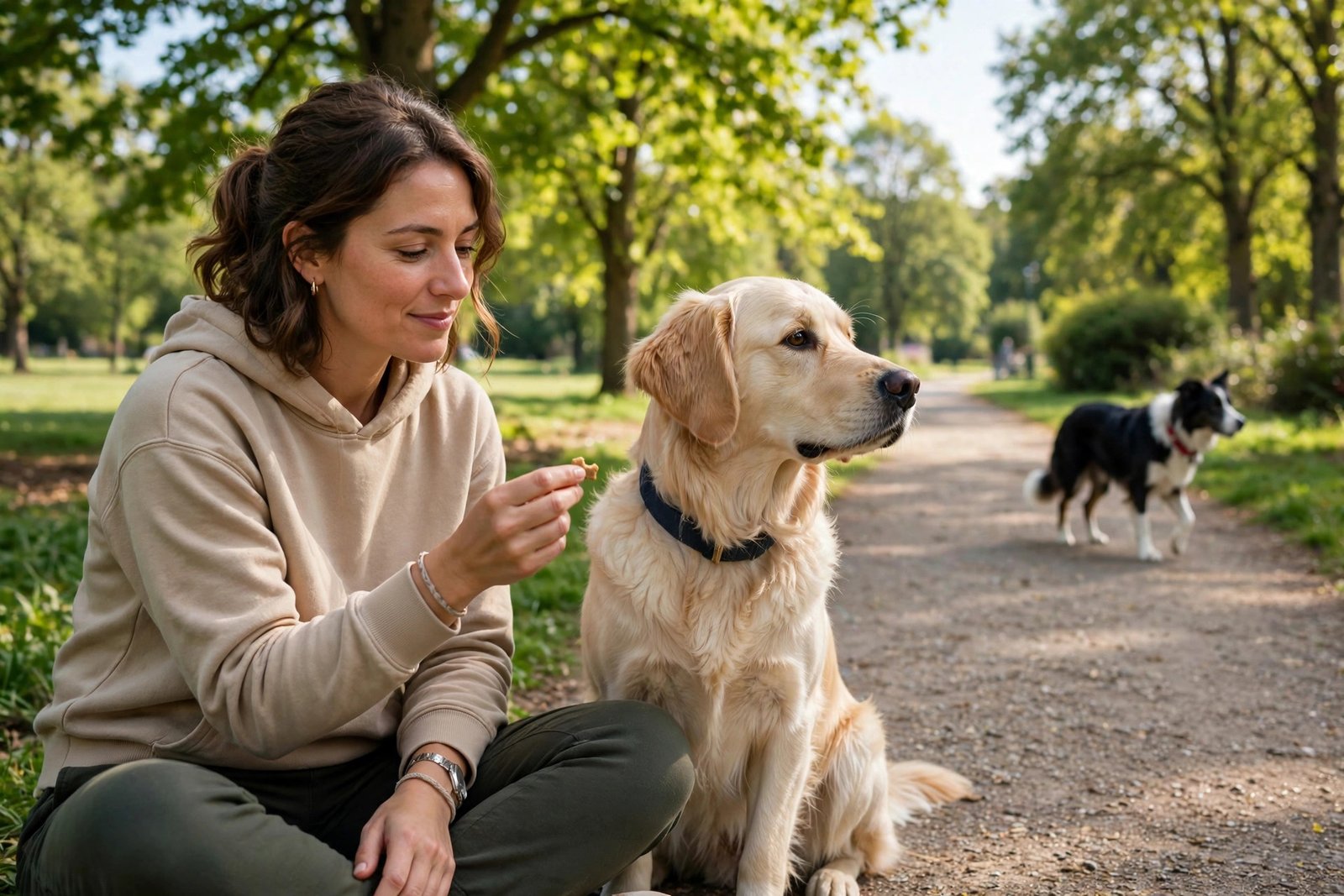
- Reward the check-in. Let the dog notice the trigger, then reward the moment they glance at the other dog and check back in with you. That check-in is the behavior you’re building.
- Don’t punish reactions. Scolding or leash jerks add stress to an already stressed animal and can make the underlying emotion worse.
Teaching an Alternative: The “Find It” and U-Turn Games
Alongside the emotional work, it helps enormously to give your dog specific alternative behaviors to do when they spot another dog. Two of the most useful:
“Find it.” Toss a treat into the grass and say “find it!” Most dogs love this sniffing game, and sniffing is naturally calming — it lowers arousal and gives the dog a job to do instead of fixating. Practice it at home first, then use it on walks when you spot a trigger at a distance.
The emergency U-turn. Teach your dog that when you say “this way!” and turn, following you pays handsomely. Practice on boring stretches until the turn is automatic, then deploy it when you spot a trigger too close for comfort. A smooth U-turn beats a dragged, protesting retreat — and it keeps you both under threshold.
What About Dog-to-Dog Introductions?
One common question: “Should I let my reactive dog meet other dogs to get used to it?” Generally, no — at least not as a training strategy. On-leash greetings are awkward even for calm dogs, and for reactive dogs they tend to rehearse the explosive behavior rather than fix it.
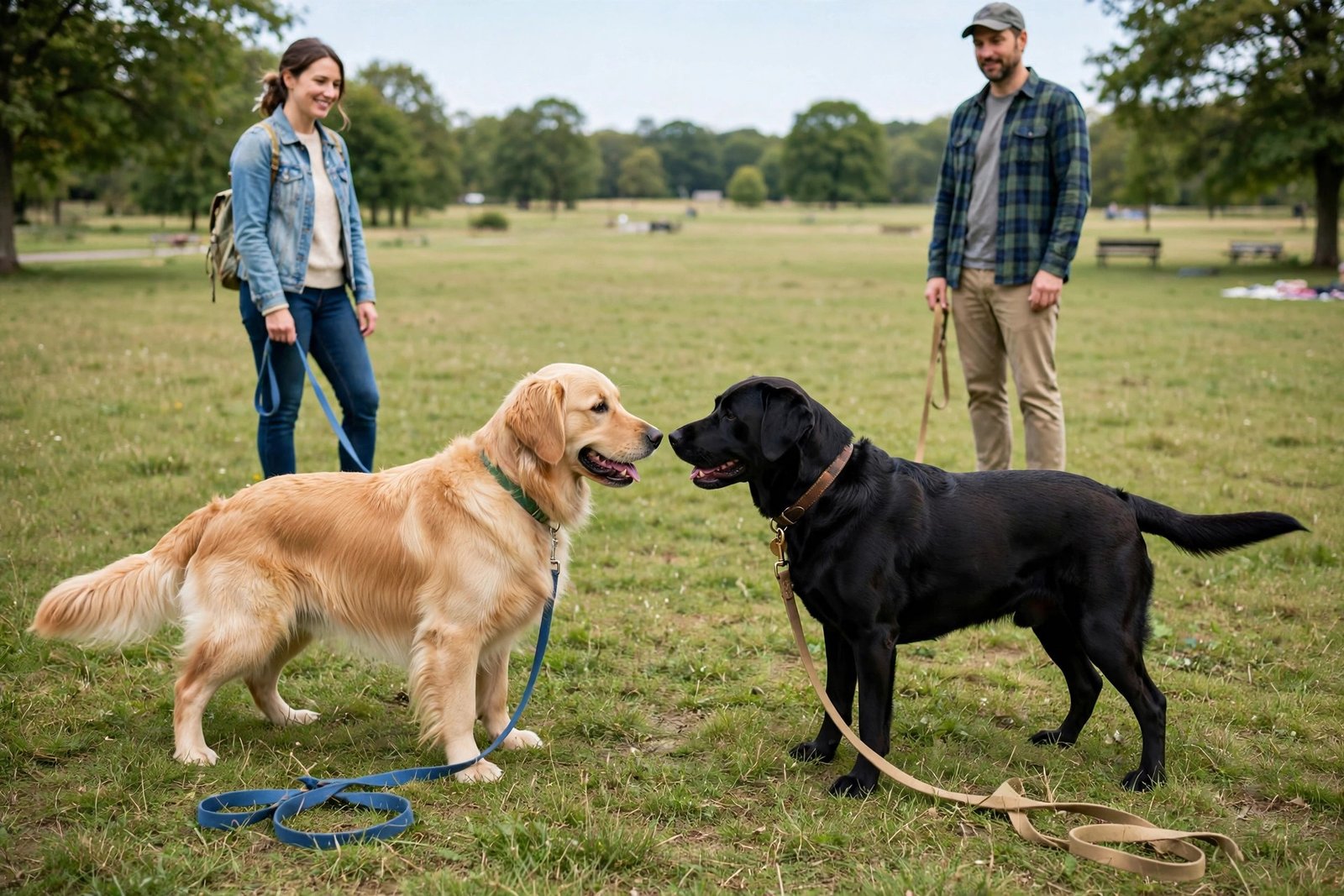
If and when your dog is ready for social time, do it right: neutral territory, loose leashes, and the freedom for either dog to walk away. There’s a fuller walkthrough of introducing dogs to each other properly if you reach that stage. But there’s no rush — plenty of dogs live happy lives without greeting every stranger-dog on the street.
When to Get Professional Help
There’s no shame in calling in a professional — reactivity is one of the most common reasons owners seek trainers. Consider it if your dog’s reactions are intense and not improving after several weeks of consistent work, if there’s any bite history, or if you’re feeling overwhelmed.
Look for a trainer or behaviorist who uses reward-based methods and has specific experience with reactivity. Be cautious of anyone who guarantees a quick fix or wants to use punishment-based tools — those carry real risks with fearful or frustrated dogs.
What Progress Looks Like (Be Patient)
Reactivity training isn’t linear, and it isn’t fast. A realistic timeline is weeks to see early improvements and months for substantial change. “Improvement” usually means smaller, quieter victories: noticing a dog across the street and looking back at you for a treat. Recovering faster after a reaction that does happen.
Bad days will happen — a surprise off-leash dog, a too-close encounter in a narrow hallway. Setbacks are part of the process, not proof it’s failing. What matters is the overall trend over weeks, not any single walk.
Frequently Asked Questions
Is my dog aggressive because they bark at other dogs on leash?
Usually not. Most leash reactivity comes from frustration or fear, not genuine aggression — many leash-reactive dogs are friendly off leash. Any dog with a bite history should be assessed by a professional.
Will my dog grow out of leash reactivity?
Probably not on its own — every reaction rehearses the habit. But it’s very trainable at any age with consistent work, though long-standing patterns take longer to undo.
Should I let my reactive dog greet other dogs on walks?
Generally no, while you’re working through the reactivity. On-leash greetings tend to rehearse the explosive behavior. Focus on calm coexistence at a distance first.
Do prong collars or shock collars help with reactivity?
They’re not recommended. These tools suppress the outward behavior without changing the underlying emotion — and can make fear-based reactivity worse. Reward-based training addresses the root cause instead.
How long does it take to fix leash reactivity?
Expect weeks for early improvement and a few months for solid progress. Consistency matters more than intensity — short regular sessions beat occasional marathon ones.
My dog is fine at the dog park but reactive on leash. Why?
This is the classic pattern: off leash, your dog can move freely and create distance. On leash, all of that is gone, and the trapped feeling turns excitement or mild unease into an explosion.
[…] around triggers, you may be dealing with leash reactivity rather than ordinary distractibility. Our dog leash reactivity guide covers that specific challenge in depth, including when to bring in a professional […]