
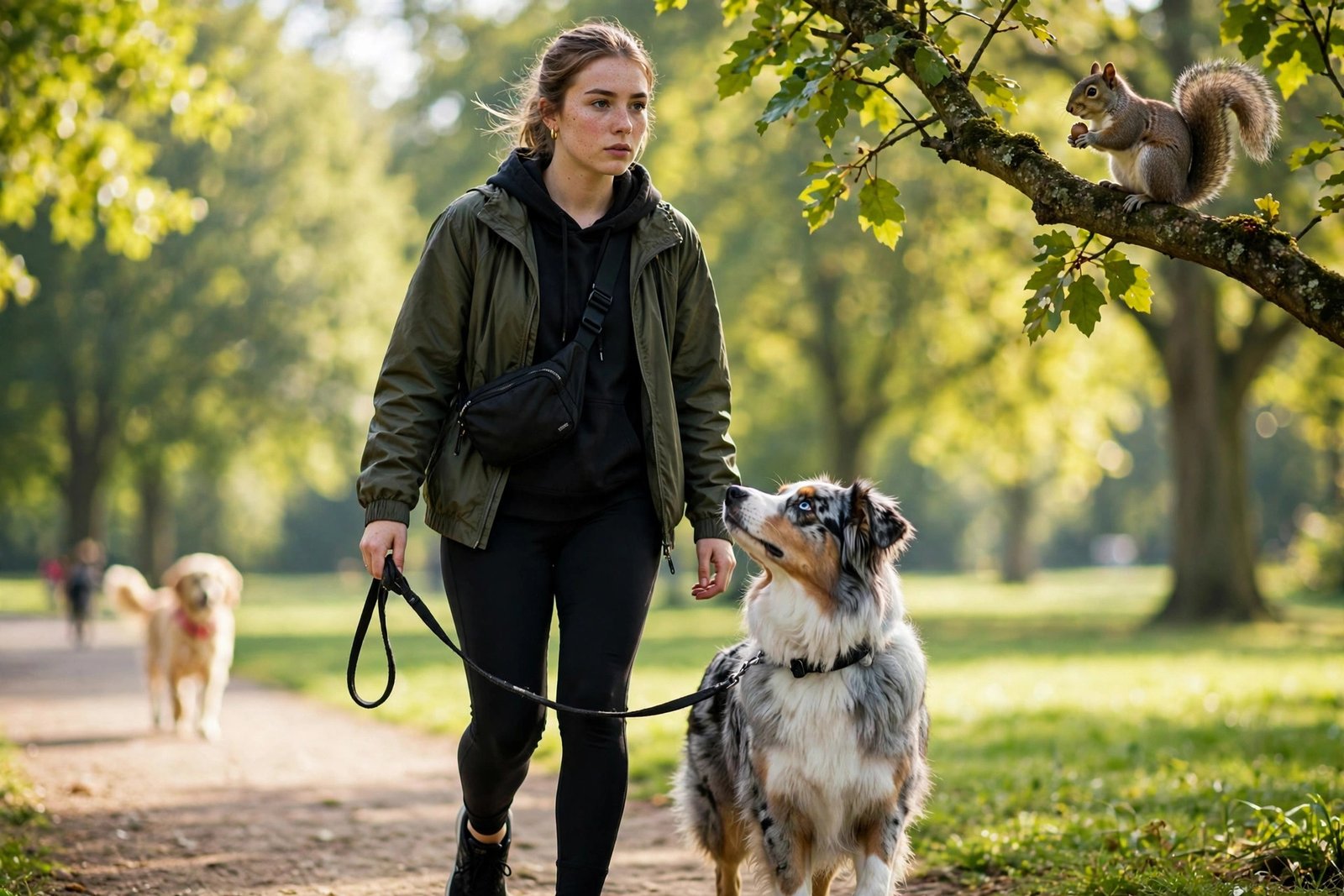

How to Train Dog to Ignore Distractions on Walks
One minute your walk is peaceful; the next, your dog has spotted a squirrel, another dog, or a kid on a scooter — and your arm is nearly yanked out of its socket. If you want to train dog to ignore distractions on walks, the good news is that focus around distractions is a skill, not a personality trait. Even the most excitable dogs can learn to notice the world without losing their minds over it.
The secret isn’t stricter control — it’s teaching your dog that checking in with you is more rewarding than lunging at everything interesting. That takes a plan: the right distance, the right rewards, and practice that gets gradually harder. This guide gives you seven practical techniques that work together to turn chaotic walks into calm ones.
Quick Tips
- Distance is your best friend — start far from distractions and close the gap slowly.
- Reward your dog for voluntarily checking in with you, even when unasked.
- Teach a “watch me” focus cue at home before using it on walks.
- Use high-value treats (cheese, chicken) for distraction work — kibble won’t cut it.
- Keep your leash loose; tension travels down the leash and winds your dog up.
- End every walk with a success, even if it means crossing the street to create distance.
Why Distractions Hijack Your Dog’s Brain
To your dog, the world is the most interesting place imaginable. Squirrels trigger a deep chase instinct; other dogs trigger social excitement; new smells trigger a whole investigation. When your dog is under-stimulated or under-exercised, these triggers hit even harder — the walk becomes the highlight of a boring day, and your dog tries to squeeze maximum excitement out of it.
Understanding this changes your approach. You’re not fighting disobedience; you’re competing with the environment for your dog’s attention. That means your job is to become more interesting than the squirrel — not through force, but through better pay. Dogs repeat what pays best. If checking in with you earns chicken and lunging earns nothing, most dogs eventually choose you. It’s economics, not dominance.
One important distinction: if your dog doesn’t just get excited but reacts with intense barking, lunging, or panic around triggers, you may be dealing with leash reactivity rather than ordinary distractibility. Our dog leash reactivity guide covers that specific challenge in depth, including when to bring in a professional trainer.
Technique 1: Master Distance First
Distance is the single most powerful tool in distraction training. Every dog has a threshold distance — close enough to notice a trigger, far enough to still think and respond to you. Inside that threshold, your dog’s brain is flooded and learning stops. Your entire job is to work outside it and shrink it gradually.
In practice: when you spot another dog across the park, don’t march straight toward it. Arc wide, cross the street, or duck behind a parked car. Reward your dog for noticing the trigger calmly and looking back at you. Over days and weeks, that comfortable distance gets smaller. Rushing this step is the number-one reason distraction training fails — if your dog can’t succeed, you’re too close.
Technique 2: Teach “Watch Me” at Home
“Watch me” (or “look”) is your focus cue: your dog makes eye contact with you on request. Teach it in your boring living room first. Hold a treat near your eyes, say “watch me” once, and mark and reward the instant your dog looks at your face. Repeat until your dog whips their head toward you at the word alone. When you train dog to ignore distractions on walks, this cue becomes your steering wheel.
Only then take it outside — starting in your yard, then a quiet street, then busier areas. Ask for “watch me” when you see a distraction at a comfortable distance, reward generously, and release your dog back to sniffing. You’re building a habit: see something exciting, check in with the human, get paid, carry on.
Technique 3: Reward Voluntary Check-Ins
Some of the most powerful training happens when you do nothing at all. On walks, watch for moments when your dog glances at you on their own — mid-sniff, mid-stroll, whenever. Mark it (“yes!”) and deliver a treat. You’re catching and paying the exact behavior you want more of: choosing you without being asked.
Many owners are amazed how quickly this changes walks. Within a week or two of consistent check-in rewards, dogs start offering eye contact constantly — because it has a history of paying out. This is the foundation that makes every other technique easier, and it costs you nothing but a few treats and some attention.

Technique 4: The “Find It” Scatter Game
When a distraction appears and you need your dog’s brain back immediately, “find it” is magic. Toss a handful of treats into the grass beside the path and say “find it!” Your dog’s nose takes over, the sniffing activates their calming system, and the trigger passes by while they’re happily foraging.
This works because sniffing is naturally soothing for dogs — it’s hard to be frantic while doing detailed nose work. Practice “find it” at home first so the cue is solid, then deploy it on walks whenever you need an emergency redirect. It’s not a long-term training plan on its own, but it’s an excellent management tool while the deeper work progresses.
Technique 5: Train the Pass-By Like a Drill
Passing another dog or an exciting trigger on a narrow path is the ultimate test. Treat it like a drill: as you approach, move to the side to create space, ask for a heel or “watch me,” and feed a steady stream of small treats as you pass. The moment you’re clear, praise and release.
Start these drills with easy triggers — a calm dog at a distance, a stationary jogger — and work up to harder ones. If your dog is still learning the basics of walking politely, revisit our guide to leash training a puppy first; loose-leash fundamentals make distraction work dramatically easier. A dog who already walks nicely in boring settings has a head start in exciting ones.
Technique 6: Keep the Leash Loose (Yes, Really)
A tight leash does two bad things: it restricts your dog’s movement, which increases frustration, and it telegraphs your tension straight to your dog. Many owners unconsciously shorten the leash when they see a trigger coming — and the dog reads that as “something exciting is about to happen!”
Practice holding the leash with a relaxed arm and a loose U-shape of slack. If your dog hits the end of the leash, stop or change direction calmly rather than yanking back. It feels counterintuitive, but dogs who learn that leash pressure means “we stop moving forward” start managing their own position — and a dog thinking about leash position is a dog not obsessing over the squirrel.
Technique 7: Exercise the Body, Train the Brain
A dog with unspent energy has a much lower distraction threshold. This doesn’t mean exhausting your dog before every walk (though a quick game of fetch before a training walk helps enormously). It means making sure your dog’s overall exercise and enrichment needs are met — sniffy walks, play sessions, puzzle feeders, training games.
Mental exercise counts double: ten minutes of nose work tires most dogs more than a thirty-minute stroll. A dog whose brain has worked walks calmer and responds to cues faster. If your walks are consistently wild, the answer is rarely more discipline — it’s usually more enrichment.

Your First Week: Train Dog to Ignore Distractions on Walks Step by Step
Theory is nice, but here’s what a realistic first week looks like when you train dog to ignore distractions on walks. Days 1–2: teach or refresh “watch me” indoors, and start rewarding voluntary check-ins on every walk. Days 3–4: add distance work — practice arcing away from triggers and rewarding calm noticing. Days 5–6: introduce “find it” on walks and run a few easy pass-by drills with mild triggers. Day 7: put it all together on a slightly busier route, keeping distances generous.
Expect good days and bad days — progress is rarely a straight line. A brilliant Tuesday can follow a wild Wednesday. Judge progress over weeks, not walks, and the trend will move in the right direction.
Frequently Asked Questions
How long does it take to train a dog to ignore distractions?
If you want to train dog to ignore distractions on walks reliably, most owners see noticeable improvement within two to four weeks, but truly reliable focus around major triggers can take months — especially for adolescents or high-prey-drive breeds. It depends on your consistency, your dog’s temperament, and how gradually you raise difficulty.
Should I use a special collar or harness for distraction training?
A well-fitted front-clip harness or head halter can give you better management while you train, but no tool replaces training itself. Avoid anything that works through pain or intimidation — a dog that’s worried about their collar isn’t learning to make good choices, they’re just suppressing behavior out of fear, and suppressed behavior tends to resurface. If you’re unsure what equipment suits your dog, a certified trainer can help you choose.
My dog is fine until they see another dog, then they explode. Is this normal?
It’s very common, especially in social, excitable dogs — but “common” and “fine to ignore” aren’t the same thing. Start with the distance techniques in this guide and see if gradual exposure helps. If your dog’s reactions are intense (lunging, barking, inability to take treats near triggers) or getting worse over time, that’s beyond basic distractibility — check our leash reactivity guide and consider working with a qualified professional.
Can I train my dog to ignore distractions off-leash?
Off-leash reliability around distractions is an advanced skill that comes much later — think months of solid on-leash work first, plus a bombproof recall. Until then, a long training line (20–30 feet) in safe open areas gives your dog freedom to practice while you keep a safety net. Never go off-leash around triggers until your dog’s focus is proven, not just hoped for.
Why does my dog listen at home but ignore me on walks?
Because home is easy mode and walks are expert mode. Dogs don’t generalize well — a cue learned in the living room needs to be systematically re-taught in the yard, on a quiet street, and then in busier places. If your dog “knows” a cue at home but not outside, they don’t really know it yet; they know the living-room version. Retrain each step outdoors and the reliability will follow.