
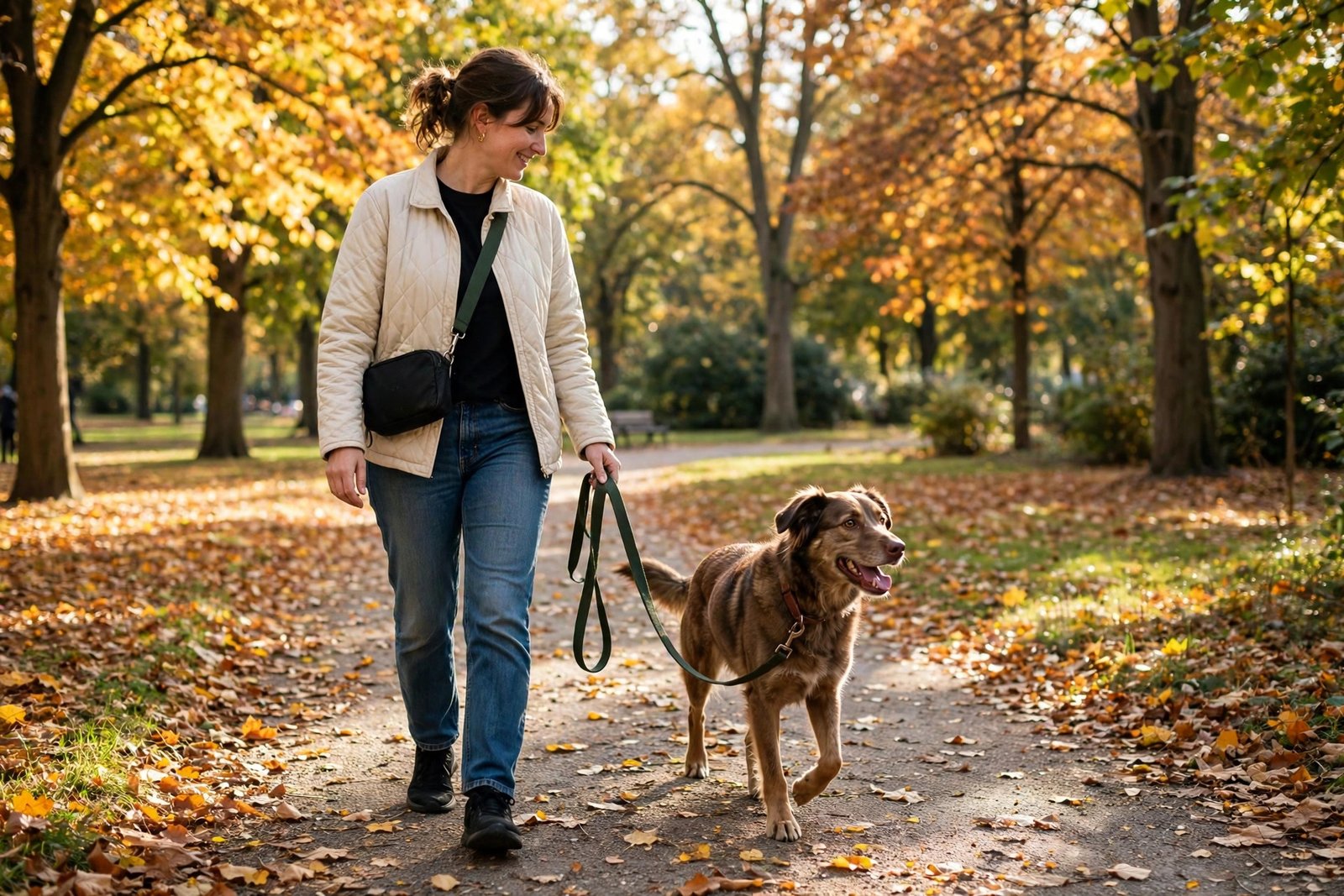

Best Everyday Leashes for Dog Walks: Finding the Best Leash for Everyday Dog Walks
Of all the gear you buy for your dog, the humble leash probably gets used more than everything else combined. Two walks a day, every day, for years — that’s thousands of outings on a single strap of nylon, leather, or rope. So it pays to get it right. The best leash for everyday dog walks isn’t the fanciest or the most expensive one; it’s the one that feels good in your hand, keeps your dog secure, and makes the daily walk something you both look forward to.
Walk into any pet store and the leash wall is overwhelming: flat nylon in forty colors, thick leather, climbing rope, bungee, hands-free waist belts, retractable reels. Each type has genuine strengths and real trade-offs, and the right choice depends on your dog’s size, strength, and walking manners — plus your own preferences. This guide breaks down every major leash type, what to look for in materials and hardware, and how to pick a daily driver you’ll love for years.
Quick Tips
- For most dogs, a 4–6 foot flat or rope leash is the best everyday length — enough freedom, full control.
- Match leash strength to your dog: a leash rated for a 15-pound dog won’t hold a 70-pound puller.
- Check the clasp quality — a cheap bolt snap on a strong leash is the weak link that fails first.
- Leather needs occasional conditioning; nylon and rope just need a wash when dirty.
- Skip retractable leashes for busy streets and untrained pullers; a fixed-length leash gives you far more control.
- Replace any leash with fraying, cracked leather, or a sticky clasp — failures happen at the worst moments.
What Makes the Best Leash for Everyday Dog Walks
A great everyday leash does three things well: it keeps your dog safely attached to you, it’s comfortable to hold for thirty minutes or more, and it survives daily use. That sounds obvious, but plenty of leashes fail at one of the three — the gorgeous leather leash with a flimsy clasp, the cheap nylon that burns your palm when your dog lunges, the rope leash whose knot comes undone after six months.
Length is the first decision. Four to six feet is the sweet spot for daily walks: short enough to keep your dog out of traffic and other dogs’ faces, long enough to let them sniff. Shorter traffic leads (around two feet) are handy add-ons for crowded sidewalks, and longer lines have their place for training — but for the standard neighborhood walk, six feet is the classic for a reason.
Width and weight matter more than most people expect. A leash that’s too heavy for a small dog drags on their neck and discourages walking; one that’s too thin for a big strong dog is hard to grip when they pull. As a rough guide, small dogs do well with half-inch to five-eighth-inch leashes, medium dogs with three-quarter-inch, and large strong dogs with a full inch or thick rope.
Flat Nylon and Polyester Leashes
Flat nylon leashes are the default for a reason: they’re affordable, lightweight, strong for their weight, and come in endless colors and patterns. A good quality flat nylon leash with solid stitching and a sturdy clasp will serve most dogs perfectly well for years, and at their price you can keep a spare without thinking twice.
The downside is hand feel. Thin nylon can burn or cut into your palm if your dog lunges suddenly, and cheaper webbing frays at the edges over time. Look for leashes with soft, tightly woven webbing and reinforced stitching at the handle loop and clasp — those are the stress points where cheap leashes fail. Reflective stitching is a genuinely useful feature if you walk before sunrise or after dark.
Polyester webbing is nylon’s slightly classier cousin: it holds color better, resists stretching when wet, and often feels a bit softer. Either way, toss the leash in a laundry bag and machine wash it when it gets grimy — a clean leash is a more pleasant leash to hold every single day.
Leather Leashes: The Long-Term Investment
Ask longtime dog people what they’d buy if they could only have one leash, and an surprising number say leather. A quality leather leash softens with use until it feels like an extension of your hand, and it can last a decade or more with basic care. There’s no break-in mystery either — it just gets better the more you use it.

The catch is that quality varies enormously. Good leather leashes use full-grain or top-grain leather with solid brass or stainless hardware; cheap ones use thin bonded leather that cracks within a year. Expect to pay more for the real thing, and condition the leather occasionally with a proper leather balm to keep it supple — especially if you walk in rain.
Leather isn’t ideal for every dog, though. Dogs that chew their leash will destroy an expensive leather one just as happily as a cheap nylon one, and leather gets heavy and slippery when soaked. For a chewer or a swim-every-day dog, rope or biothane (more on that below) usually makes more sense.
Rope and Climbing-Rope Leashes
Rope leashes — the kind made from actual climbing rope with a knotted or spliced handle — have a devoted following, and it’s easy to see why. They’re incredibly strong for their weight, the round profile is comfortable to grip, and the slight stretch in the rope absorbs the shock of a sudden lunge better than flat webbing. For strong pullers, that shock absorption is genuinely easier on both your shoulder and your dog’s neck.
The hardware on rope leashes deserves a close look. The best ones use locking carabiners or heavy-duty bolt snaps rated well above your dog’s weight. Avoid rope leashes where the rope is just glued into the clasp — sewn or spliced attachments are far more reliable. And check the knot or splice at the handle periodically; it’s the one wear point unique to this style.
One practical note: rope leashes collect dirt and can be awkward to coil neatly. They also aren’t the best choice for very small dogs, where the rope’s thickness and weight are disproportionate. But for medium and large dogs, a good rope leash is one of the most comfortable everyday options you can buy.
Biothane and Waterproof Leashes
Biothane is a coated webbing that looks and feels a bit like leather but behaves like plastic: it’s waterproof, it doesn’t absorb smells, mud wipes right off, and it won’t get stiff in cold weather. If your dog swims, hikes in mud, or just lives somewhere rainy, a biothane leash is close to perfect for daily use.
They’re also easy to clean — a quick wipe or rinse and you’re done — which makes them popular with owners of dogs that roll in interesting smells. The main trade-off is that biothane doesn’t soften and mold to your hand the way leather does; it feels the same on day one hundred as day one. Some people love that consistency, others find it a bit plasticky. Try holding one before you commit if you can.
Hands-Free and Waist Leashes
Hands-free leashes that clip around your waist or across your body are brilliant for runners, hikers, and anyone who needs their hands for a stroller, a coffee, or a second dog. The bungee section in most designs absorbs pulling shock, which makes jogging with a dog noticeably more comfortable.
They’re not for every situation, though. On a busy street, a waist leash gives you less precise control than a hand-held leash, and a sudden lunge from a big dog transfers straight to your hips. Many owners use a hands-free leash for trails and parks and switch to a standard hand-held leash for city sidewalks — a two-leash system that covers all bases.
A Note on Retractable Leashes
Retractable leashes are everywhere, and they do have legitimate fans — they give dogs more roaming room on open paths. But for everyday walks, most trainers recommend against them. The thin cord can cause nasty friction burns, the locking mechanism is a single point of failure, and the constant tension teaches dogs that pulling is simply how walks work.
If you do use one, reserve it for open spaces with no traffic, keep the lock engaged near roads, and never use it with a dog that pulls hard or lunges. For the daily neighborhood walk, a fixed-length leash gives you better communication with your dog and far fewer things that can go wrong.

Matching Your Leash to Collar or Harness
The leash is only half the system — what it clips to matters just as much. A leash clipped to a flat collar works for calm dogs that don’t pull, but for pullers, a front-clip harness distributes pressure across the chest instead of the neck and gives you better steering. Our collar vs. harness comparison walks through which setup suits which dog.
Also check clasp compatibility: a heavy brass bolt snap is overkill on a cat-sized collar ring and can actually weigh down a small dog’s collar, while a tiny clasp on a big dog’s harness is a failure waiting to happen. The clasp should be proportionate to the dog and the attachment point, and it should open and close smoothly every single time.
If you’re starting with a young dog, the leash you buy now should be light and easy to manage — heavy hardware discourages a puppy from moving freely. Pair a lightweight leash with positive training early, and our guide on how to leash train a puppy will help you build good walking habits from day one.
Frequently Asked Questions
What length leash is best for everyday walks?
Four to six feet works for most dogs and most situations. It gives your dog room to sniff and explore while keeping them close enough to manage around traffic, other dogs, and distractions. Shorter traffic handles are useful add-ons for crowded areas.
Is a harness or collar better with an everyday leash?
For dogs that pull, a harness — especially a front-clip design — is usually more comfortable and gives you better control. Calm dogs that walk on a loose leash do fine on a flat collar. It really depends on your individual dog’s walking style.
How do I stop my leash from hurting my hands?
Choose a leash with a comfortable profile — round rope or padded handles beat thin flat webbing when a dog pulls. Gloves help in the short term, but the real fix is loose-leash training so there’s less tension on the leash in the first place.
When should I replace my dog’s leash?
Replace it at the first sign of fraying webbing, cracked leather, a stiff or sticky clasp, or worn stitching at the handle or clasp. A leash failure usually happens at the worst possible moment, so inspect yours every month or so.
Are expensive leashes worth it?
Up to a point, yes. The jump from the cheapest leash to a mid-range one with solid hardware and good stitching is the most worthwhile upgrade. Beyond that you’re paying for premium materials like full-grain leather, which last longer and feel better but aren’t necessary for every dog.
Can I use the same leash for two dogs?
A coupler or splitter attachment lets you walk two calm dogs on one leash, and it works well for pairs that walk nicely together. For dogs that pull in different directions, though, two separate leashes give you much better control.