

Best Puzzle Feeders for Cats: Top Picks for Every Budget
If your cat inhales dinner in ninety seconds flat and then spends the evening bouncing off the furniture, mealtime might be part of the problem. In the wild, cats work for their food — stalking, pouncing, and problem-solving. A bowl of kibble sitting on the floor asks for none of that. That is where the best puzzle feeders for cats come in: they turn eating back into an activity, making your cat think, bat, and forage for every bite.
Puzzle feeders are one of the simplest upgrades you can make for an indoor cat. They slow down fast eaters, burn mental energy, and add a little enrichment to an otherwise uneventful day. This guide explains the main types, what to look for when you shop, and our top picks for different cats and budgets — no prior experience needed.
Quick Tips
- Puzzle feeders make cats work for food, which slows fast eaters and fights boredom.
- Start easy: a simple rolling treat ball is the best first puzzle feeder for most cats.
- Match difficulty to your cat — too hard and they will give up; too easy and they will get bored.
- Choose feeders that come apart for washing; dried wet food gets gross fast.
- Supervise the first few sessions, especially with enthusiastic paw-swipers.
- Puzzle feeders supplement playtime, they don’t replace it — keep the wand toy in rotation too.
Why Puzzle Feeders Are Worth It for Indoor Cats
Indoor cats live comfortable lives, but comfort can curdle into boredom. A cat that sleeps eighteen hours and eats from a bowl in under two minutes is missing the two activities their brain was built for: hunting and problem-solving. Many owners notice the fallout as scarf-and-barf vomiting, 3 a.m. zoomies, or a cat that begs for food out of sheer lack of anything better to do.
A puzzle feeder addresses the root of that restlessness. Instead of free food, your cat earns kibble piece by piece — batting a ball, fishing treats out of compartments, or nudging a wobbling toy. Meals stretch from one minute to ten or fifteen, which is closer to the pace of a real hunt and gives that busy brain something to do.
There is a digestive angle too. Cats that eat too fast swallow air along with their kibble, and that is a classic recipe for regurgitation shortly after meals. Anything that forces a slower pace — smaller openings, obstacles, rolling dispensing — tends to reduce the post-dinner cleanup. It is not a cure for every vomiting episode (recurring vomiting always deserves a vet visit), but for the simple speed-eater, it helps a lot.
The Main Types of Cat Puzzle Feeders
Shopping for the best puzzle feeders for cats gets easier once you know the handful of designs everything falls into. Most feeders are variations on these five ideas.
Rolling Treat Balls
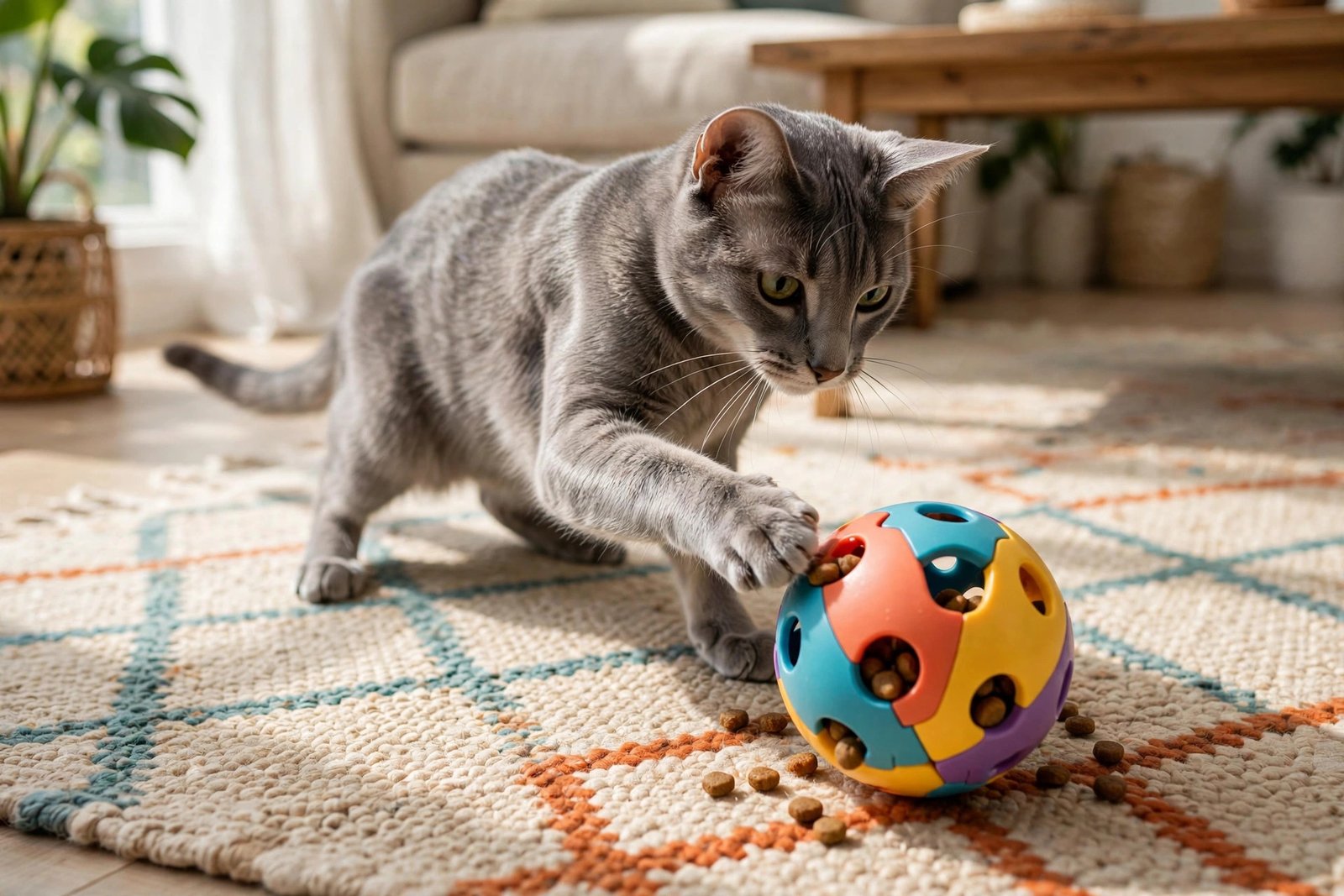
The classic starter: a hollow ball with an adjustable opening that drops kibble as the cat bats it around. Simple, cheap, durable, and genuinely effective. The adjustable opening lets you start generous (easy wins keep a beginner engaged) and tighten it as your cat gets clever.
Stationary Maze Boards
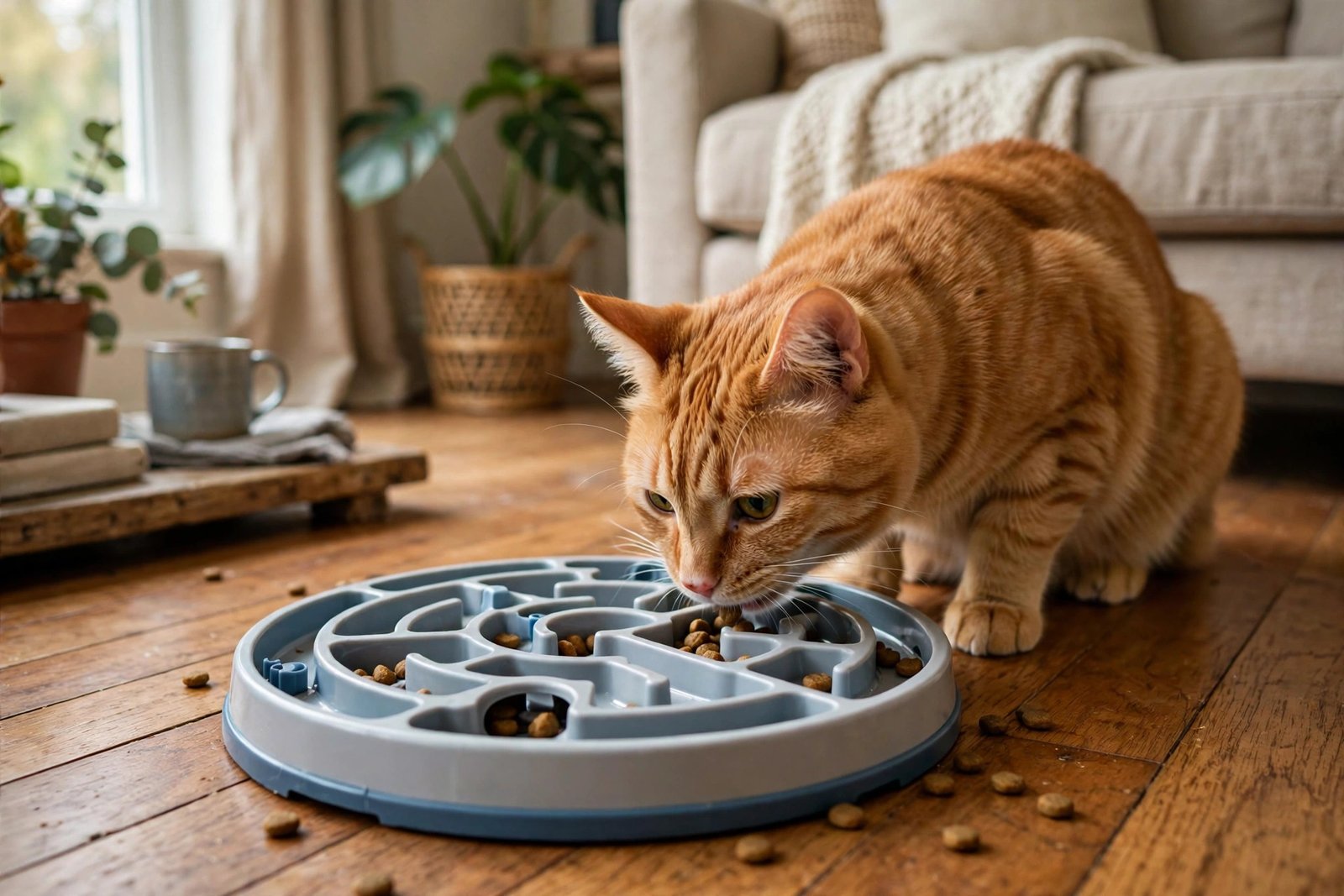
Flat boards or trays with ridges, pegs, and compartments that the cat must fish kibble out of with a paw. These stay put, so they are quieter than balls and good for cats that prefer to sit and work rather than chase. They also double as slow feeders for wet food if the compartments are shallow enough to lick clean.
Wobble and Tumbler Feeders
Weighted toys that rock and wobble, spilling a few pieces of kibble each time the cat paws them. They are sturdier than rolling balls and harder to lose under the sofa. Many cats find the unpredictable wobble extra engaging, though very timid cats can find the movement startling at first.
Snuffle Mats and Foraging Boxes
Fabric mats with folds and pockets where you hide kibble for the cat to sniff out. These lean into the foraging instinct and are wonderfully quiet — a good pick for nighttime use. They suit dry treats best and need regular washing, since crumbs collect in the folds.
Multi-Level Puzzle Towers
Stacked tracks or towers where the cat bats kibble down through levels. Visually fun and great for confident, playful cats. They take up more space and have more parts to clean, so they suit owners who do not mind a slightly bigger commitment.
What to Look for When Choosing One
With the types understood, here is how to judge any individual feeder before you buy.
Difficulty level — and whether it adjusts. This is the single most important feature. A feeder with adjustable openings or removable obstacles grows with your cat. Fixed-difficulty toys are fine once you know your cat’s skill level, but for a first purchase, adjustability removes the guesswork.
Ease of cleaning. You will be washing this thing regularly, especially if you use wet food. Look for feeders that come apart into a few smooth pieces with no tiny crevices. Dishwasher-safe is a bonus. If a design looks like dried food would cement itself into the corners, keep scrolling.
Stability and durability. Cats play rough. A feeder that tips, cracks, or sheds small parts is a non-starter — small detachable pieces are a swallowing hazard. Heavier, well-made feeders survive the enthusiastic cats; flimsy ones become expensive confetti.
Size and kibble compatibility. Check that the openings suit your cat’s usual kibble size. Oversized openings turn a puzzle into a regular bowl; undersized ones jam. If you feed wet food, look specifically for lick-friendly designs rather than dry-kibble dispensers.
Noise level. Hard plastic on tile at 2 a.m. is a real lifestyle consideration. If your cat eats at night, favor fabric, silicone, or rubber designs — or place hard feeders on a rug.
Our Top Picks: Best Puzzle Feeders for Cats by Category
Rather than naming one “winner,” here are the best puzzle feeders for cats grouped by what different cats and owners actually need. Any well-reviewed product matching these descriptions is a solid buy.
Best for Beginners: An Adjustable Rolling Treat Ball
If you buy exactly one puzzle feeder, make it this. A simple ball with a twist-to-adjust opening is inexpensive, nearly indestructible, and easy for cats to understand — most figure it out within a day. Start with the opening wide, let your cat win easily, then narrow it over a week or two. It is the lowest-risk entry point in the category.
Best for Clever Cats: A Multi-Compartment Maze Board
Some cats master a treat ball in days and need a real challenge. A maze board with varied compartments, sliding covers, and pegs asks for actual paw dexterity rather than just batting. These keep smart cats occupied far longer, and many designs let you rearrange the obstacles to create fresh puzzles.
Best Budget Pick: A DIY Foraging Box
You do not have to spend anything to try puzzle feeding. A cardboard box filled with crumpled paper or toilet-roll tubes, with kibble scattered through it, is a genuinely effective foraging puzzle. It will not last forever, but as a free experiment to see whether your cat enjoys the concept, it is unbeatable. Many owners are surprised how long a cardboard puzzle holds a cat’s attention.
Best for Wet Food: A Lick Mat or Shallow Maze Tray
Wet-food cats deserve puzzles too. A textured silicone lick mat spreads a meal thin so the cat must work their tongue across every ridge, slowing eating dramatically. Shallow maze trays with wide compartments work similarly for chunkier wet food. Both rinse clean in seconds, which is the whole point.

How to Introduce a Puzzle Feeder (Without Frustrating Your Cat)
The biggest mistake owners make is handing the cat a difficult puzzle and walking away. A confused cat does not persevere — they quit, and then they distrust the weird new object. Set it to the easiest possible setting, put a few high-value treats (not just regular kibble) in or around it, and let your cat investigate at their own pace.
Sit nearby for the first few sessions. If your cat seems stuck, nudge the toy so a treat falls out — you are demonstrating the cause and effect, not doing it for them. Most cats connect the dots within a few days. Once they are reliably succeeding, increase the difficulty one notch. The goal is a feeder your cat can solve with effort, not one that defeats them.
A few practical notes: start puzzle feeding with one meal a day rather than all of them, so a frustrated cat still eats normally from a bowl. Always supervise the first week with any new toy, checking for chewed-off bits or parts coming loose. And keep expectations realistic — some cats take to puzzles instantly, others need two weeks of easy wins first. Both are normal.
Puzzle feeders pair beautifully with other enrichment, too. A cat that works for dinner and then gets a proper play session is a cat with a full, satisfying day. If boredom is the broader issue, our guide to the best toys for bored indoor cats covers the playtime side of the equation. (Dog owners dealing with speed-eaters, by the way, have their own version of this solution — slow feeder bowls for dogs work on the same principle.)
Frequently Asked Questions
Are puzzle feeders good for cats?
For most indoor cats, yes. They slow down fast eaters, provide mental stimulation, and mimic natural foraging behavior. The exceptions are cats with certain health conditions — for example, a cat on a strict vet-supervised feeding plan or one recovering from surgery should stick to their prescribed routine. When in doubt, ask your vet.
What is the best puzzle feeder for a beginner cat?
A simple adjustable rolling treat ball. It is cheap, durable, easy to clean, and most cats understand it quickly. Start with the opening at its widest so your cat wins easily, then make it harder over a week or two as they get the hang of it.
Can I use a puzzle feeder with wet food?
Yes, but choose the right design. Lick mats and shallow maze trays are made for wet food; rolling balls and narrow dispensers are not — wet food will clog them and turn cleaning into a chore. Match the feeder to the food type and you will have no trouble.
How often should my cat use a puzzle feeder?
Many owners use one for a single meal a day, which gives enrichment without making every meal a project. There is no rule against using them for all meals once your cat is confident, though — just make sure the total daily food amount stays the same and the feeder is cleaned regularly.
My cat ignores the puzzle feeder. What should I do?
Make it easier and the reward better. Widen every opening, use smellier high-value treats instead of plain kibble, and place a few treats around (not just inside) the feeder so your cat associates it with good things. Some cats need a week of easy wins before they engage. If yours still refuses after a couple of weeks, try a different style — some cats prefer stationary puzzles to rolling ones, or vice versa.
Are puzzle feeders safe to leave with my cat unsupervised?
Once your cat has used a sturdy feeder for a week or two with no chewing or breakage, most owners leave simple designs out unsupervised. Avoid leaving feeders with small detachable parts, strings, or flimsy construction unattended, and inspect any feeder regularly for wear. When anything looks chewed or cracked, replace it.