


Calming Routine for Anxious Dogs
An anxious dog doesn’t need a dramatic intervention — most of the time, they need a boring, predictable day. Dogs with nervous temperaments do best when they know exactly what happens next, because surprises are stressful and routine is reassuring. A thoughtful calming routine for anxious dogs won’t erase their worries overnight, but it can lower their baseline stress enough that the scary stuff — the doorbell, the thunderstorm, the lonely afternoon — becomes manageable instead of overwhelming.
Below is a full-day framework you can adapt to your schedule: calm mornings, well-timed exercise, midday enrichment, and an evening wind-down that teaches your dog the day always ends peacefully. Think of it as scaffolding for a calmer life, not a rigid timetable you must follow to the minute.
Quick Tips
- Keep wake-up, meals, walks, and bedtime at consistent times — predictability lowers anxiety.
- Exercise before alone time, not after — a tired dog settles more easily.
- Swap exciting play for sniffing, chewing, and licking, which naturally calm dogs down.
- Build a wind-down ritual each evening: dim lights, quiet time, same cozy spot.
- Practice short, positive alone-time sessions rather than only long absences.
- If anxiety is severe or getting worse, talk to your vet — some dogs need professional support.
Why Routine Calms an Anxious Brain
Anxiety in dogs, much like in people, is largely about uncertainty. A dog who can’t predict what happens next stays in a low-grade state of alertness all day, which is exhausting and makes every small surprise feel bigger than it is. A consistent routine removes dozens of tiny daily question marks: when food comes, when the walk happens, when the humans leave and return. Each answered question is one less thing to worry about.
This doesn’t mean your life has to run like clockwork. Dogs learn sequences and rhythms rather than exact times, so “walk after breakfast” matters more than “walk at 7:15.” The goal is a recognizable shape to the day that repeats. Many owners of nervous dogs report that the first two weeks of a steady routine bring the biggest visible change — less pacing, less whining, quicker settling. It won’t resolve serious anxiety disorders on its own, but it’s the foundation everything else builds on.
A Calming Routine for Anxious Dogs: The Morning Plan
How the day starts sets the tone, so keep mornings low-drama. Avoid the frantic rush — the snoozed alarms, the running around, the emotional goodbye at the door — because your dog absorbs all of it. Instead, wake up with enough buffer to move calmly: a quiet bathroom break, breakfast in a puzzle feeder or snuffle mat, and a relaxed walk before the busier part of the day begins.
That morning walk matters more than you might think. A sniff-heavy walk in a quiet area lets your dog decompress through their nose — sniffing is one of the most naturally calming activities a dog can do. Twenty to thirty minutes of meandering at the dog’s pace does more for an anxious dog than a fast forced march around the block. If your dog is nervous around traffic or other dogs, choose calmer routes and off-peak times; there’s no rule that says walks must happen on the busiest street.
Before you leave for the day, keep departures boring. Long emotional goodbyes teach your dog that your leaving is a big event worth panicking about. A calm “see you later,” a stuffed food toy to work on, and out the door. The same goes for arrivals: greet calmly, let the excitement pass, then give affection. Calm in, calm out.

Midday: Enrichment Over Excitement
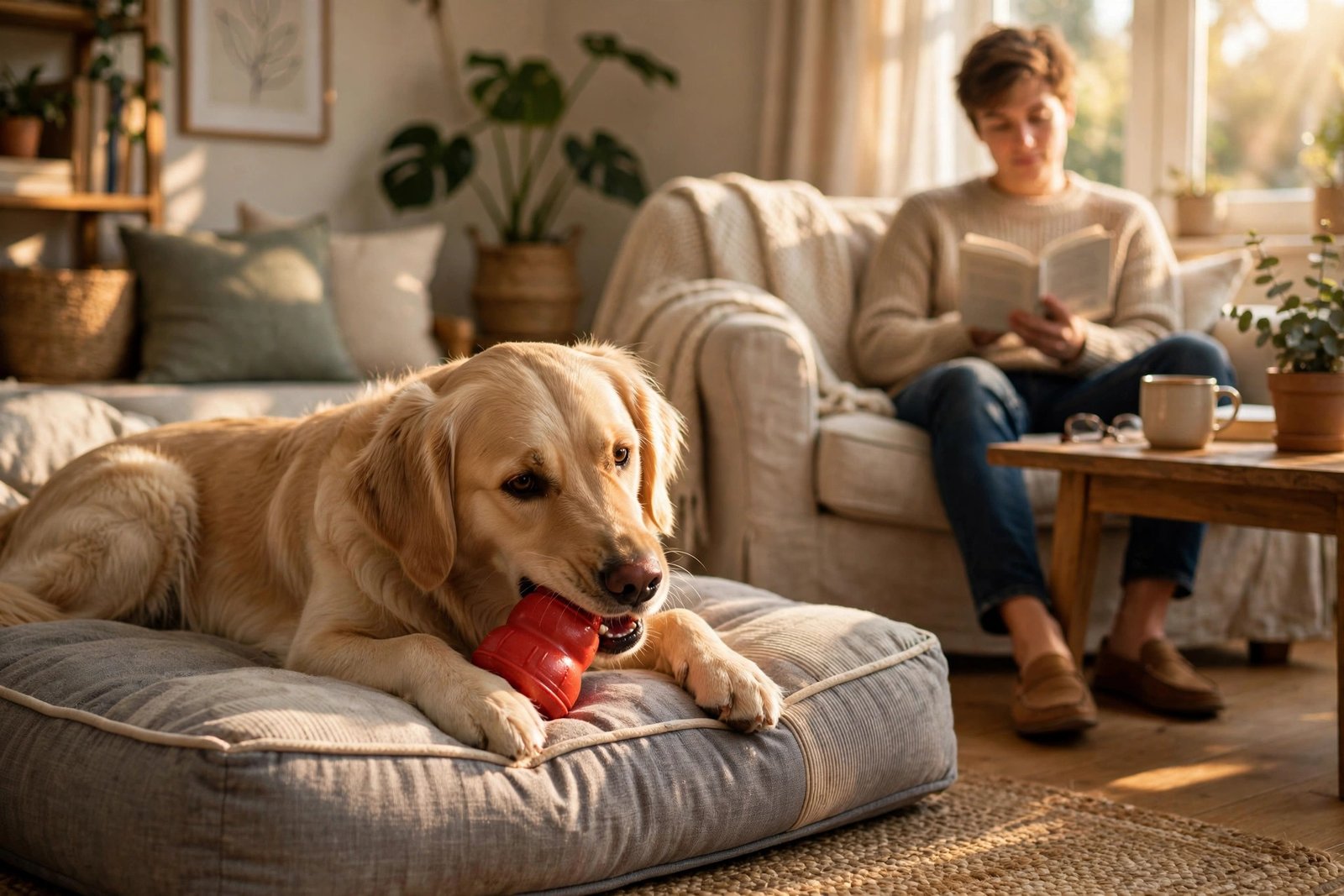
If you’re home during the day or have someone checking in, the middle of the day is ideal for calm mental work. Anxious dogs often do poorly with high-arousal play — fetch marathons and wrestling can spike adrenaline that takes hours to come down. Instead, lean into activities with a naturally soothing rhythm: chewing a safe chew, working a frozen food toy, or licking food from a textured mat. The repetitive jaw and tongue motions involved in chewing and licking seem to have a genuinely calming effect on many dogs.
Short training sessions are another good midday anchor. Five minutes of easy, well-rewarded basics — touch, find it, settle on a mat — gives an anxious dog a job to do and a string of small wins. Keep the difficulty low and the rewards high; this is about confidence, not challenge. A dog who earns ten treats in five minutes feels good about themselves, and that feeling carries into the rest of the day.
If your dog is alone midday, set up the environment for calm rather than entertainment. A safe chew, a comfortable resting spot with your scent on it (an old t-shirt works), and background noise like calm music or talk radio can take the edge off an empty house. Many owners find that a midday dog walker or neighbor visit breaks up a long alone stretch — not just for the bathroom break, but because it splits the day into two shorter, more predictable halves. For bad-weather days when walks are short, our indoor exercise ideas for dogs can fill the gap without ramping anyone up.
Evening: The Wind-Down Ritual
Evenings are where a calming routine really shows its value. Dogs pick up on household energy, so a chaotic evening — loud TV, kids running around, everyone stressed — keeps an anxious dog wired. You don’t need monastery silence, but a gradual wind-down helps: dim the lights a bit, lower the volume, and give the dog a final gentle walk or yard sniff.
Build a specific bedtime ritual and repeat it nightly. It might be: last walk, a small chew or lick mat, lights low, dog settles on their bed while you read or watch something calm. After a week or two, the dog will start anticipating the sequence, and anticipation of rest is itself relaxing. The bed matters too — a consistent sleeping spot, whether a crate or a bed in a quiet corner, becomes a cue that the day is safely over.
Be mindful of evening triggers. If the doorbell sends your dog into a spiral, manage it: put a note on the door, use a doorbell cover, or train a “go to mat” behavior for knocks. If your dog struggles specifically with loud weather events, our guide on fireworks and thunderstorm anxiety in pets covers desensitization and management strategies in more depth. The evening routine won’t fix a thunderstorm phobia on its own, but a dog going into a storm already calm handles it better than one who’s been wired all day.
Bad Days and When to Get Help
Even with a great routine, anxious dogs have bad days. A scary encounter on a walk, a schedule disruption, a house full of guests — setbacks happen. On those days, don’t try to train through it. Just provide comfort and quiet: a safe space, a chew, your calm company. Comforting a frightened dog doesn’t reinforce fear — that’s a persistent myth. You can’t reinforce an emotion; you can only help a dog feel safer, which is always the right move.
Track patterns if you can. A quick note on your phone — what happened, how the dog reacted, how long recovery took — often reveals triggers you wouldn’t otherwise connect. Maybe the anxiety spikes on trash day, or after the neighbor’s dog barks through the fence, or on days the walk gets skipped. Patterns point to solutions: a different walking route, white noise during trash pickup, a frozen toy on no-walk days.
And know when the routine isn’t enough. If your dog’s anxiety is severe — panic, escape attempts, self-injury, or no improvement after several consistent weeks — talk to your vet. Some dogs benefit from professional behavior support, and in some cases medication can lower anxiety enough for training and routine to actually work. There’s no shame in it; it’s medical care, like glasses for bad eyesight. A good vet can also rule out pain or illness, since discomfort often masquerades as behavior problems.
Frequently Asked Questions
How long before a calming routine starts working?
Many owners notice small improvements — faster settling, less pacing — within one to two weeks of consistent routine. Deeper changes usually take a month or more. Consistency matters more than perfection; a mostly-predictable day still beats chaos.
Should I crate my anxious dog during the day?
Only if the dog already finds the crate comforting. A crate can be a wonderful den for a dog who likes it, but crating a dog with separation anxiety who panics in confinement can make things worse. Never use the crate as punishment, and if your dog injures themselves trying to escape, stop crating and talk to your vet.
Does comforting a scared dog make the fear worse?
No — this is a myth. Fear is an emotion, not a behavior, and you can’t reinforce an emotion with comfort. Calmly comforting a frightened dog helps them feel safer and often shortens the fearful episode. What’s unhelpful is panicking yourself or forcing the dog toward the scary thing.
Are calming supplements or vests worth trying?
Some dogs seem to benefit from pressure wraps or calming supplements, and they’re generally low-risk to try. But evidence is mixed, and they’re best viewed as small helpers alongside routine, training, and exercise — not replacements. If anxiety is significant, discuss options with your vet rather than relying on products alone.
My dog is only anxious when I’m gone. Will routine help?
Routine helps, but separation-related anxiety often needs targeted work too: gradual desensitization to departures, practiced alone-time sessions that start very short, and management so the dog isn’t pushed past their limit while learning. If your dog panics when left, consider working with a professional — separation anxiety is very treatable with the right plan.