


Why Does My Dog Jump on People? (And How to Stop It)
It is the classic embarrassing dog-owner moment: a guest arrives, the dog launches like a missile, paws on shoulders, and you are apologizing while peeling ninety pounds of enthusiasm off someone’s nice shirt. Jumping up is one of the most common behavior complaints in dog ownership — and one of the most misunderstood. Owners tend to treat it as defiance or dominance. It is neither. It is a communication strategy that works, so the dog keeps using it.
This guide explains why dogs jump on people, why the usual corrections (kneeing, yelling, pushing) tend to backfire, and the positive, step-by-step method that actually teaches a dog to keep four paws on the floor.
Quick Tips
- Dogs jump to get closer to faces — it is attention-seeking, not dominance.
- Any reaction (even scolding) can reward jumping — attention is attention.
- Teach an incompatible behavior: sitting for greetings.
- Reward four-on-the-floor calmly and consistently.
- Manage the environment while training — prevention beats correction.
- Make sure every human in the house follows the same rules.
Why Dogs Jump: It Works
To understand jumping, get down to dog height — literally. A dog’s world happens around knee level. Human faces, where all the interesting expressions and greeting energy live, are a full body-length away. Jumping is simply the dog’s way of closing that distance: paws up, face to face, hello achieved.
Puppies start it naturally. When puppies greet their mother, they jump up toward her face — it is how they solicit attention and food. Humans inadvertently continue the education: the puppy jumps, the human laughs, bends down, pets the puppy, talks in an excited voice. From the puppy’s perspective, jumping produced exactly the desired outcome — closeness and attention. The behavior is reinforced from day one, by the very people who will later complain about it.
And here is the uncomfortable truth about adult jumping: it persists because it keeps working. The dog jumps on a guest, the guest reacts — pets the dog, talks to the dog, pushes the dog while laughing, even scolds the dog. Every one of those is attention, and attention is the currency. Dogs do not distinguish between “good” attention and “bad” attention the way we do. A scolding delivered with eye contact, physical touch, and an excited voice is, to the dog, a highly engaging interaction. The dog asked for engagement and got it.
This is not dominance, stubbornness, or disrespect. It is a learned, reinforced behavior — which is actually good news, because learned behaviors can be re-taught.
Why the Usual Corrections Backfire
Before the method that works, a tour of the methods that do not — because most owners try these first:
Kneeing the dog in the chest. Besides being unpleasant and potentially injurious, it gives the dog exactly what it wanted: intense physical engagement. Some dogs find it exciting. It can also make a dog hand-shy or anxious around people’s legs — trading one problem for a worse one.
Pushing the dog down while saying “no.” Pushing is contact, “no” is attention, and the whole interaction is dramatic. For many dogs this reads as a rough game, not a correction. Watch a dog’s body language during a push-down “correction” — tail often wagging.
Yelling or stamping. Startling a dog into stopping is suppression, not training. It may interrupt this instance, but it teaches nothing about what to do instead, and in sensitive dogs it damages trust. The dog learns that greetings are scary, not that sitting is rewarding.
Ignoring inconsistently. Turning away works — but only if everyone does it every time. If three family members ignore the jumping and one laughs and pets the dog, the dog just learned that jumping works 25% of the time. Intermittent reinforcement creates the most persistent behaviors known to science (it is the slot-machine principle). Inconsistency does not weaken jumping; it strengthens it.
The pattern: corrections focus on stopping the jump, but give the dog no alternative behavior to perform instead. Dogs need a job. “Do not jump” is not a job — “sit for greetings” is.

The Method That Works: Train the Replacement
The core strategy is beautifully simple: make sitting the way greetings happen, and make jumping the way greetings do not happen. You are not fighting the dog’s desire to greet — you are redirecting it into a behavior you can live with.
Step 1: Teach a rock-solid sit. If the dog does not have a reliable sit yet, build that first — my teaching your dog to sit guide covers it step by step. The sit needs to work with mild distractions before you use it for greetings.
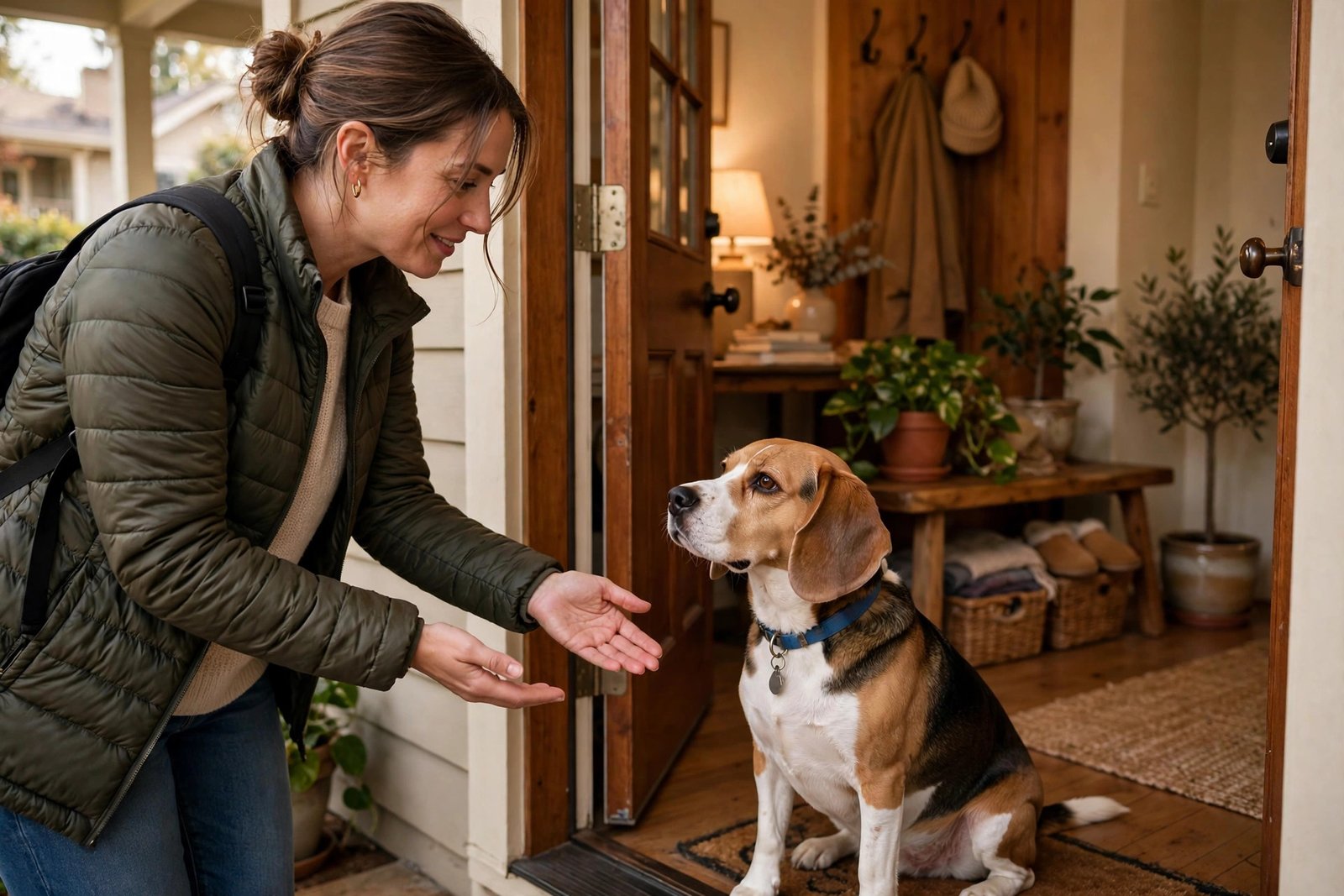
Step 2: Set up greeting practice. Enlist a helper. Have the dog on leash at a distance from the “visitor.” Ask for a sit. The helper approaches. The instant the dog’s rear leaves the ground — before the jump completes — the helper turns and walks away, calmly, no drama. The dog learns: jumping makes the person leave. When the dog holds the sit as the helper approaches, the helper greets calmly and delivers a treat. The dog learns: sitting makes the person arrive with good things.
Step 3: Reward four-on-the-floor constantly. Outside of formal practice, catch the dog being calm and reward it. Dog lying quietly while you talk to a guest? Treat appears. Dog sitting instead of launching when the doorbell rings? Jackpot. You are building a reinforcement history for calm that eventually outweighs the reinforcement history for jumping.
Step 4: Manage while training. Training takes weeks; management prevents rehearsal in the meantime. Leash the dog when guests arrive. Use baby gates to create a greeting buffer zone. Ask visitors to ignore the dog until it is calm — give them the script in advance (“please turn away if he jumps; I’ll tell you when to say hi”). Every unrewarded jump during the training period is progress; every rewarded one is a setback.
Step 5: Generalize. Practice with different people, in different places, at different excitement levels. Dogs are terrible generalizers — a dog that sits politely for family may launch at strangers. Each new context needs its own practice reps. This is the same generalization principle behind good puppy socialization: the behavior has to be rehearsed across the dog’s whole world, not just the living room.
The Human Side: Training the People
Here is the part trainers emphasize that owners resist: the dog is only half the equation. Jumping is a two-player game, and the humans are the ones feeding it.
Give visitors a script. Most guests do not know your training plan, and their instincts (excited voice, petting the jumping dog, laughing) actively undo your work. A brief, friendly briefing works: “We’re training him not to jump — if he jumps, please turn away and ignore him; once he’s sitting I’ll let you say hi.” Most people are happy to help when they understand the assignment.
Watch the kids. Children are jumping magnets — small, squeaky, at face height already, and prone to the exact excited reactions that reward jumping. Supervise greetings with kids closely during training, and teach children the same turn-away script. A dog that learns kids are an exception will jump on every child it meets.
Check your own behavior. Be honest: do you pet the dog when it jumps on you in the morning because it is cute? Do you let it slide “just this once” when you are in a good mood? Every exception is data for the dog. The rule has to be the rule — for everyone, every time — until the new habit is solid. Then, and only then, can you relax.
Do not punish the enthusiasm itself. The goal is a dog that greets happily with four on the floor — not a dog that is afraid to greet. Keep your energy warm and positive throughout. You are redirecting joy, not suppressing it.
Special Cases
Jumping on children. Treat as a safety priority, not just a manners issue. A large dog can knock a small child over easily. Until the behavior is reliable, manage with leashes and barriers around kids — no exceptions, no “he’s friendly” assumptions.
Jumping on furniture guests (couch, bed). Same principle, different surface. Decide the rule (allowed or not), teach an alternative (go to bed, sit for invitation), and enforce consistently. Dogs cannot understand “the couch is fine when it is just us but not when guests come” — pick one rule.
Excitement urination with jumping. Some young or submissive dogs pee when excited during greetings. This is involuntary — never punish it. Keep greetings low-key (no high-pitched excited voices), let the dog settle before interacting, and greet outside when possible. It usually resolves with maturity and calm handling.
Senior dogs that just started jumping. A sudden behavior change in an older dog is worth noting — sometimes it reflects anxiety, cognitive changes, or a medical issue affecting impulse control. If a previously calm senior starts jumping, mention it at the next vet visit rather than just retraining.
Frequently Asked Questions
How long does it take to stop a dog from jumping?
With consistent training from the whole household, most dogs show clear improvement within 2–4 weeks and reliable behavior within a couple of months. Puppies learn fastest. The biggest variable is human consistency — one person rewarding jumps can stall progress indefinitely.
Should I use a spray bottle to stop jumping?
It is not recommended. Startling punishments suppress the behavior in the moment without teaching an alternative, and they can create anxiety or damage trust — especially in sensitive dogs. The reward-based replacement method is both kinder and more reliable long-term.
Why does my dog only jump on certain people?
Because those people reward it. The dog has learned which humans are “soft targets” — the ones who pet, laugh, or engage when jumped on. It is actually useful information: it tells you exactly whose behavior needs to change alongside the dog’s.
My dog jumps on me but not strangers. Is that normal?
Very. Owners are often the worst offenders for accidentally rewarding jumping — the morning greeting, the excited homecoming, the roughhousing. The dog has simply learned that you are the most reliable source of jump-rewards. Apply the same rules to yourself first.
Can I train an old dog to stop jumping?
Yes. The method is identical at any age — the dog’s learning ability does not expire. Older dogs may have a longer reinforcement history to overcome, so expect it to take a bit longer, but the principles (reward the sit, remove rewards for jumping, be consistent) work the same.
What if my dog jumps and mouths at the same time?
Treat it as two behaviors with the same root cause: overarousal during greetings. The replacement training is the same (calm sit for greetings), but keep arousal lower during practice — calmer greetings, shorter sessions — and make sure the dog is getting enough exercise and mental stimulation overall. An under-exercised dog is much harder to keep calm.