


Why Do Dogs Tilt Their Heads?
It’s one of the most charming things dogs do. You say something — maybe their name, maybe the word “walk” — and suddenly their head tips sideways, ears perked, eyes locked on you like you’re the most fascinating creature alive. If you’ve ever wondered why do dogs tilt their heads, you’re in good company: it’s one of the most-searched dog behavior questions, and scientists have actually studied it.
The short answer is that nobody knows for certain, but researchers have a few strong theories involving hearing, vision, and good old-fashioned communication. Let’s look at what the science suggests, why some dogs do it more than others, and the rare cases where a head tilt is worth mentioning to your vet.
Quick Tips
- The leading theories: dogs tilt to locate sounds better and to see past their own muzzle.
- Dogs often tilt when concentrating — new words, interesting noises, or an unfamiliar voice.
- We may accidentally train it: laughing and fussing over the tilt teaches dogs it gets attention.
- Puppies and younger dogs tend to tilt more as they learn the sounds of their world.
- A sudden, persistent head tilt with balance problems is different — check with your vet.
- Enjoy it, but don’t overthink it — most head tilts are just curiosity in action.
Why Do Dogs Tilt Their Heads? What the Research Suggests
In 2021, researchers at a Hungarian university ran a clever experiment. They taught dogs the names of toys, then watched which dogs tilted their heads while listening to their owners name them. The dogs that were best at learning toy names tilted their heads significantly more often — about 43% of the time, compared to under 2% for the other dogs. The researchers suggested the tilt might be linked to concentration and memory recall, like a person furrowing their brow when thinking hard.
That study doesn’t settle the question, but it lines up with what many owners notice: the tilt shows up when a dog is really paying attention. A familiar word said in a familiar tone might get no reaction, while a new phrase, an odd sound, or a question in a curious voice gets the full sideways look. Whatever the mechanism, the head tilt seems to go hand in hand with mental effort — your dog working something out in real time.
The Hearing Theory: Pinpointing Where Sounds Come From
Dogs hear a wider range of frequencies than we do, and their movable ears are excellent at catching sound. One long-standing theory says the head tilt helps dogs fine-tune where a sound is coming from. By adjusting the angle of their head, they can slightly change how sound waves reach each ear, which may help them pinpoint the source more precisely — the same reason we cup a hand behind our ear in a noisy room.
This could explain why dogs often tilt at unfamiliar or interesting sounds: a strange noise on a walk, a new ringtone, a voice coming from a speaker. They’re essentially adjusting their antenna. It’s also why the tilt so often comes with perked ears and a frozen body — the whole posture is about listening as carefully as possible. Of course, this is still a theory rather than proven fact, but it fits the pattern of when tilts happen.
Seeing Past That Long Snout
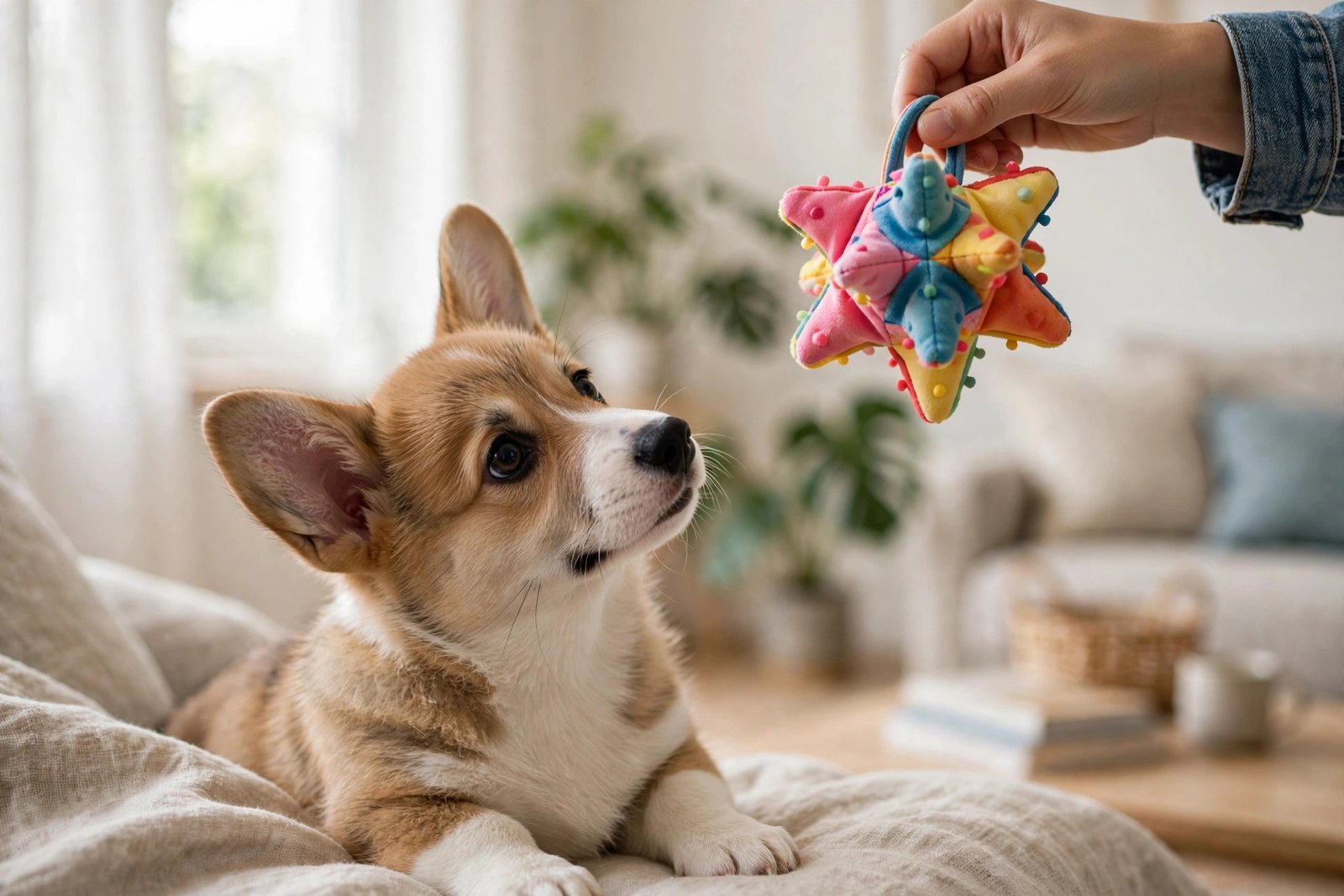
Another theory is about vision rather than hearing. Dogs with longer muzzles — think greyhounds, collies, or German shepherds — may have part of their view blocked by their own nose. Tilting the head could shift the muzzle out of the way, giving them a clearer look at your face and especially your mouth, which they’re watching for cues.
This might be why head tilts often happen during face-to-face moments: you’re talking, the dog is watching, and the tilt improves their view of your expressions. Dogs are remarkably good at reading human faces — studies have shown they can distinguish happy from angry expressions — so anything that sharpens that view has real value to them. Flat-faced breeds tilt too, though, which suggests vision is only part of the story. Like most dog behaviors, the head tilt probably has more than one cause.
It’s Also Communication — They’ve Trained Us, Too
Here’s the theory every dog owner secretly suspects: the head tilt works on us, so dogs keep doing it. Think about your own reaction the first time your dog tilted its head at you. You probably laughed, said “aww,” maybe grabbed your phone. Dogs are keen observers of what gets a reaction, and a behavior that reliably produces delighted attention is a behavior worth repeating.
This doesn’t mean the tilt is fake — the curiosity is genuine. But our response likely reinforces it. Animal behaviorists call this a feedback loop: the dog tilts while concentrating, we reward it with attention and treats, and the dog learns that tilting during listening time pays off. Many owners report their dogs tilt more around people who react strongly to it. If your dog seems to ham it up for guests, this is probably why. It’s a small, harmless example of how dogs and humans shape each other’s behavior every day — much like how a dog that follows you everywhere has learned that staying close keeps the good things coming.
Do Some Dogs Tilt More Than Others?
Yes — and the differences are noticeable. Puppies and young dogs tilt a lot, which makes sense: everything is new, and they’re constantly concentrating on unfamiliar sounds and words. As dogs mature and their world becomes familiar, many tilt less often, though plenty of adult dogs keep the habit for life.
Breed may play a role, though the evidence is mostly anecdotal. Owners of herding breeds and other highly attentive dogs often report frequent tilters, possibly because these dogs are bred to watch humans closely. The 2021 study mentioned earlier found that “gifted” word-learner dogs tilted far more than typical dogs, hinting that dogs who pay closer attention in general tilt more. And of course, individual personality matters: some dogs are simply more expressive. A dog that also licks everything in sight and one that tilts its head constantly may just share the same curious, engaged temperament.
When a Head Tilt Could Mean a Vet Visit
Almost all head tilts are normal, but there’s one version that isn’t: a sudden, persistent tilt where the dog holds its head to one side all the time and doesn’t straighten up. If that comes with stumbling, circling, nausea, or a drooping face, it can indicate an inner ear issue or a neurological problem, and it deserves a prompt vet visit. The key difference is persistence — a curious tilt comes and goes in seconds; a medical tilt doesn’t resolve.
Ear infections are the most common culprit behind a stuck head tilt, especially if the dog is also scratching at the ear or shaking its head. Older dogs can develop a condition sometimes called old-dog vestibular disease, which looks alarming — sudden tilt, wobbly walking, flicking eyes — but often improves with veterinary care. The point isn’t to diagnose anything yourself; it’s simply to know that a tilt that won’t go away is worth a phone call. For the everyday adorable version, though? Just enjoy the show.
Frequently Asked Questions
Do all dogs tilt their heads?
Most do at least sometimes, but frequency varies a lot. Some dogs are constant tilters, others rarely do it. Puppies tilt more than adults, and attentive breeds seem to do it more often. A dog that never tilts is perfectly normal too — it just isn’t their particular habit.
Can I teach my dog to tilt its head on cue?
Many owners do, usually by accident. If you mark and reward the tilt when it happens naturally — with a clicker or a “yes!” and a treat — most dogs will start offering it more often. Just keep sessions short and fun. It’s a trick that basically teaches itself.
Why does my dog tilt its head at the TV?
Televisions produce sounds that are slightly off from real life — compressed audio, voices without matching body language, odd background noises. Dogs often tilt at the TV the same way they tilt at any puzzling sound: they’re trying to figure out what they’re hearing and where it’s coming from.
Is head tilting a sign of intelligence?
The 2021 study found a link between frequent tilting and skill at learning object names, which is intriguing. But it’s one study, and “intelligence” in dogs covers many things — problem-solving, trainability, social smarts. A frequent tilter might be an attentive learner, but a dog that never tilts can be just as clever in other ways.
My dog suddenly started tilting and seems dizzy — what should I do?
Call your vet the same day. A sudden, nonstop head tilt with balance problems, circling, or nausea can signal an ear or neurological issue that needs professional assessment. Don’t wait to see if it passes — prompt care generally leads to better outcomes, and your vet can tell you whether it’s urgent.