


How Often Brush Cats Teeth: A Realistic Routine
How often brush cats teeth — it is one of those questions that makes many cat owners feel a little guilty, because the honest answer is that most cats never get their teeth brushed at all. If that describes your household, you are in crowded company: surveys consistently show that only a small fraction of cat owners brush regularly, even though dental buildup is one of the most common issues vets see in adult cats.
The good news is that you do not need a perfect daily record to make a difference. The ideal target is daily brushing, but even two or three sessions a week removes plaque before it hardens and gets your cat comfortable with mouth handling. This guide covers what a realistic frequency looks like, why it matters, how to start with a reluctant cat, and when a professional dental cleaning might be worth discussing with your vet.
Quick Tips
- Aim for daily brushing, but treat 2–3 sessions a week as a genuine win — consistency matters more than perfection.
- Always use cat-specific toothpaste (it is made to be swallowed); never use human toothpaste on a cat.
- A finger brush is the easiest starting tool for beginners and nervous cats.
- Keep sessions to 30–60 seconds at first and build up gradually.
- Focus on the outer surfaces of the upper teeth, where buildup collects fastest.
- Reward with a treat or play session so tooth brushing becomes a positive ritual.
Why Brushing Your Cat’s Teeth Matters
A cat’s teeth collect a soft film of plaque every day, just like ours do. If that plaque is not removed, it hardens into tartar within a few days, and tartar cannot be brushed away at home — it needs a professional cleaning under anesthesia. Over time, heavy buildup can irritate the gums and lead to the kind of dental problems that eventually require extractions, which are stressful for the cat and expensive for the owner.
Many owners never look inside their cat’s mouth, so dental issues go unnoticed until they are advanced. Brushing does double duty here: it removes plaque and it gives you a regular peek at the gums and teeth, so you notice redness, broken teeth, or bad breath early. As always, brushing is prevention and observation — it is not a diagnosis or treatment. If you see bleeding gums, a cracked tooth, or your cat suddenly avoids hard food, that is a vet visit, not a brushing problem.
How Often Brush Cats Teeth: The Realistic Answer
Veterinary dental guidelines generally point to daily brushing as the gold standard, because plaque begins hardening into tartar within about 48 to 72 hours. Brushing every day interrupts that cycle before it completes, which is why daily is the number quoted most often.
But here is the part the guidelines sometimes skip: a cat that gets brushed three times a week has dramatically healthier teeth than a cat that gets brushed never. If daily feels impossible — and for many busy households it does — commit to every other day or a solid three-times-a-week schedule. The key is that the sessions happen on a rhythm your cat can predict. Cats learn routines quickly, and a cat that expects a short brushing session after dinner is far more cooperative than one that gets ambushed randomly. If your household also has a dog, the routine is similar in spirit — our dog teeth brushing guide covers the canine version of the same habit.
Getting Started With a Reluctant Cat
Most adult cats that have never had their teeth brushed will not volunteer for it. The trick is to break the process into tiny steps spread over a week or two, so the cat never has a bad experience to remember.
Step 1: Get Your Cat Used to Mouth Handling
Start with no tools at all. During a calm cuddle session, gently lift your cat’s lip for a second, then release and offer a treat. Repeat over a few days until the lip lift gets no reaction. You are teaching your cat that mouth touching is boring and rewarding, which is the entire foundation of tooth brushing.
Step 2: Introduce the Taste
Put a dab of cat-safe toothpaste on your fingertip and let your cat lick it off. Most cat toothpastes come in poultry or fish flavors that cats genuinely enjoy — many owners say this is the easiest step, because the cat thinks it is treat time. If your cat turns up their nose, try a different flavor rather than forcing the issue.
Step 3: Try the Finger Brush
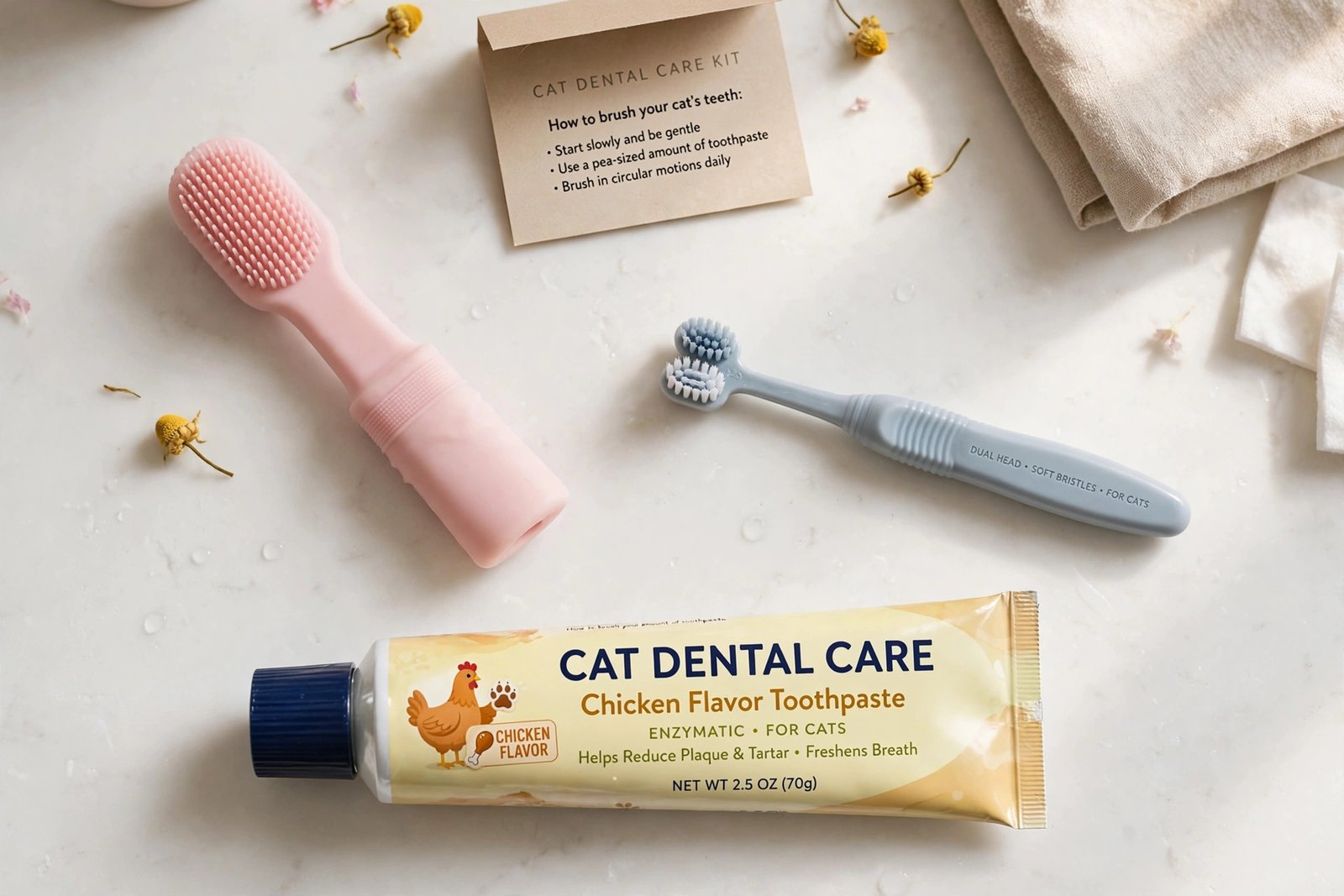
A finger brush — a small textured sleeve that fits over your fingertip — gives you more control and feels less foreign to the cat than a handled brush. Add a dab of toothpaste and gently rub the outer surfaces of the upper teeth for fifteen to thirty seconds. Stop while your cat is still relaxed. Over the next week or two, extend the time gradually and start covering the lower teeth and the inner surfaces too.
Step 4: Build the Routine
Once your cat accepts the finger brush, you can move to a small pet toothbrush with a handle if you prefer — it reaches the back teeth more easily. Pick a consistent time, keep early sessions under a minute, and always end with something your cat loves. The steps above assume a few sessions a week, which is a realistic answer to how often brush cats teeth for busy households — and you can build toward daily from there. Many owners find that pairing brushing with the evening treat ritual makes it self-sustaining. For more on building grooming habits in general, see our complete guide to brushing your cat.
What to Use (and What to Avoid)
Use toothpaste made specifically for cats. Human toothpaste contains foaming agents and fluoride levels that are not meant to be swallowed, and cats will swallow whatever you put on the brush. Cat toothpastes are designed to be safe when swallowed and come in flavors cats actually like, which removes half the battle.
For the brush, start with a finger brush and graduate to a small soft pet toothbrush or a dual-head brush sized for cats. Replace the brush every few months or when the bristles splay. Avoid hard-bristled brushes, abrasive “whitening” products, and any homemade paste recipes involving baking soda or hydrogen peroxide — a cat’s mouth is delicate, and harsh products can do more harm than good. If your cat has known dental issues, check with your vet about which products suit their situation before you start.

Signs Your Cat May Need a Professional Cleaning
Home brushing prevents new buildup, but it cannot remove tartar that is already there. Watch for the signs that it is time to talk to your vet about a professional dental cleaning: thick yellow or brown tartar along the gumline, red or bleeding gums, persistent bad breath, drooling, pawing at the mouth, or a sudden preference for soft food. A professional cleaning is done under anesthesia so the vet can clean below the gumline and take dental X-rays — it is the only way to fully address established dental disease. Many vets recommend a dental check as part of the annual exam, which is the natural moment to ask whether your cat is due.
Think of it as a partnership: the vet handles the deep cleaning when needed, and your brushing routine at home stretches the time between those visits. Owners who brush regularly often find their cats need professional cleanings far less often, which is better for the cat and the budget alike.
Frequently Asked Questions
Is it too late to start brushing my adult cat’s teeth?
No — it is rarely too late to start, though an adult cat that has never been brushed will need a slower introduction than a kitten. Start with the lip-lift and toothpaste-tasting steps described above and give it two to three weeks. If your cat already has heavy tartar, have the vet assess the teeth first, since brushing irritated gums can be uncomfortable.
What if my cat absolutely will not let me brush?
Some cats are genuinely difficult, and that is okay. Keep trying the gradual approach — many “impossible” cats come around with enough patience. In the meantime, ask your vet about alternatives like dental diets, water additives, or dental treats, which are less effective than brushing but better than nothing. Never restrain a panicking cat to brush; a bad experience sets the whole project back.
Can I use the same toothbrush for my cat and dog?
It is better to keep separate brushes for hygiene reasons, and the sizing is different anyway — cat brushes are smaller and softer. The toothpaste can be shared if it is a pet-safe formula both animals like, but give each pet their own brush and replace them on the same schedule.
Do dental treats replace brushing?
Not really. Dental treats and diets can help reduce buildup, and they are a reasonable supplement, but studies and vet experience consistently rank mechanical brushing as the most effective home care. Think of dental treats as a helpful sidekick rather than a replacement — useful on the days you cannot brush, not instead of brushing.
How long should each brushing session last?
For beginners, thirty to sixty seconds is plenty — just the outer surfaces of the main teeth. As your cat gets comfortable, you can work up to a minute or two covering all surfaces. Longer is not better if it makes your cat dread the next session; a short, calm session beats a long, stressful one every time.