

Teaching Your Dog to Come When Called (Recall Training Guide)
Of everything you will ever teach your dog, “come” matters most. Sit is polite. Stay is useful. But a dog that comes when called — every time, even mid-chase, even at the dog park — is a dog that stays safe. A reliable recall is what stands between your dog and the road, the aggressive off-leash dog, the cliff edge at the hiking trail. It is the one command worth training like lives depend on it, because occasionally they do.
The good news: recall is one of the most trainable behaviors there is, because it aligns with what dogs already want — to be near you, doing fun things, getting rewarded. This guide lays out how to teach a dog to come reliably, from the first indoor repetitions to off-leash reliability, plus the mistakes that quietly sabotage recall.
Quick Tips
- Coming to you must always pay better than whatever the dog was doing.
- Start indoors with zero distractions; add difficulty gradually.
- Never punish a dog for coming — even if it took forever or it did something wrong first.
- Use a long line for safe practice at distance before going off-leash.
- Do not repeat the cue — say it once, then help the dog succeed.
- Proof recall in many locations; dogs do not generalize well.
The Golden Rule: Coming to You Must Always Be Worth It
Everything in recall training flows from one principle: from the dog’s perspective, coming to you has to be the best deal available. Better than the squirrel. Better than the other dog. Better than the fascinating smell. If coming to you sometimes ends the fun — the leash goes on, the park visit ends, the scolding starts — the dog does the math, and the math says “stay away.”
This is why the classic recall-killer is calling the dog to end something good. Dog is playing at the park, owner calls, dog comes, leash goes on, park is over. The dog just learned that “come” means “fun ends.” Do that a few times and you have trained a dog to weigh every recall against the loss of freedom — and freedom usually wins.
The fix is simple: most of the time you call your dog, something great happens and then the dog goes back to what it was doing. Call, treat party, release back to play. Call, favorite game, back to sniffing. The recall becomes a pause for good things, not the end of them. When you do need to leash up and leave, mix it in unpredictably among the reward recalls — and sometimes leash up, treat, and unleash again just to break the association.
And the absolute rule, no exceptions: never punish a dog for coming to you. Not for taking too long. Not for the muddy paws it arrived with. Not for the thing it did before you called. If the dog came, the dog gets rewarded — even if you are frustrated, even if it took five minutes, even if you had to chase it down first. This pairs naturally with the patience-first approach in my teaching your dog to stay guide — both commands live or die on the dog’s trust that listening pays.
Phase 1: Building the Habit Indoors
Start where it is easy — inside your home, no distractions, dog nearby and relaxed.
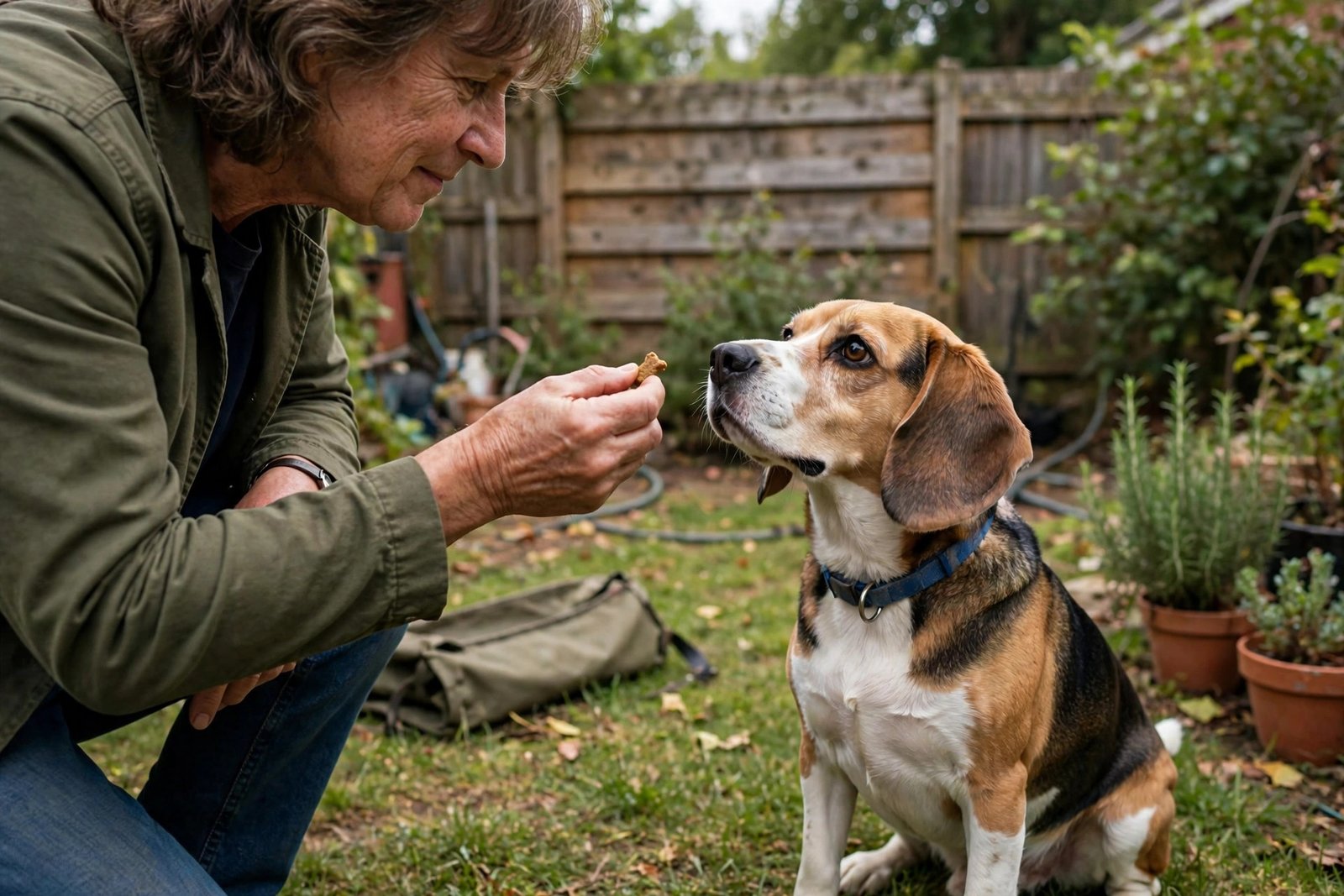
Step 1: Charge the cue. Say the dog’s recall word once (“come,” “here,” or a whistle — pick one and stick with it), then immediately produce something wonderful: a high-value treat, a favorite toy, an excited happy voice. You are not asking for behavior yet; you are building the association that the word predicts great things. Repeat a dozen times across a day, always pairing word with reward.
Step 2: Tiny distances. With the dog a few feet away and looking at you, say the cue once. When the dog moves toward you — any movement counts at first — mark it (“yes!”) and reward generously. Gradually increase the distance: across the room, from another room, from upstairs. Keep sessions to a few minutes; quit while the dog is still enthusiastic.
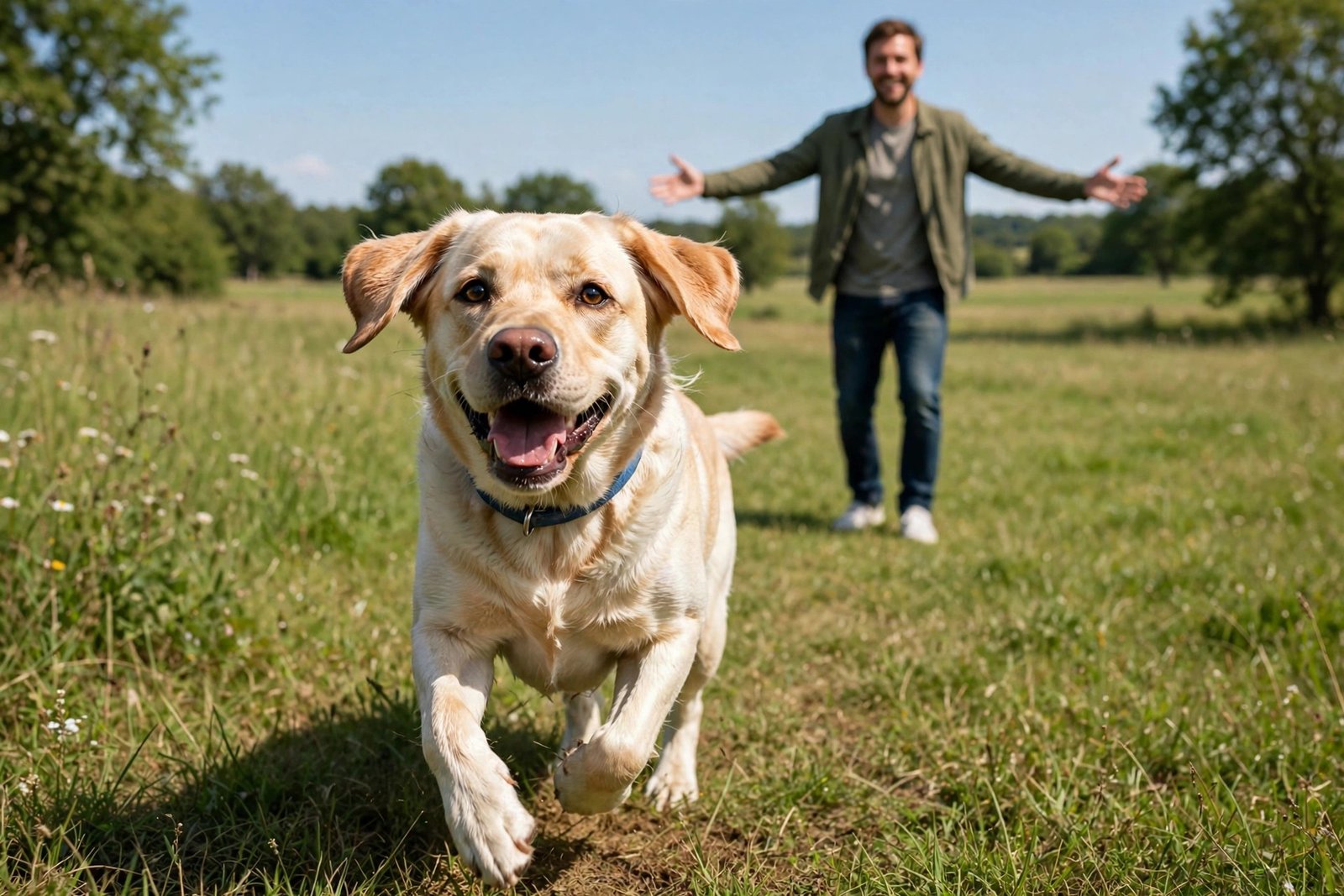
Step 3: Make yourself the party. Crouch down, open your arms, use an excited voice, back away a few steps as the dog approaches — movement away from the dog triggers chase instinct, which works in your favor. The arrival should feel like the best moment of the dog’s day: several treats in a row (not just one), praise, maybe a quick game. One treat says “okay.” A handful says “THIS is the behavior.”
Use genuinely high-value rewards for recall training — the good stuff, not the everyday kibble. Real meat, cheese bits, whatever your dog would choose over a squirrel. Recall is the command where you bring out the big guns, because you are competing with the most exciting distractions in the dog’s world.
Phase 2: Adding Distance and Distraction
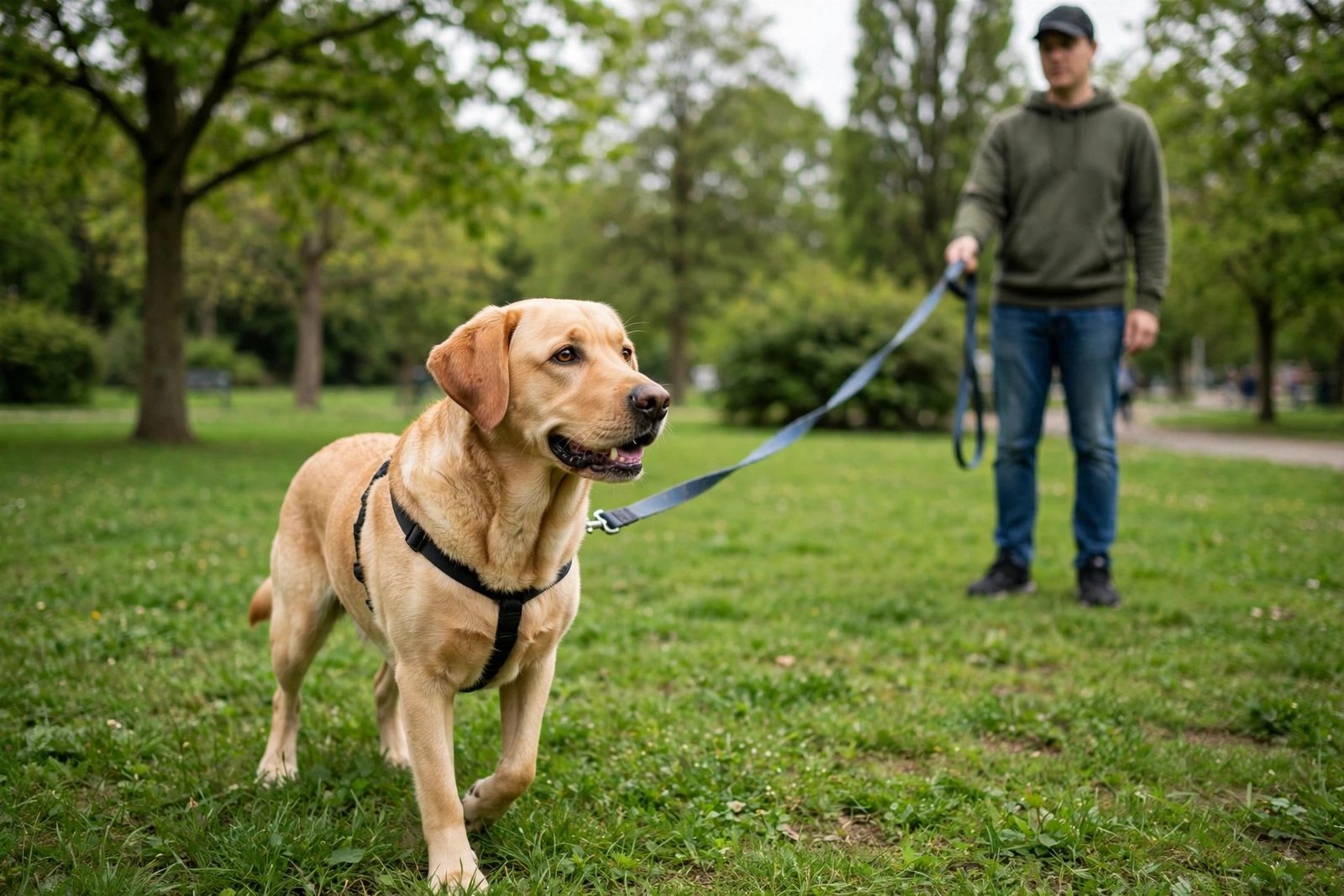
Once the dog rockets to you indoors, move outside — but on a long line, not off-leash. A long line (20–30 feet of lightweight rope or biothane with a harness, never a collar for this) gives the dog freedom to roam while giving you a safety net. It is the bridge between “reliable in the kitchen” and “reliable in the world.”
Increase one variable at a time. Distance, distraction level, and novelty are three separate difficulties — raise only one at once. New backyard with no distractions? Keep distances short. Familiar yard? Add distance. Familiar yard at distance? Add a mild distraction (a toy on the ground, a family member standing nearby). Rushing this phase is the most common reason recall “works at home but not at the park.”
Practice the surprise recall. While the dog is sniffing around on the long line, call once. If the dog turns and comes — jackpot reward. If not, do not repeat the cue; instead, gently reel in or move to a closer distance and try again. Every ignored repetition teaches the dog that the cue is optional. Say it once, then make success happen.
Reward the check-ins. Dogs naturally glance back at their owners on walks. Reward those voluntary check-ins heavily, especially early on. You are building a dog that defaults to keeping track of you — which is what off-leash reliability actually looks like in practice.
How long does this phase take? Weeks, not days. A month of consistent long-line practice is normal before considering off-leash work, and longer for distractible adolescents or high-prey-drive breeds. There is no prize for rushing; there is a lost dog for rushing.
Phase 3: Going Off-Leash (Carefully)
Off-leash is a privilege the dog earns through demonstrated reliability, not a milestone on a calendar. Test in safe, enclosed areas first — a fenced field, an empty tennis court, a Sniffspot rental. The criteria: the dog recalls promptly away from real distractions (other dogs, people, wildlife smells) on the long line, repeatedly, before the line comes off.
First off-leash sessions: keep them short, in boring locations, with the long line dragging (so you can step on it if needed). Call a few times during the session, reward massively, and end before the dog gets bored or overstimulated.
Maintain the habit forever. Recall is not a trick you teach once — it is a behavior you maintain. Keep rewarding recalls intermittently for the dog’s whole life, keep practicing in new locations, and never assume a reliable adult dog cannot have an off day. The owners with bombproof recalls are the ones still carrying treats at year five.
Have an emergency recall. Many trainers teach a separate, special recall word — used rarely, rewarded extravagantly — reserved for genuine danger. It is the fire alarm of cues: almost never used, unmistakable when it is. Worth building once the regular recall is solid.
Off-leash freedom pairs with solid leash skills for the times freedom is not appropriate — my puppy leash training guide covers the other half of the equation, since a dog needs both modes.
The Mistakes That Sabotage Recall
Repeating the cue. “Come… come… COME! … I said COME!” Every repetition without a response teaches the dog that the first four do not count. Say it once. Then help the dog succeed (move closer, increase excitement, use the long line) rather than nagging.
Calling when you cannot enforce it. Every ignored recall is a deposit in the “come is optional” account. If the dog is mid-chase and you know it will not come, do not call — go get the dog (or use the long line). Only call when you are reasonably sure of success, especially early on. Protect the cue’s reputation fiercely.
Poisoning the cue. Using “come” for unpleasant things — baths, nail trims, leaving the park, scoldings — attaches dread to the word. If the cue is already poisoned (the dog visibly hesitates or avoids), retire it and train a fresh word from scratch. A new cue with a clean history beats rehabilitating a dreaded one.
Training only when you need it. Owners who never practice recall until the emergency discover in the emergency that it does not work. Recall needs regular low-stakes reps — a few per walk, a few per day — to stay sharp.
Chasing the dog. When the dog will not come and you chase it, you have just invented the best game ever: keep-away with the human. If the dog bolts, run the other way (exciting!), crouch down, or lie down — be more interesting than the escape. Chasing teaches the dog that running away works.
Frequently Asked Questions
How long does it take to train a reliable recall?
Expect several weeks of consistent practice for a solid foundation and a few months before true off-leash reliability around distractions. Puppies often learn the basics fast but become less reliable as adolescents — this is normal, not failure. Plan on maintaining recall with regular practice for life.
Should I use treats forever for recall?
Keep rewarding recalls for the dog’s whole life, but you can vary the rewards — sometimes treats, sometimes a game, sometimes just enthusiastic praise. Intermittent, unpredictable rewards actually maintain behavior better than constant ones. What you should never do is stop rewarding entirely; the behavior will fade.
My dog comes inside but ignores me outside. Why?
Because outside is harder — more distractions, more space, more competing motivations. This is not disobedience; it is a training gap. Go back to the long line, lower the difficulty (shorter distances, quieter locations), and rebuild. The dog is telling you exactly where its current limit is.
Is it ever okay to punish a dog that finally comes after running off?
No — this is the single most damaging thing you can do to recall. The dog cannot connect your anger to the running-off; it connects it to the coming-back. Reward the return, every time, even through gritted teeth. Address the running-off separately with better management and training.
What is the best recall word to use?
Short, distinct, and upbeat — “come,” “here,” or a specific whistle all work. Avoid the dog’s name alone (it gets used in too many contexts) and avoid any word you have already used for scolding. Consistency matters more than the specific choice.
Can old dogs learn recall?
Absolutely. The method is identical regardless of age — the dog’s motivation and physical ability are the only variables. Senior dogs may move slower and need lower-value distractions to practice around, but the learning mechanism works the same at any age.