
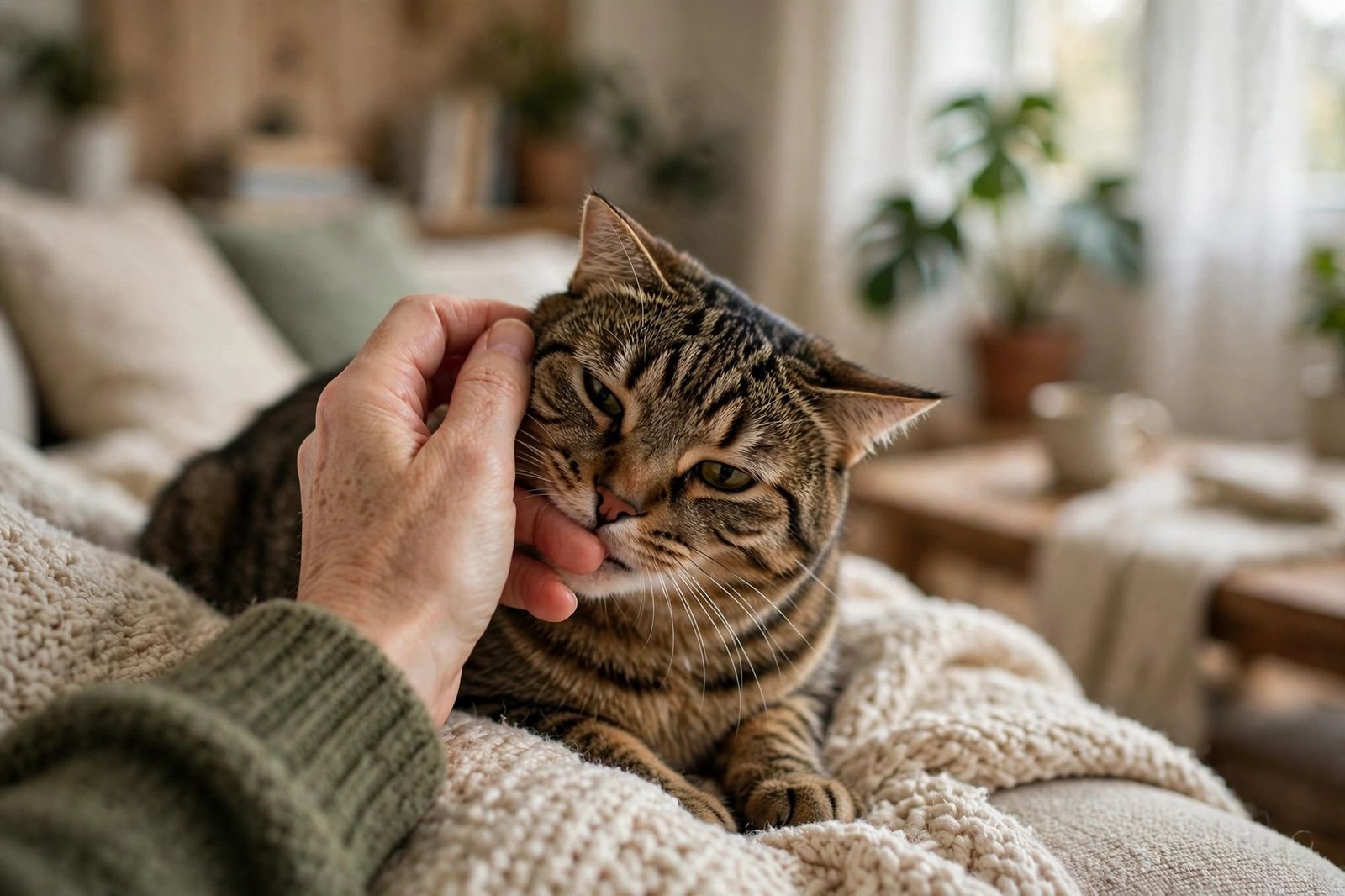

Why Does My Cat Bite Me? Understanding Love Bites and Real Bites
Picture this: your cat is sprawled across your lap, purring like a tiny engine, eyes half closed in bliss. Then — teeth. A sudden clamp on your hand, and you are left staring at your cat thinking, what was that for? We were having a moment.
The instinct after a surprise bite is to wonder whether the cat secretly hates you. Spoiler: it doesn’t. Cat biting has its own vocabulary — love bites, play bites, “I have had enough” bites, scared bites — and once you learn to read it, most biting stops being a mystery and becomes something you can actually work with.
Quick Tips
- Most bites during petting are love bites or overstimulation — not aggression.
- Watch for warning signs: tail flicking, rippling skin, ears turning flat.
- Never punish a biting cat — redirect the energy to a toy instead.
- Keep hands out of the game: use wand toys for play, not your fingers.
- A frightened cat needs space and patience, never confrontation.
- A sudden change in biting behavior is worth a conversation with your vet.
Not All Bites Are Created Equal
Here is the thing most new cat owners miss: the teeth are the same, but the message changes completely with context. A gentle mouthing while your cat kneads your lap means something wildly different from a hard bite when you reach for a hiding cat. Lumping them all together as “my cat bites me” is like saying a whisper and a scream are the same because both use your voice.
Most cat bites fall into four buckets: love bites (gentle, during affection), play bites (during wrestling-style play), overstimulation bites (the petting was great until it suddenly was not), and real defensive bites (fear or pain talking). Your response should match the bucket. Comfort a love-biter the wrong way and you punish affection; ignore a fear-biter and you confirm the cat’s suspicion that humans are scary.
Love Bites: A Weird Little Compliment
Love bites are the softest item on the menu. Your cat wraps its mouth around your hand or finger, applies the lightest pressure, and lets go. No broken skin, no real pain — sometimes you barely feel teeth at all. It usually happens mid-cuddle, often paired with purring or kneading, which is another one of those confusing cat behaviors I wrote about in my guide to why cats knead.
Why do they do it? Cats groom each other with their teeth — gentle nibbling is literally how cats say “you are one of mine.” Some cats also do it when stimulation tips over the edge: the petting felt amazing, then their nerves got overloaded and the mouth took over before the brain caught up. Either way, the intent is not to hurt you.
The Petting Threshold: When “More” Becomes “Too Much”
Every cat has a petting threshold — a number of strokes after which pleasure flips to irritation. For some cats it is fifty strokes. For others it is four, and stroke number five gets you teeth. Learning your cat’s number is one of the highest-value skills in cat ownership, and it takes about a week of paying attention.
The signs build in a sequence if you know what to watch for. Purring continues but the tail starts to twitch at the tip. The skin along the back ripples. The cat’s body goes still instead of melting. Then the head whips around — the last warning before teeth. Lift your hand at the stillness stage and the bite never happens.
Play Biting: You Accidentally Taught This One
Kittens bite. It is how they learn the world — wrestling with littermates teaches them where the line is, because a sibling that gets bitten too hard squeals and stops playing. The problem starts when humans become the wrestling partner. Wiggling your fingers under a blanket is hilarious when the kitten weighs a pound. It is less hilarious when the cat weighs twelve pounds and still thinks your hand is prey.
If your cat grabs your hand with both front paws, kicks with the back feet, and bites, that is not aggression — that is the full hunting sequence, performed on the wrong target. The fix is boring but effective: hands are never toys. The moment teeth touch skin during play, go still, then calmly withdraw and offer a real toy instead. Wand toys are perfect because they put distance between the “prey” and your fingers — my guide to toys for indoor cats has options that survive enthusiastic hunters.
Real Bites: Fear, Pain, and “Back Off”
Then there are the bites that mean business: fast, hard, sometimes breaking skin, usually paired with hissing, flattened ears, or a puffed-up tail. These are defensive bites, and the cat is not being mean — it is scared, hurt, or cornered, and biting is the only tool it has left.
Common triggers include reaching into a hiding spot to drag a cat out, restraining a cat that wants to leave, or touching a painful area. Newly adopted cats are especially prone to fear biting in the first weeks — everything is unfamiliar and their nerves are shot. If you are in that settling-in phase, my guide to introducing a new cat to your home covers how to give them space to decompress. The golden rule: give the cat an exit. A cat that can walk away almost always chooses walking away over biting.
Reading the Warning Signs Before Teeth Appear
Cats almost always warn you. The warnings are just written in body language, and most of us are illiterate in it at first. Two areas to study:
The tail tells the truth
A relaxed tail means a relaxed cat. A tail tip that starts flicking during petting means irritation is building. Fast, hard thumps against the floor mean the cat is done — stop what you are doing. A puffed-up bottle-brush tail means fear, and a fearful cat should be left completely alone until the tail returns to normal size.
Ears, skin, and body tension
Ears rotating sideways or flattening back signal rising discomfort. Rippling skin along the back — like a shiver that is not from cold — means the nerves are overloaded. And a body that goes suddenly still is a bigger warning than it looks: a happy cat melts; a cat about to bite freezes first. Learn to spot the freeze and you will dodge nine out of ten bites.

What to Do in the Moment (and What Not To)
So teeth are on your hand. Now what? First: go still. Yanking your hand away triggers the prey reflex and can turn a gentle mouthing into a real bite, plus claws often come out in the scramble. A still hand is boring; a fleeing hand is a toy.
Then calmly withdraw and end the interaction for a little while — not as punishment, just as information. The cat learns that biting makes the fun stop. If the bite broke skin, wash it well with soap and water. Cat bites can get infected, so anything that looks angry, swollen, or is not improving deserves a call to your doctor.
What not to do: do not yell, do not hit, do not squirt, do not shove the cat away roughly. Punishment teaches a cat that hands are scary and unpredictable, which creates exactly the fear-biting you are trying to prevent. Take the breath, go still, and handle it like the boring adult in the room.
Building Better Habits Over Time
Stopping biting is less about any single trick and more about the overall deal you offer the cat. Cats that get enough appropriate play are dramatically less bitey — a solid fifteen-minute play session with a wand toy, ending with a “catch” and a small meal, drains the hunting energy that otherwise lands on your ankles.
Keep the rules consistent across the whole household. If one person lets the kitten chew their fingers “because it is cute” while another scolds for it, the cat picks the fun option. Reward the behavior you want: when the cat is calm during petting, that is the moment for a treat. And respect the cat’s no — a cat that learns humans listen to body language stops needing teeth to be heard.

Frequently Asked Questions
Why does my cat bite me gently while purring?
That is the classic love bite — affection mixed with mild overstimulation. The purring tells you the cat is happy; the gentle teeth are grooming instinct leaking out. It is normal, and as long as it stays gentle, it is nothing to fix. Shorten petting sessions if you want less of it.
How do I get my cat to stop biting my hands during play?
Stop offering your hands as playthings, completely and consistently. Redirect to wand toys or kicker toys the instant play starts, and if teeth touch skin, go still, then withdraw calmly. Everyone in the house must follow the same rule. Most cats adjust within a couple of weeks.
Why does my cat bite my ankles when I walk by?
Ambush play. Your moving feet trigger the hunting sequence, especially in young, under-stimulated indoor cats. It is not anger — it is boredom with a target. Add structured daily play sessions and the ankle attacks usually fade.
Is it normal for kittens to bite a lot?
Completely normal. Kittens explore with their mouths and learn bite inhibition from littermates. Be a boring target: go still when teeth land, redirect to toys, and never wrestle with bare hands. They grow out of the worst of it as they mature.
My cat suddenly started biting hard — should I worry?
A sudden change in a previously gentle cat is worth attention. Pain is a common hidden cause — dental issues, arthritis, or an injury can make a cat lash out when touched. If the behavior is new or intense, book a vet visit rather than treating it as a training problem.