

Why Does My Cat Knock Things Off Tables?
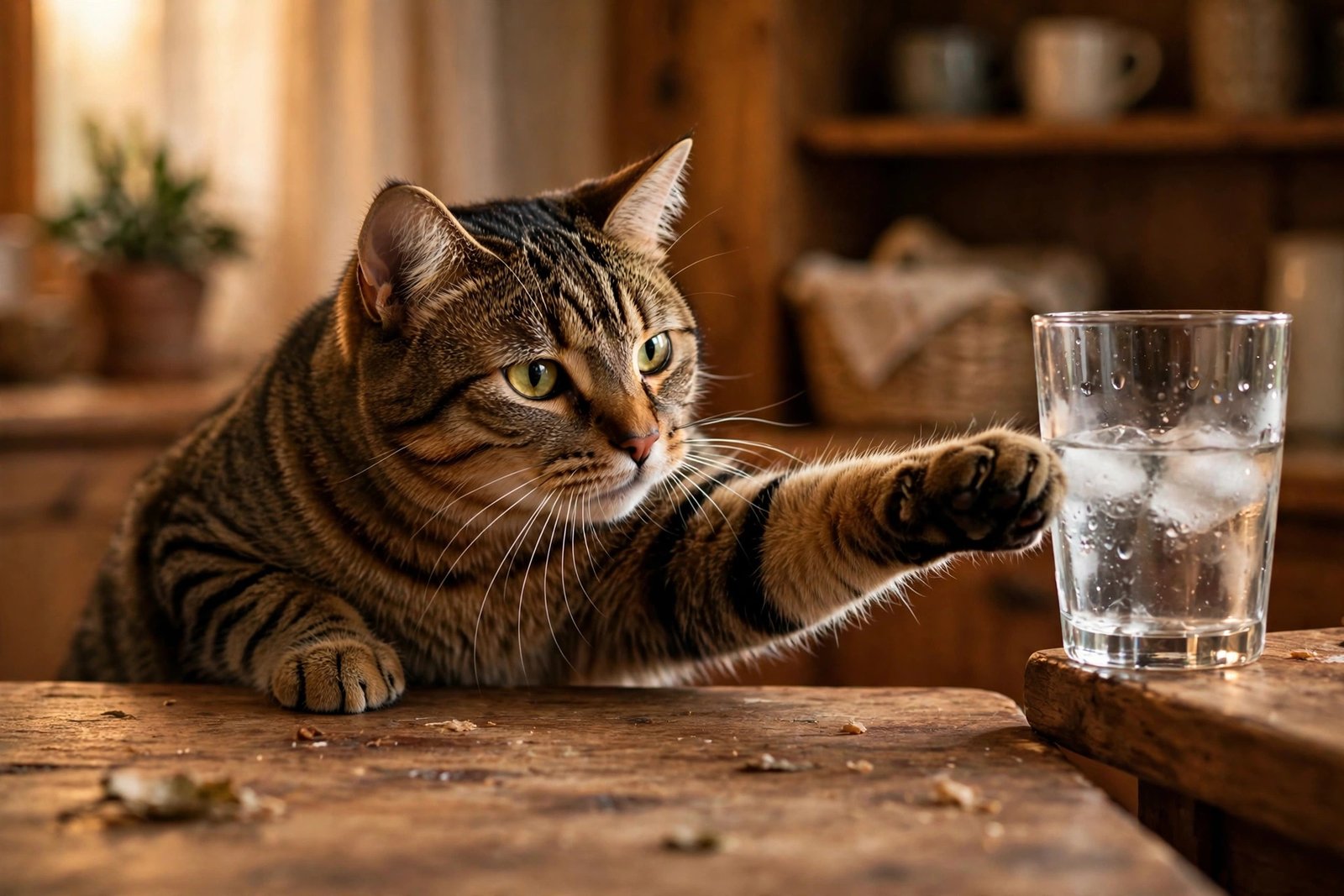
You have seen the look. Your cat sits on the table, makes deliberate eye contact with you, and slowly — so slowly — extends one paw toward your water glass. You say “no.” The paw advances anyway. The glass tips. The cat watches it fall with the satisfaction of a scientist concluding an experiment. And then, often, looks back at you as if to say: noted.
It feels personal. It feels like spite. It is neither — and understanding what is actually happening is the key to keeping your belongings intact without declaring war on your cat.
Quick Tips
- It is not spite — it is hunting instinct, curiosity, boredom, or attention-seeking.
- Never punish; the cat will not connect the punishment to the crime.
- Cat-proof surfaces: museum putty, closed cabinets, and cleared tables work best.
- Boredom is the top driver — more play usually means less swatting.
- Give legal swatting outlets: batting toys and puzzle feeders.
- Stay calm when it happens — dramatic reactions teach the cat it works.
The Hunting Instinct Explanation
At its root, swatting objects off surfaces is a hunting behavior. In the wild, a cat tests potential prey with a paw — is it alive? does it move? can I catch it? Your keys, your pen, your glass of water are all getting the same treatment: a paw tap to see what happens. When the object moves or falls, that is interesting data. When it makes a satisfying crash, that is very interesting data.
This is also why cats are most enthusiastic about objects near edges. An object in the middle of the table is boring; an object near the edge is a physics experiment waiting to happen. The cat is not planning destruction — it is running the same “paw it and see” subroutine it would run on a beetle. Your belongings are just collateral.
Curiosity: The Original Motive
Cats explore with their paws the way we explore with our hands. A new object on the table gets investigated, and investigation involves touching, pushing, and seeing how it responds. The first swat is pure curiosity: what is this, what does it do, what happens if I push it?
This is why the behavior spikes with novel objects. The glass that has sat on the nightstand for a year is invisible; the new phone you just set down is fascinating. Cats are neophiles about some things — new objects get the full inspection protocol, which unfortunately includes the edge-of-table test.
Boredom: The Great Amplifier
A well-entertained cat still swats things occasionally — it is instinct, after all. But a bored cat turns it into a hobby. The under-stimulated indoor cat with nothing to hunt, nothing to chase, and nothing changing in its environment will manufacture its own entertainment, and gravity is always available.
The pattern is recognizable: the behavior happens most when the house is quiet, often in the evening, often right in front of you. That last detail is the tell — the cat is not just entertaining itself, it is recruiting you as the audience. Which brings us to the most powerful driver of all.

Attention: Because It Works Every Time
Knocking something off a table is the single most reliable way to get a human’s immediate, focused attention. It works 100% of the time. You will look up, you will react, you will get up — possibly while making interesting noises. From the cat’s perspective, this is a flawless communication tool, and cats are ruthless optimizers of what works.
This is where most owners accidentally train the behavior to escalate. The first swat gets a mild “hey.” The tenth gets a dramatic leap across the room. The cat learns the exchange rate: bigger crash, bigger reaction. Within weeks you have a cat that bypasses the pen and goes straight for the full water glass, because the data says that is what gets results.
The fix is deeply unglamorous: make it boring. When the cat swats something, respond minimally — calmly remove the cat or the object without drama, without eye contact theatrics, without the entertaining chase. And crucially, give the cat attention on your terms at other times, so it does not need to manufacture emergencies. A cat that gets two good play sessions a day has far less reason to start a tabletop demolition derby.
What Actually Protects Your Stuff
Training a cat to never swat is like training water to never be wet — you will lose. The winning strategy is environmental: make the behavior unrewarding and the environment resilient.
Clear the surfaces. The simplest and most effective fix. If there is nothing near the edge, there is nothing to knock off. It requires a habit change for the humans, not the cat — but it works immediately and completely for valuables.
Museum putty. The removable adhesive putty used in museums (also sold as earthquake putty) anchors vases, frames, and decorative objects to shelves. The cat can swat all it wants; the object stays put. The game becomes boring within days.
Closed storage. Cabinets with doors beat open shelving for anything fragile. Cats cannot swat what they cannot reach, and a closed door is the only truly cat-proof barrier ever invented.
Provide legal alternatives. A cat with approved batting toys, puzzle feeders, and regular interactive play has less motive to improvise. Place a crinkle ball or a batting toy on the table the cat favors — some cats will happily redirect to the sanctioned object. For scratching-related surface issues, my guide to why cats scratch everything covers the vertical side of the same instinct.
Make edges less fun. Double-sided tape strips along the edges of frequently targeted surfaces create a texture most cats dislike stepping on. It looks slightly odd for a week or two, but it quietly retrains the cat’s table habits without any confrontation — the cat simply decides the table is less appealing and moves on to better things.
What Not to Do
Do not punish. Spray bottles, yelling, clapping — none of it teaches the cat “do not swat objects.” At best the cat learns “do not swat objects when the human is watching,” which just moves the behavior to 3 a.m. At worst it damages trust, and a cat that is anxious about its owner is a cat with more behavior problems, not fewer.
Do not chase the cat after the crash, either. To the cat, the chase is the best part — you have just turned a mildly interesting experiment into the greatest game ever invented. Calm cleanup, minimal drama, and the cat learns that the whole production was not worth the effort.
And do not take it personally. The slow, deliberate, eye-contact swat feels like a message, but the message is not “I hate you.” It is closer to “watch this” — which, depending on the day, is either infuriating or the funniest thing in your house. For keeping the rest of the play relationship healthy, my toy guide for bored indoor cats has the enrichment side covered.
Frequently Asked Questions
Do cats knock things over out of spite?
No — spite requires a theory of mind about your feelings that cats do not really operate with. The behavior is driven by hunting instinct (paw-testing objects), curiosity, boredom, and attention-seeking. It feels personal because the cat often does it while looking at you, but the look is about monitoring your reaction, not malice.
How do I stop my cat from knocking things off the table?
Combine three approaches: clear or secure surfaces (museum putty for valuables), increase daily play and enrichment to reduce boredom-driven swatting, and react minimally when it happens so the behavior stops paying off. Punishment does not work and usually backfires.
Why does my cat only knock MY stuff over?
Probably because your stuff is the newest, the most interesting-smelling, or the most reliably near edges — plus you give the best reactions. Cats also tend to focus on one person’s belongings because that person’s response pattern is the most rewarding. It is not favoritism in the way you fear; it is just the data.
Is it dangerous for my cat to knock things over?
It can be — heavy objects, glass, candles, and anything toxic (medications, certain plants, chemicals) are genuine hazards. Cat-proofing is not just about protecting your belongings; it is about protecting the cat. Secure or remove anything that could injure the cat if swatted, especially in rooms the cat accesses unsupervised.
Will my cat grow out of knocking things over?
Kittens and young cats do it most, and the frequency often decreases with age as the novelty wears off — but the instinct never fully disappears. Most owners find that a combination of maturity, good enrichment, and a well-puttied house reduces it to an occasional quirk rather than a daily event.