
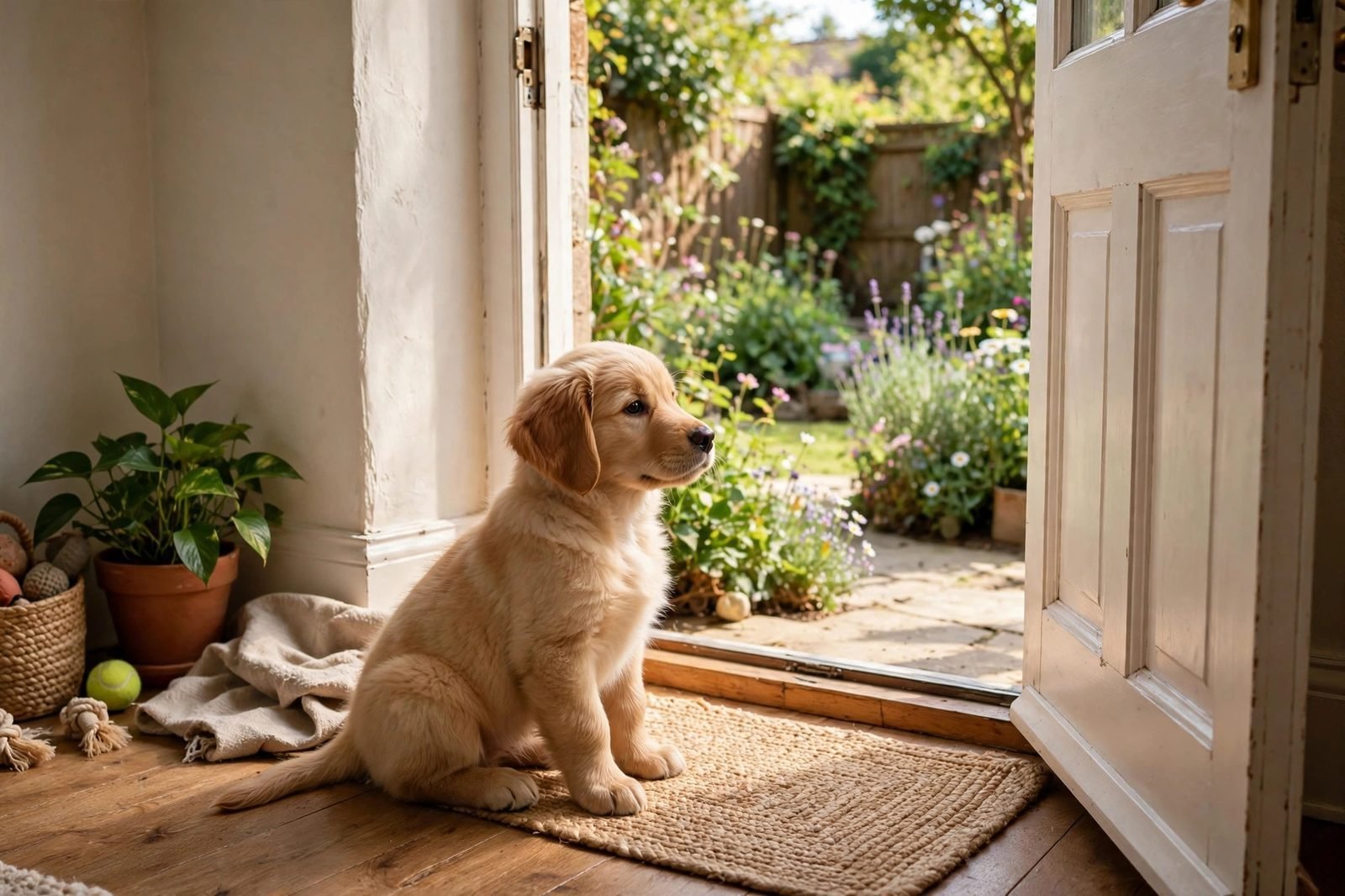

When I brought my first puppy home, I had a plan — scheduled outings, a crate, what I confidently called “a strict routine.” Within forty-eight hours, that puppy had peed on the rug, the hallway, and my favorite slippers. House training isn’t about the perfect system — it’s about consistency, timing, and accepting accidents as part of the deal. This is the step-by-step I wish I’d had — no tricks, no gadgets, just the method that works for most puppies.
Published: May 9, 2026 | Last updated: May 9, 2026
Quick Tips
- Take your puppy out first thing in the morning, after meals, naps, and play, and last thing at night.
- Reward outdoor success immediately with a treat and praise — timing is everything.
- Never punish accidents; interrupt calmly and clean thoroughly with an enzymatic cleaner.
- Supervise constantly indoors, or use a crate/playpen when you can’t watch.
- Feed on a schedule — predictable meals mean predictable bathroom trips.
- Learn your puppy’s “I need to go” signals: sniffing, circling, squatting, sudden restlessness.
- Most puppies aren’t reliably trained until 4–6 months old. Patience is the whole game.
Before You Start: Set Realistic Expectations
A common rule of thumb: about one hour per month of age — two hours at eight weeks, three at three months. It’s rough, not law, and shorter when they’re awake and active. Expecting a tiny puppy to hold it through the night or a six-hour workday asks something their body literally can’t do yet.
Most puppies start getting the idea within a few weeks, but reliable, accident-free living usually arrives between four and six months. Small breeds often take longer — smaller tanks, to be blunt. None of this means you’re failing. It means you have a baby animal.
What you’ll need
Almost nothing: a leash for outdoor trips (even with a yard — I’ll explain why), small training treats, and an enzymatic cleaner for accidents. The enzymatic part matters: regular cleaners mask smell for humans, but dogs still detect the residue — and that residue says “bathroom spot” to a puppy. Enzymatic cleaners break down the proteins. Best purchase of the whole process, and it costs less than a takeaway coffee.
Step 1: Build the Schedule
House training runs on routine. Puppies’ digestive systems are remarkably clockwork — food goes in, and twenty to thirty minutes later something needs to come out. Stay one step ahead of it. Take your puppy out at these times, every day:
First thing in the morning. Before coffee, before your phone, before anything — a puppy that’s held it all night has about thirty seconds of patience. Carry them if you have to.
After every meal. Eating stimulates the digestive tract — within fifteen to thirty minutes, most puppies need to go. Scheduled meals beat free-feeding during training: know when food goes in and you know when to head for the door. If you’re still figuring out portions, my guide on how much to feed a puppy will help you nail amounts and timing.
After naps and play. Puppies wake up needing to pee almost immediately — the moment those eyes open, it’s go-time. And excitement gets everything moving, so vigorous play is almost always followed by a bathroom trip.
Last thing at night. Keep evenings calm — wild play right before bed fills the tank. A final outing at your bedtime sets everyone up for the longest sleep.
Every couple of hours in between, adjusted for age. Set a timer — I set alarms labeled “dog toilet” and felt ridiculous, but it worked.
Step 2: Make Outdoor Trips Boring and Rewarding
This sounds contradictory: the trip outside should be boring right up until your puppy goes — then it should become the best moment of their day.
Take your puppy to the same spot each time, on leash, and stand there like the world’s most boring statue — no playing, no exploring, no chatting. Give them five minutes. The leash matters even in a fenced yard: it keeps them focused instead of wandering off to investigate a leaf for twenty minutes, then peeing on your rug the moment you’re back inside.
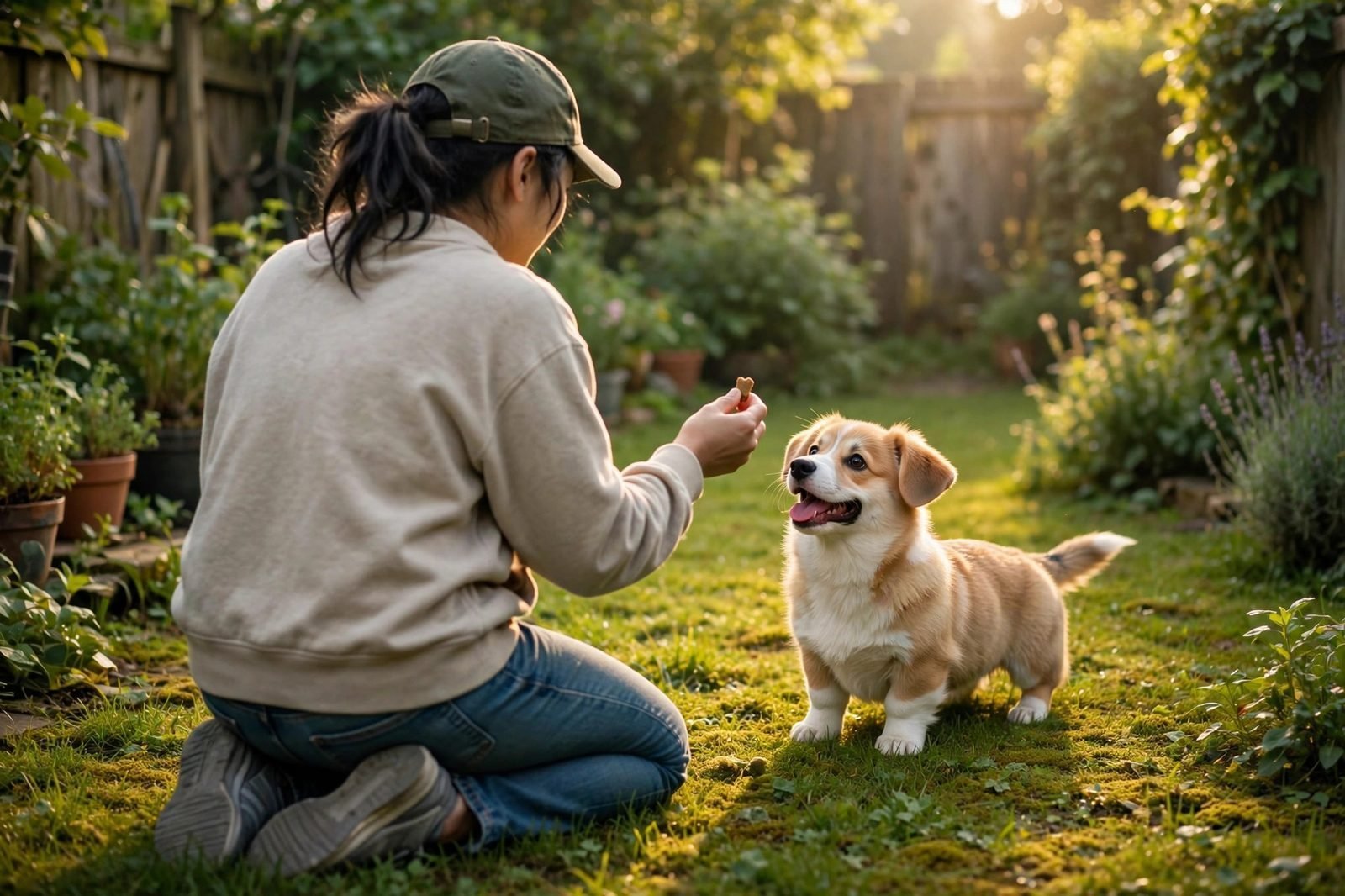
The second they start going — not after they finish — praise them warmly, then deliver the treat immediately, right there on the spot. The timing is the whole lesson: the treat must connect to going there, not to walking back inside. A treat delivered thirty seconds later at the door teaches “coming inside earns treats” — not the lesson we’re after.
Some people add a cue word like “go potty,” said quietly while the puppy is in the act. Over time the puppy associates the phrase with the action, and you end up with a dog you can send out on rainy nights with a single word. It’s just repetition.
Step 3: Supervise Like It’s Your Job (Because It Is)
Most accidents are human failures, not puppy failures. A puppy doesn’t sneak off to pee out of spite — they pee because nobody noticed the sniffing-and-circling, or because they were unsupervised too long.
A loose, awake puppy needs actual eyes on them — not “same house,” eyes. Watch for sudden floor-sniffing, circling, wandering toward a quiet corner, squatting, or an abrupt stop mid-play. When you see them, don’t shout or startle — calmly and quickly get them outside. Scoop them up mid-squat if you must — an interrupted puppy will usually finish outside, and then you reward like they won a prize.
When you can’t supervise, confine
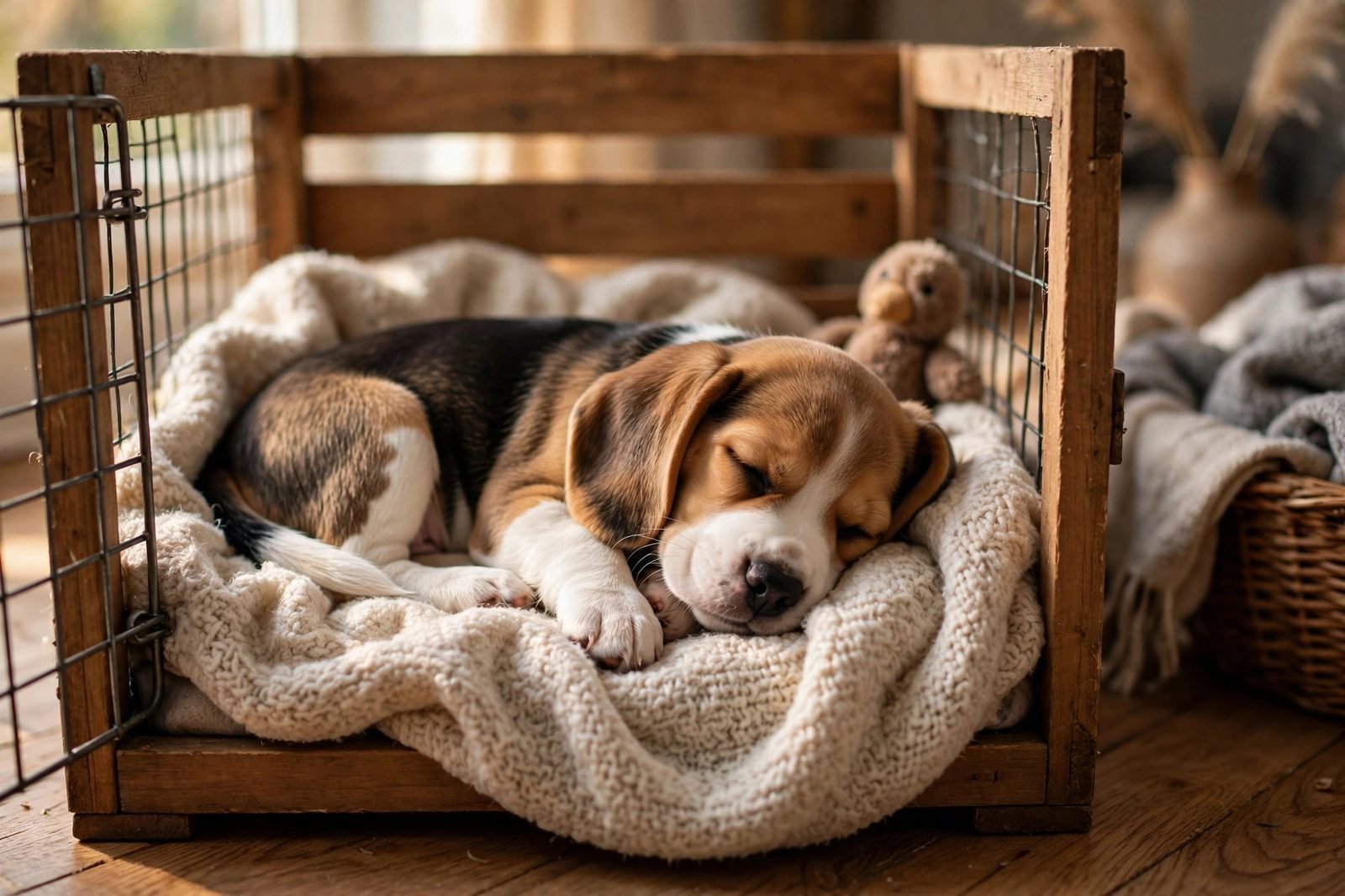
You can’t watch a puppy every second — that’s what crates and playpens are for. Dogs avoid soiling their sleeping area, so a properly sized crate — big enough to stand, turn, and lie down, but not big enough for a pee corner and a sleep corner — teaches bladder control in short stretches and keeps them safe when you’re cooking or in the shower.
The key word is short stretches: a crate is not a storage box, so don’t crate a puppy longer than they can hold it. Overnight most manage longer, but you’ll likely need a middle-of-the-night trip for the first few weeks. Yes, it’s exhausting. Yes, it ends.
Step 4: Handle Accidents the Right Way
Accidents will happen — not “might,” will. Even with a perfect schedule, there’ll be a puddle at some point, and your reaction genuinely affects how fast training progresses.
If you catch them in the act: interrupt calmly — a gentle “oops” or clap — and take them outside to finish. Reward if they finish outside. No anger, no drama.
If you find it after the fact: say nothing, clean it up, move on. The puppy has no idea why you’re upset about a puddle from twenty minutes ago. Rubbing noses in it or scolding teaches only that you’re unpredictable and scary. Punished puppies learn to hide it from you, not to hold it.
Clean it properly. Blot up everything, then use the enzymatic cleaner per its instructions. This is the step people half-do — then wonder why the puppy keeps returning to the same spot behind the sofa. To the puppy’s nose, that spot is now a marked toilet. Break the cycle.
The Nighttime Question
Nighttime is where most new owners hit a wall — usually around 3 a.m., standing in a cold garden in pajamas, questioning their life choices. Here’s how to survive it.
For the first few weeks, set an alarm halfway through your sleep. Keep it boring: no bright lights, no playing, no chatting — out, statue routine, treat, back to bed. Night outings are functional, not a party.
As your puppy grows, push the alarm later until it merges with your morning wake-up — most drop the night trip between three and five months. Limiting water in the last hour or two before bed can help, with plenty during the day. The crate’s “don’t soil the den” instinct does quiet work all night.
Common Setbacks (and What’s Actually Going Wrong)
“They were doing great, and now they’re peeing inside again”
Regression is normal, especially around adolescence (five to eight months) and during big changes — a house move, a new family member, a new work schedule. Go back to basics: tighter schedule, more supervision, more rewards — it usually resolves in a week or two. Don’t assume the puppy “knows better”; they’re a teenager with a full bladder and a disrupted routine.
“They pee right after coming back inside”
Almost always a focus problem: distracted outside — smells, a cat, a leaf — the puppy forgot the mission, then indoor calm relaxed them. Fix it with the boring-statue method: leash, same spot, no entertainment until the job is done. If five minutes pass with nothing, bring them in, crate or supervise closely for ten minutes, and try again.
“They only go on the rug / in one specific spot”
That’s a cleaning problem: somewhere in that rug is a scent marker saying “this is the place.” Soak it with enzymatic cleaner — more than once if needed, per the product instructions. Until it’s truly neutralized, block access to that spot.
Submissive or excitement peeing
This isn’t a training failure; it’s an emotional response they usually outgrow. Keep greetings calm and low-key, crouch instead of looming, and avoid scolding — it makes it worse. If it persists into adulthood, mention it to your vet.
A Note on Puppies and the Great Outdoors
If your puppy hasn’t finished vaccinations, your vet may advise sticking to your own garden for now — completely compatible with house training; your garden is all you need. When your vet gives the all-clear, the world opens up. I wrote about the timing in when puppies can go outside, because getting this wrong either way causes its own problems.
Frequently Asked Questions
How long does it take to house train a puppy?
Most puppies grasp the basics within 4–8 weeks of consistent training, but reliable, accident-free behavior usually arrives between 4 and 6 months. Small breeds and easily distracted puppies may take longer. Consistency beats speed — a steady two-month routine beats a frantic perfect week followed by giving up.
Should I use puppy pads indoors?
Pads help in specific situations — high-rise apartments, limited mobility, very young puppies — but they teach that going indoors is acceptable, which you then have to un-teach. If you use them, put them in one consistent spot near the door you’ll eventually use, and transition to outdoor-only as soon as practical. With garden access, going straight to outdoor training is simpler long-term.
My puppy cries in the crate at night — what do I do?
Some protest is normal the first few nights. Make the crate pleasant: meals there, special chew toys that only appear there, a worn t-shirt that smells like you. Respond to crying calmly and boringly — a quiet word, not a rescue. But learn the difference between protest crying and “I need to go out” crying (more urgent, sometimes door-scratching). When in doubt at 3 a.m., take them out — you can’t un-teach a puppy that crying gets ignored when they genuinely needed you.
Is it okay to punish my puppy for accidents?
No. A puppy can’t connect your anger now with something they did earlier — scolding after the fact just teaches them you’re scary, and harsh mid-act interruption teaches them to hide accidents instead of stopping them. Calm interruption, thorough cleaning, better supervision: that’s the formula.
When should I worry that something’s wrong?
If a progressing puppy suddenly regresses hard, strains, goes very frequently in tiny amounts, has cloudy or bloody urine, or seems in pain — that’s a vet conversation, not a training problem. Urinary tract infections can masquerade as training failure. I’m not a vet and this isn’t medical advice — but “sudden change” is always worth a professional opinion.
[…] it becomes a training battle, because medical causes come first. If you’re in the middle of house training a puppy, regression can be developmental; in an adult dog, it’s a […]
[…] house training go hand in hand — I’ve written more about the whole process in my guide on how to house train a puppy, because the crate is really just one tool in that bigger […]
[…] you want the full deep-dive on the method, my house training guide walks through the whole process step by step. Week one is just the foundation: frequent trips, big […]